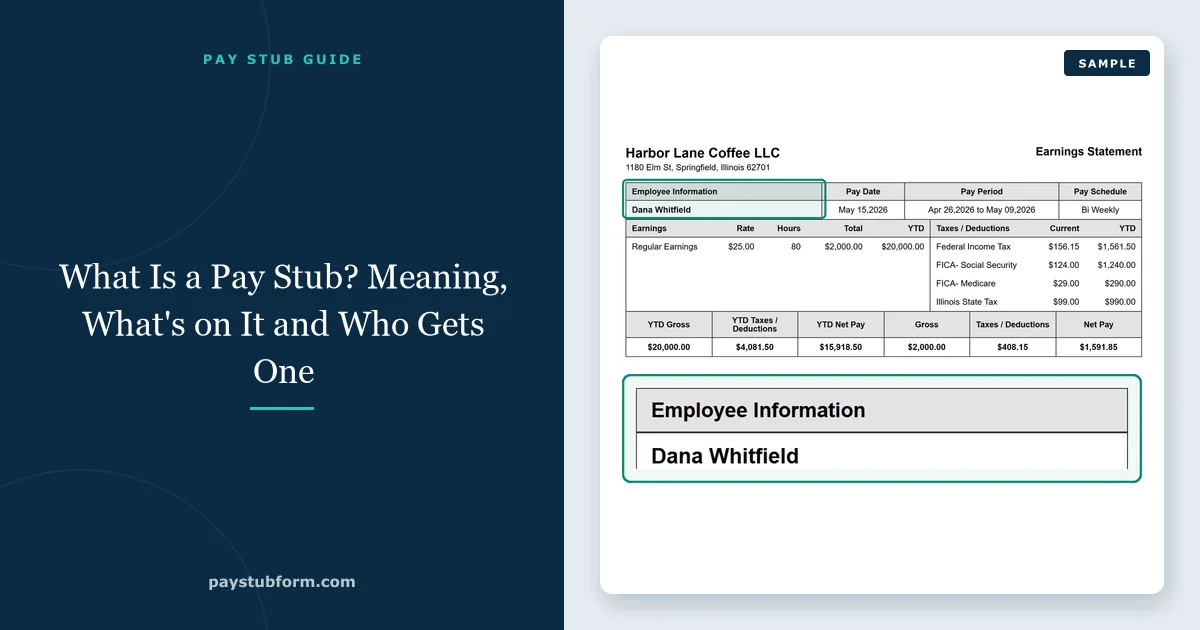
A pay stub is the statement that comes with each paycheck and shows how your pay was calculated: what you earned, what was taken out, and what was left. It is also called a paycheck stub, a pay statement, a wage statement, an earnings statement or a payslip — different names for the same document. Whether it arrives on paper, as a PDF or in an employee app, it is the only record that connects the hours you worked to the money that reached your account.
This guide explains what a pay stub is, every section you will find on one, what the federal and state rules require, and how to check that yours is right.
Quick take: A pay stub shows gross pay, every tax and deduction, net pay and year-to-date totals for one pay period. Federal law does not require employers to provide one, but most states do. It is the document lenders and landlords ask for as proof of income, and the one you use to check your W-2 at year-end.
What a pay stub is — and what it is not
A pay stub is a record of a single pay period. It is not the payment itself: the money moves by direct deposit, paper check or pay card, and the stub explains it. When pay was issued as a paper check, the stub was the detachable part — hence the name — but today most stubs are electronic.
It is also not a W-2. A W-2 summarises a whole calendar year for tax purposes, while a pay stub covers one pay period and shows current income. Our guide to the W-2 versus your final pay stub explains how the two connect.
Contractors paid on a 1099 normally do not receive pay stubs at all, because no payroll taxes are withheld from their pay. See what a contractor gets instead of a pay stub.
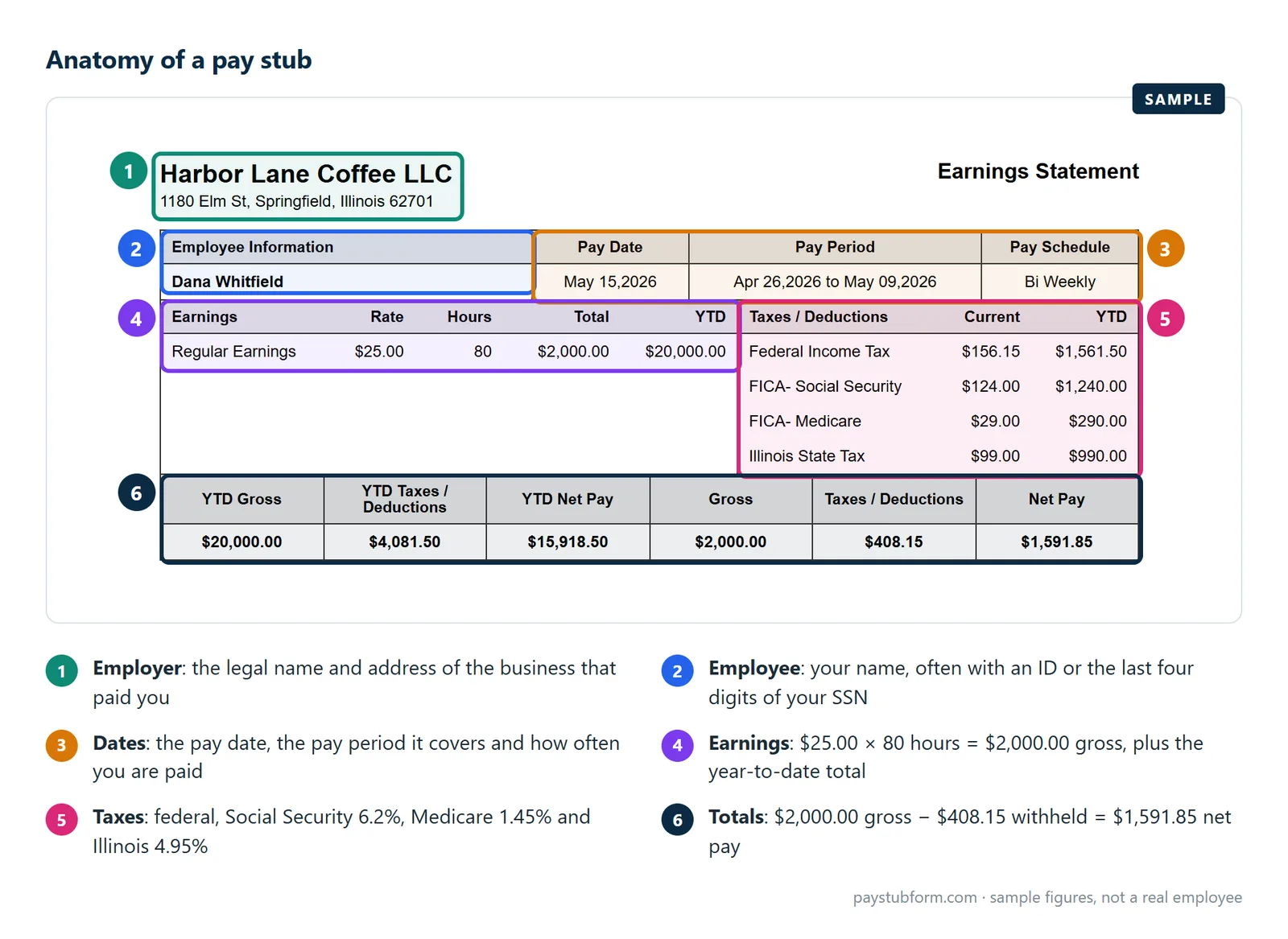
What is on a pay stub: section by section
To see every section on one stub with real figures, see our pay stub example, explained line by line.
Layouts differ from one payroll system to the next, but the content follows the same order: who and when, what you earned, what came out, and what was left.
1. Employee and employer details
Your name, often a partial Social Security number or employee ID, and your address. The employer's legal name and address. Some states, California among them, require the employer's legal name and address to be printed, so a stub without them may not meet your state's rules.
2. Pay period and pay date
The pay period is the span of days you worked; the pay date is when you were paid. They are different dates, and confusing them is the most common reason a stub looks wrong. Our guide to pay period versus pay date explains why. Your pay frequency — weekly, biweekly, semimonthly or monthly — decides how many stubs you get a year; see payroll frequency explained.
3. Earnings
Each type of pay appears on its own line, usually with hours, rate and amount:
- Regular pay — hours times your hourly rate, or your salary divided across the year's pay periods.
- Overtime — for non-exempt employees, at least 1.5× the regular rate for hours over 40 in a workweek. See overtime on a pay stub.
- Paid time off and holiday pay — shown separately from hours worked. See PTO and holiday pay on a pay stub.
- Bonuses, commissions and tips — often taxed differently; see bonus withholding.
All the earnings lines added together make up your gross pay.
4. Taxes withheld
| Line | Typical label | 2026 rate |
|---|---|---|
| Federal income tax | FIT, FWT, Fed Tax | Depends on your W-4 and pay |
| Social Security | OASDI, SS, FICA-SS | 6.2% up to $184,500 of wages |
| Medicare | MED, FICA-MED | 1.45%, plus 0.9% on wages over $200,000 |
| State income tax | SIT, SWT, state code | Depends on the state; nine states have none on wages |
| Local tax and state programs | City, EIT, SDI, PFL | Depends on location |
Federal income tax depends on the W-4 you gave your employer; see how a W-4 change affects your paycheck. Social Security and Medicare are fixed percentages, explained in Social Security and Medicare on a 2026 pay stub. State and local lines vary the most — state and local taxes on a pay stub decodes them.
5. Deductions
Everything else that comes out of your pay, split into two groups:
- Pre-tax deductions reduce your taxable wages: traditional 401(k) contributions, health, dental and vision premiums under a cafeteria plan, HSA and FSA contributions.
- Post-tax deductions come out after tax: Roth 401(k) contributions, some insurance, union dues, wage garnishments.
The difference changes how much tax you pay, which is why it matters; see pre-tax versus post-tax deductions, 401(k) contributions on a pay stub and health insurance on a pay stub. For the whole stack in one place, read paycheck deductions explained.
6. Net pay
Gross pay minus all taxes and deductions. This is your take-home pay, and it should match the amount deposited — unless you split your deposit across accounts. See gross pay versus net pay and direct deposit on a pay stub.
7. Year-to-date totals
A second column showing running totals since 1 January for every earnings, tax and deduction line. It is the most useful column on the stub: lenders use it to annualise your income, and your final stub's YTD figures are what your W-2 should match. Our guide to what YTD means on a pay stub explains how to read it.
8. Other information
Many stubs also show paid time off balances, employer contributions to benefits (shown for information — they are not taken from your pay), and messages from payroll.
Are employers required to provide pay stubs?
Not under federal law. The Fair Labor Standards Act requires employers to keep accurate payroll records, but it does not require them to give employees a pay statement.
Most states fill that gap, in three broad ways:
- Access states require a pay statement to be provided, on paper or electronically.
- Opt-out states allow electronic stubs but let employees request paper.
- States with no general requirement leave it to the employer.
Many states also specify what the statement must contain. California requires nine items, including every hourly rate and the hours worked at each. New York requires regular and overtime rates and hours for non-exempt employees. North Carolina requires only an itemised statement of deductions. Our state-by-state guide covers the rule in every state.
Why your pay stub matters
- Proof of income. Landlords, mortgage lenders, car lenders and benefits offices ask for recent stubs — usually two to four consecutive ones. See using pay stubs as proof of income.
- Catching payroll errors. Missed hours, the wrong rate, overtime calculated across two weeks instead of one, a deduction you never authorised. The stub is the only place they show up.
- Tax season. Your final stub of the year is the check on your W-2. If a box does not match, see how to request a W-2 correction.
- Budgeting. Net pay and pay dates, not your headline salary, decide what you can spend. See building a budget from net pay.
- Leaving a job. Your last stub shows final hours, unused leave and YTD totals; see the final paycheck checklist.
How to check your pay stub in five minutes
- Details. Your name, the employer, and the pay period and pay date are right.
- Earnings. Hours and rate match your own record; overtime is calculated per workweek.
- Taxes. Social Security is 6.2% and Medicare 1.45% of the right wages; federal and state withholding look consistent with previous stubs.
- Deductions. Each one is something you elected or that the law requires.
- The arithmetic. Earnings add to gross; gross minus taxes and deductions equals net; net equals your deposit.
- YTD. The running totals moved by exactly this period's amounts.
Our hourly and salary checklists go further, and common pay stub mistakes covers the errors worth raising. If your pay changed and you cannot see why, start with why your paycheck changed in 2026.
How to get a copy of your pay stub
Ask your employer's payroll or HR team, or sign in to the payroll portal or app they use. Large employers have their own systems: see our guides for Walmart, Sam's Club and Dollar General. If you have left the job and lost portal access, a written request to HR is the most reliable route — employers must keep payroll records for at least three years under federal law.
If you are self-employed or run payroll for a small business, you produce the pay stubs yourself. Keep them consistent with your payroll records — our small business payroll records checklist covers what to keep — and you can create a pay stub here with federal and state taxes calculated for 2026. A stub must always reflect real pay that was actually issued; changing or recreating an employer's stub is falsifying a document. Our step-by-step guide shows how to make a pay stub, with a worked example.
Quick answers
What is a pay stub?
A statement issued with each paycheck that shows gross pay, every tax and deduction, net pay and year-to-date totals for one pay period. It is also called a paycheck stub, pay statement, earnings statement or payslip.
Is a pay stub the same as a paycheck?
No. The paycheck — or direct deposit — is the payment. The pay stub is the statement that explains how that payment was calculated.
Are employers required to give pay stubs?
Not under federal law, but most states require a pay statement, and many specify what it must include. A few states have no general requirement.
How many pay stubs do I need for proof of income?
Usually the two to four most recent consecutive stubs. Lenders often also ask for your latest W-2, and some want a month or more of stubs if your hours vary.
What does YTD mean on a pay stub?
Year to date: the running total of each line since 1 January. It is not an extra deduction — it is the sum of every pay period so far this year.
What is the difference between gross pay and net pay?
Gross pay is what you earned before anything was taken out. Net pay is what is left after taxes and deductions — the amount that reaches your account.
How long should I keep my pay stubs?
At least until you have checked them against your W-2 for that year, and longer if you may need proof of income. Many people keep a full year of stubs and the final stub of each year indefinitely.
Sources
- U.S. Department of Labor — Fact Sheet #21, Recordkeeping Requirements under the FLSA: what employers must record, and that federal law does not require a pay statement.
- U.S. Department of Labor — Fact Sheet #23, Overtime Pay Requirements of the FLSA: overtime at 1.5× the regular rate for hours over 40 in a workweek.
- IRS Topic no. 751 — Social Security and Medicare withholding rates: the 6.2% and 1.45% rates and the Additional Medicare Tax.
- Social Security Administration — Contribution and Benefit Base: the $184,500 wage base for 2026.
- IRS Publication 15 (2026), Employer's Tax Guide: federal income tax withholding and the W-4.
General U.S. information, current for 2026. State pay statement rules differ — check your state's requirements alongside this.


Comments (0)
Loading comments...
Leave a Comment