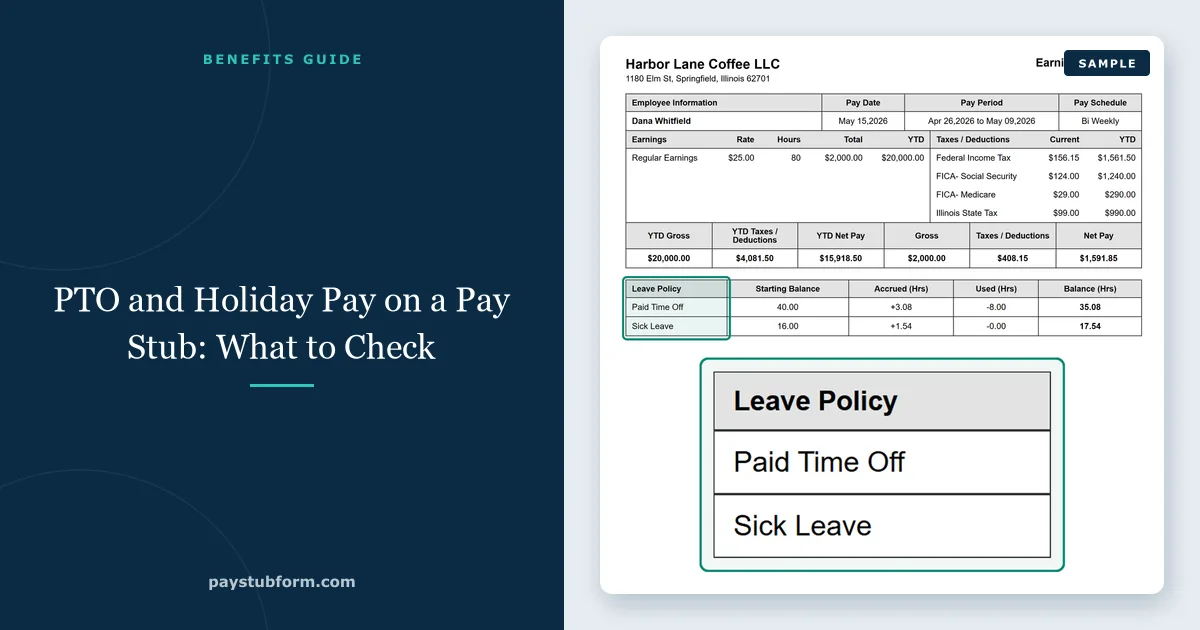
A pay period with a holiday or a few days off often produces a stub that looks wrong at first glance: fewer regular hours, a new earnings line, maybe no overtime in a week where you were paid for more than 40 hours. Usually the stub is right and the rules are simply different from what most people assume. Sometimes it is not, and paid leave is one of the places small errors hide because the hours are harder to check than a timecard.
This guide explains how vacation, sick leave and holiday pay appear on a pay stub, how they interact with overtime, and what to check line by line.
Quick take: Paid time off and holiday pay are taxable wages, but under federal law they are not hours worked, so they do not count toward the 40 hours that trigger overtime. Holiday premium pay for working on a holiday is a different line with different rules. Check each separately.
1. Is your employer required to pay for holidays and vacation?
Under the federal Fair Labor Standards Act, no. The FLSA does not require payment for time not worked — vacations, holidays, sick days or federal holidays included. It also does not require extra pay for working on a holiday or a weekend; that is ordinary working time paid at the normal rate unless it pushes you over 40 hours in the workweek.
What you are owed comes from three other places:
- Your employer's policy or employment agreement — the most common source of paid holidays and PTO.
- A collective bargaining agreement, if you are covered by one.
- State and local law — especially for sick leave. A growing number of states and cities require paid sick leave. California requires at least 40 hours or five days per year; New York requires up to 56 hours for employers with 100 or more employees, with smaller amounts for smaller employers.
So the first check is not arithmetic: find the written policy and confirm what it promises.
2. How leave appears on a pay stub
Most payroll systems show each kind of paid time as its own earnings line, with hours and a rate. Labels vary, but the categories are consistent:
| Line | What it means | Compare with |
|---|---|---|
| PTO / Vacation | Hours paid while on approved leave | Your approved leave request |
| Sick | Paid sick hours used | Sick leave record and state rules |
| Holiday | Paid holiday hours not worked | Holiday calendar in the policy |
| Holiday premium / Holiday worked | Extra pay for working on a holiday | Hours worked that day and the policy rate |
| PTO balance | Hours remaining — information, not a payment | Your leave system |
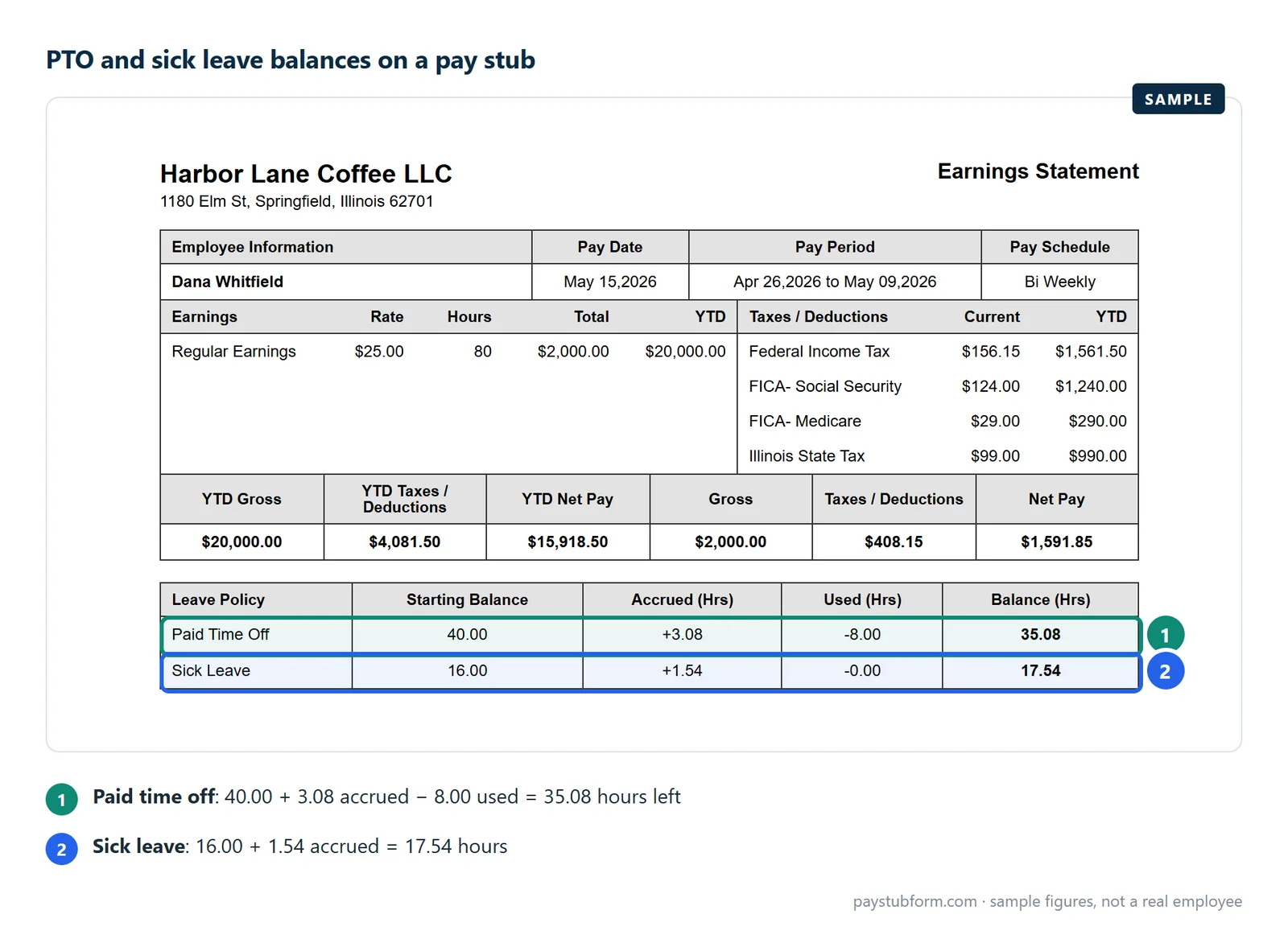
The balance line is the one people misread most often. It is not money on this check; it is the hours you still have. California requires available paid sick leave to be shown on the wage statement or in a separate writing provided on payday, which is why Californian stubs often carry it.
3. PTO and holidays do not count toward overtime
Federal overtime is owed for hours worked over 40 in a workweek. Paid hours that were not worked — vacation, holiday, sick — are excluded from that count. Two examples:
- You work 32 hours and take an 8-hour paid holiday. You are paid for 40 hours, all at straight time. No overtime.
- You work 40 hours and are also paid 8 hours of holiday pay. You are paid for 48 hours, but only 40 were worked. Federally, no overtime is owed.
Those payments are also excluded from your regular rate of pay, so they do not raise the rate your overtime is calculated on. Some employers count paid leave toward overtime voluntarily, and some union contracts require it — check your policy before assuming the stub is wrong in either direction. Our overtime guide covers the regular-rate calculation in full.
Tip: If you worked more than 40 hours in a holiday week and see no overtime, count only the hours you actually worked. If those are over 40, overtime is owed regardless of the holiday.
4. Holiday premium pay is different
When an employer pays extra for working on a holiday — time and a half or double time — that premium is a separate line. If the premium is at least 1.5× the normal rate and is paid specifically for working on a holiday, federal rules let the employer exclude it from the regular rate and credit it toward any overtime owed for that week.
In practice, that means a week with 8 hours of holiday work at time and a half plus 36 other hours may show no separate overtime line: the holiday premium already covers it. Check the total, not just whether an "OT" line appears.
5. PTO is taxed like any other wages
Vacation, sick and holiday pay are taxable wages. Federal income tax, Social Security (6.2%) and Medicare (1.45%) apply exactly as they do to regular pay, and so do state income tax and any state disability or leave programs. They also count toward your 401(k) deferral if your plan defines compensation to include them, which most do.
A lump-sum PTO payout — when you cash out unused leave or leave the company — is different. Employers may treat it as supplemental wages and withhold federal income tax at a flat 22%, the same way they treat a bonus. That often makes the payout look heavily taxed; the final tax is settled on your return. Our guide to bonus withholding explains why.
6. Unused PTO when you leave a job
Whether accrued vacation must be paid out at the end of employment depends on your state and your employer's policy. California treats vested vacation as earned wages that must be paid in the final paycheck and does not allow "use it or lose it" forfeiture. Many other states let the written policy decide. If you are leaving, check the final paycheck checklist before your last day.
The five-minute version
- Find the written policy: which holidays are paid, how PTO accrues, whether holiday work earns a premium.
- Match each leave line on the stub to the dates you actually took off, in the right pay period.
- Check the hours and rate on each line, then confirm the balance moved by the hours used.
- For overtime, count only hours worked in each workweek — not paid leave.
- If a holiday premium appears, check it against the policy rate and the hours worked that day.
- Expect PTO and holiday pay to be taxed normally, and a lump-sum payout to be withheld at a flat rate.
For the rest of the stub, see our hourly and salary checklists. You can also create a pay stub with separate PTO and holiday lines.
Quick answers
Does PTO count as hours worked for overtime?
Not under federal law. Paid time off, holidays and sick leave are not hours worked, so they do not count toward the 40 hours that trigger overtime. An employer policy or union contract may count them anyway.
Is my employer required to pay me for federal holidays?
No. Private employers are not required by federal law to give paid holidays or to pay extra for working on one. Paid holidays come from your employer's policy or an agreement.
Why is my PTO taxed so heavily when I cash it out?
A PTO payout can be treated as supplemental wages and withheld at a flat 22% federal rate, plus Social Security, Medicare and state tax. The withholding is not your final tax; your actual rate is settled when you file.
My PTO isn't on this paycheck. Was it lost?
Probably not. Leave approved after the payroll cutoff often appears on the next check. Ask payroll before treating it as unpaid, and confirm your balance was not deducted for hours that were not paid.
Do I get time and a half for working on a holiday?
Only if your employer's policy or contract provides it, or if the holiday hours push you over 40 hours worked in the workweek. Federal law does not require a holiday premium.
Does my employer have to pay out unused vacation when I quit?
It depends on your state and your employer's written policy. California requires accrued vacation to be paid out; many other states follow the policy.
Sources
- U.S. Department of Labor — Holiday Pay: the FLSA does not require payment for time not worked, including holidays.
- U.S. Department of Labor — Fact Sheet #56A, Overview of the Regular Rate of Pay: exclusion of pay for time not worked and of qualifying holiday premiums from the regular rate.
- U.S. Department of Labor — Fact Sheet #23, Overtime Pay Requirements of the FLSA: overtime is owed on hours worked over 40 in a workweek.
- IRS Publication 15 (2026), Employer's Tax Guide: treatment of supplemental wages and the 22% optional flat rate.
General U.S. information, current for 2026. State and local leave laws are frequently more generous than the federal standard — check yours alongside this.


Comments (0)
Loading comments...
Leave a Comment