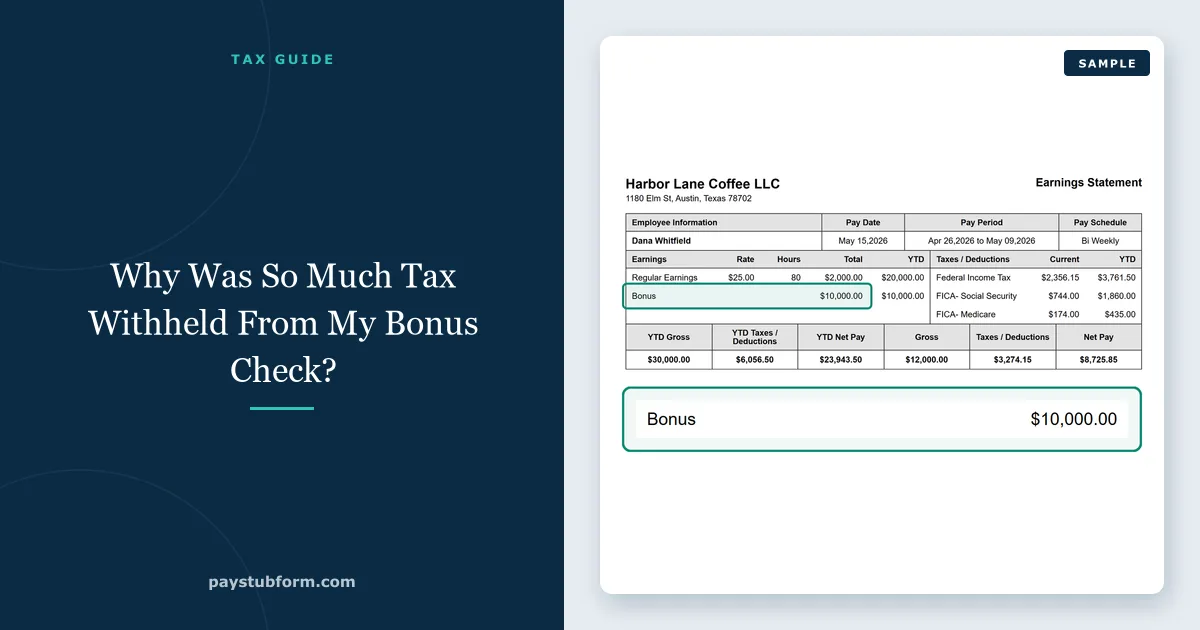
A $10,000 bonus arrives as something closer to $6,000, and the obvious conclusion is that bonuses are taxed at a punitive rate. They are not. Bonuses are taxed at exactly the same rates as the rest of your income — they are withheld differently, and the difference between those two words is worth about a third of the check.
Withholding is an estimate your employer makes on the IRS's behalf. Tax is what you actually owe, settled when you file. When the estimate overshoots, the excess comes back. Here is why it overshoots so reliably on bonus checks, and what you can do about it.
Quick take: Supplemental wages like bonuses are commonly withheld at a flat 22%, plus 6.2% Social Security, 1.45% Medicare and any state tax. Above $1,000,000 of supplemental wages in a year, 37% withholding is mandatory. None of these are your tax rate.
Withholding is not tax
Every dollar of your pay — salary, overtime, bonus, commission — lands in the same pot on your tax return and is taxed at the same progressive rates. Your bonus is not a separate category of income with its own penalty rate.
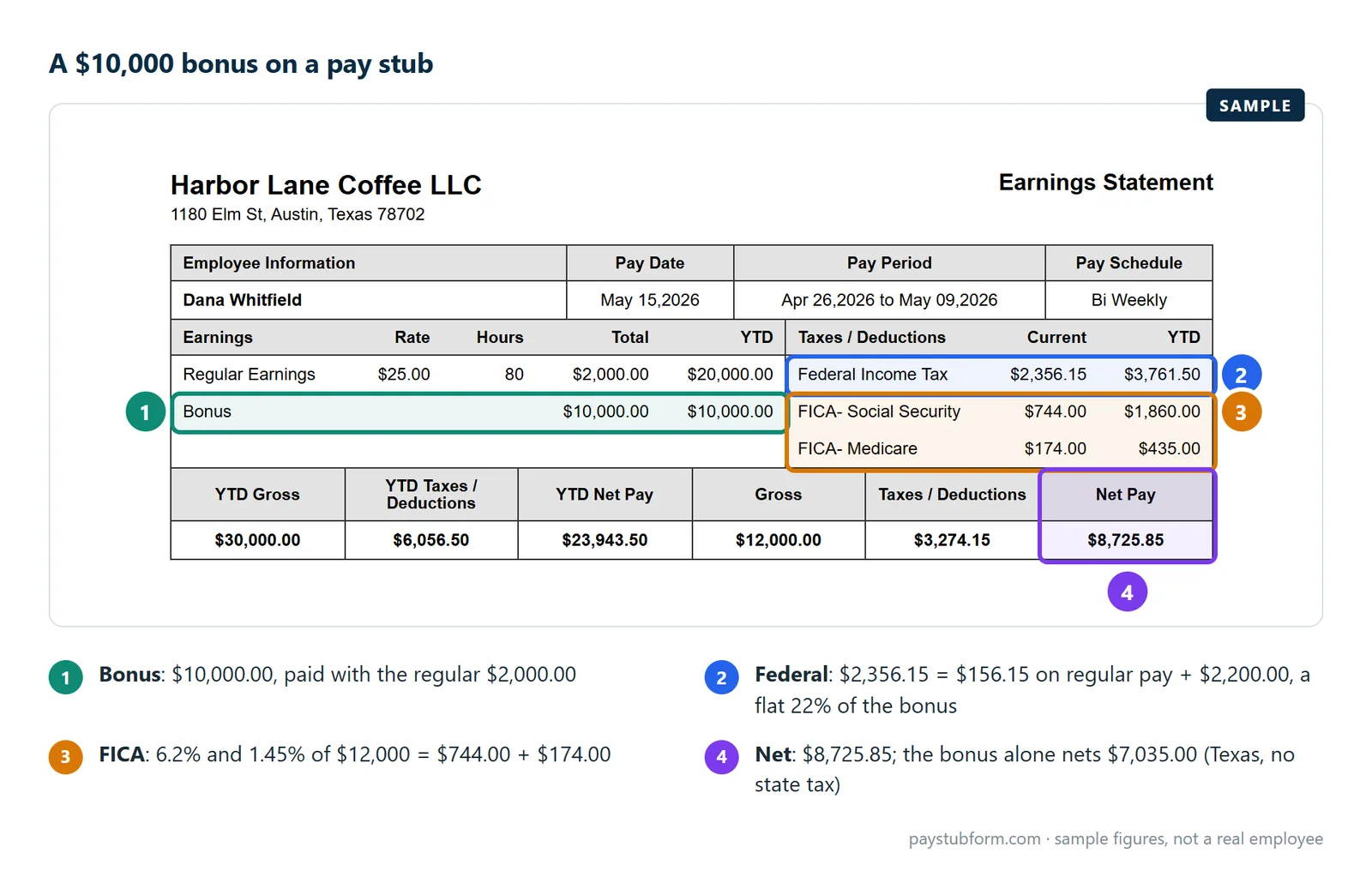
What differs is the mechanism for taking money out in advance. Your regular paycheck is withheld using tables built around your W-4 and your normal earnings pattern. A bonus does not fit that pattern, so the IRS allows employers a separate method for what it calls supplemental wages.
If too much comes out, you are owed it back. That is the whole story — but it is an interest-free loan to the government for up to sixteen months, which is a reasonable thing to want to avoid.
What counts as supplemental wages
More than you might expect. Alongside bonuses, the category covers commissions, severance pay, back pay, sick pay, allocated tips and vacation pay — any of which can show up withheld at a rate that does not match the rest of your stub.
The two methods, and why it matters which one your employer used
The percentage method (flat 22%). If the bonus is paid separately from your regular wages, or identified separately on the stub, your employer may withhold a flat 22% for federal income tax and ignore your W-4 entirely. This is the method behind most "why is my bonus taxed at 40%" questions, once Social Security, Medicare and state tax are added on top.
The aggregate method. The bonus is added to your regular pay for the period and the whole amount is withheld using your normal tables. This sounds fairer and is frequently worse. Withholding tables annualise: a system seeing $12,000 in a period where it usually sees $2,000 withholds as though you earn $12,000 every period, which can push the calculation into much higher brackets for that one check.
Neither method is a choice you make. Which one you get depends on your employer's payroll setup and whether the bonus was run separately.
Above $1,000,000 the rate is not optional
Once supplemental wages paid to you during the calendar year exceed $1,000,000, withholding on the excess is 37% and the employer has no discretion. The first $1,000,000 can still be withheld at 22%; everything after it cannot.
What else comes out of a bonus
Federal income tax withholding is only part of the deduction, which is why the 22% figure never matches what you see.
- Social Security, 6.2%, on wages up to $184,500 for 2026. If you have already passed the wage base, this does not apply — which is why a December bonus can net more than the same bonus in March.
- Medicare, 1.45%, with no ceiling at all.
- Additional Medicare, 0.9%, if the bonus takes your wages from that employer above $200,000 for the year. A large bonus is the most common trigger — see the $200,000 trigger explained.
- State and sometimes local income tax, often with its own supplemental rate. This is where the same bonus diverges most sharply by location: in Texas there is no state income tax to withhold at all, while in New York the state takes its share and a New York City resident pays a city tax on top of it.
- Your overtime rate, if you work overtime. A nondiscretionary bonus, one promised for production, attendance or hitting a target, has to be added to the regular rate for the weeks it covers. That raises the overtime premium owed for those weeks, and with it the qualified overtime reported in Box 12 code TT on your 2026 W-2. See overtime on a pay stub.
- Your 401(k) deferral, if your plan counts bonuses as eligible pay. Plans differ; checking the contribution line is the quickest way to find out which yours does.
A $10,000 bonus, line by line
Flat method, mid-year, no state tax, no retirement deferral:
| Line | Rate | Amount |
|---|---|---|
| Bonus | — | $10,000.00 |
| Federal income tax withholding | 22% | $2,200.00 |
| Social Security | 6.2% | $620.00 |
| Medicare | 1.45% | $145.00 |
| Net | — | $7,035.00 |
That is 29.65% withheld before any state tax. Add a state with a 5% supplemental rate and it is nearly 35%. If your actual marginal rate is 22%, roughly $500 of that federal withholding is money you will get back — and the Social Security and Medicare portions you will not, because those are real tax, not an estimate.
What you can actually do about it
Three things work, and one thing that people try does not.
- Adjust your W-4 for the rest of the year. If a bonus has left you meaningfully over-withheld, Step 4(b) deductions or a reduced extra-withholding amount in Step 4(c) brings your remaining paychecks back into line rather than waiting for the refund. The reverse applies if the bonus left you under-withheld.
- Defer part of it. If your plan treats bonuses as eligible pay, directing some into a traditional 401(k) reduces the federal income tax withheld on it. It does not reduce Social Security or Medicare, which apply to deferred wages too.
- Know where you are against the wage base. Nothing you do changes the rules, but knowing that a late-year bonus escapes the 6.2% once you have passed $184,500 is useful when a payment date is negotiable.
What does not work is asking payroll to use the other method. Employers apply the method their system is configured for; it is not a per-employee election.
Tip: Keep the bonus stub. It is the document that shows the flat rate was withholding rather than tax, and it is what you will want when the refund arrives and you are trying to work out where it came from.
Check the bonus stub
- Find the bonus as its own earnings line rather than folded into regular pay.
- Divide the federal withholding on that check by the bonus amount. Close to 22% means the flat method; anything much higher points to the aggregate method.
- Confirm Social Security was applied only up to $184,500 of year-to-date wages, and check whether the bonus pushed year-to-date wages past $200,000 and triggered the 0.9%.
- Compare the implied federal rate against the marginal rate you expect for the year. A large gap is over-withholding, not overtaxing.
For the full picture of how deductions stack up on any paycheck, see gross pay versus net pay; the two FICA lines are covered in Social Security and Medicare on a 2026 pay stub. If you need a correctly calculated stub showing a bonus as its own line, you can create one here.
Quick answers
Are bonuses taxed at a higher rate than salary?
No. Bonuses are taxed at the same rates as all other income. They are often withheld at a flat 22%, which is a prepayment, not a tax rate. Any excess is refunded when you file.
Why was 22% taken when my bracket is 12%?
Because the flat supplemental rate ignores your W-4 and your actual bracket. Someone in the 12% bracket is over-withheld on a bonus by design, and gets the difference back.
Can I ask my employer to withhold less?
Not on the bonus itself — the method is a payroll configuration. You can adjust your W-4 so the rest of the year's paychecks compensate.
Why did two bonuses in the same year net different amounts?
Most often because one fell after your year-to-date wages passed $184,500, so no Social Security was withheld on it. Crossing $200,000 and picking up the 0.9% Additional Medicare Tax works in the other direction.
Is severance withheld the same way?
Yes. Severance is supplemental wages, as are commissions, back pay, sick pay and vacation pay, so the same flat-rate treatment can apply. Our final paycheck checklist covers what else to verify when you leave a job.
Does a bonus affect my 401(k)?
Only if your plan counts bonuses as eligible pay, in which case your usual percentage is deducted from it. Plans vary — a large bonus is also a common way of reaching the annual deferral limit earlier than expected.
Sources
- IRS Publication 15 (Circular E), Employer's Tax Guide for 2026: the 22% optional flat rate for supplemental wages, the mandatory 37% above $1,000,000, and what counts as supplemental wages.
- IRS Topic no. 751 — Social Security and Medicare withholding rates: the 6.2%, 1.45% and 0.9% rates and the $200,000 employer withholding rule.
- Social Security Administration — Contribution and Benefit Base: the $184,500 wage base for 2026.
- IRS Topic no. 560 — Additional Medicare Tax: the filing-status thresholds a large bonus can push you past.
General U.S. information, current for the 2026 tax year. Your own outcome depends on your total income, filing status, state and plan rules.


Comments (0)
Loading comments...
Leave a Comment