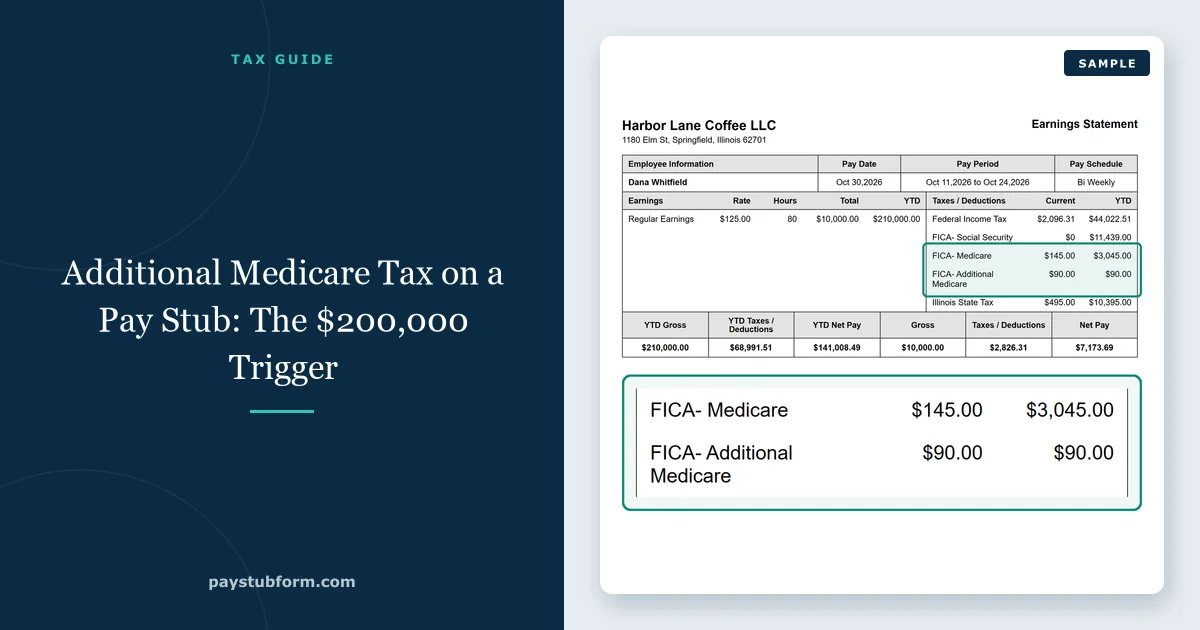
Somewhere past the middle of a good year, a line appears on the pay stub that was not there in January. It is usually called Addl Medicare, Add'l Med EE or Additional Medicare Tax, it is 0.9%, and unlike every other payroll tax on the stub, the employer does not match a cent of it.
It is also the one payroll tax whose withholding is openly designed not to match what you owe. Your employer applies one rule; the IRS applies a different one when you file. For a single filer with one job the two usually agree. For a married couple, for anyone with two jobs, and for anyone with self-employment income alongside wages, they frequently do not — and the difference runs into thousands of dollars in either direction.
Quick take: Your employer withholds 0.9% once it has paid you more than $200,000 in a year, regardless of your filing status. What you actually owe is settled on Form 8959 against a threshold of $250,000 if married filing jointly, $125,000 if married filing separately, and $200,000 for everyone else.
The rule your employer follows
An employer must withhold the 0.9% Additional Medicare Tax on wages it pays you in excess of $200,000 in a calendar year, without regard to your filing status.
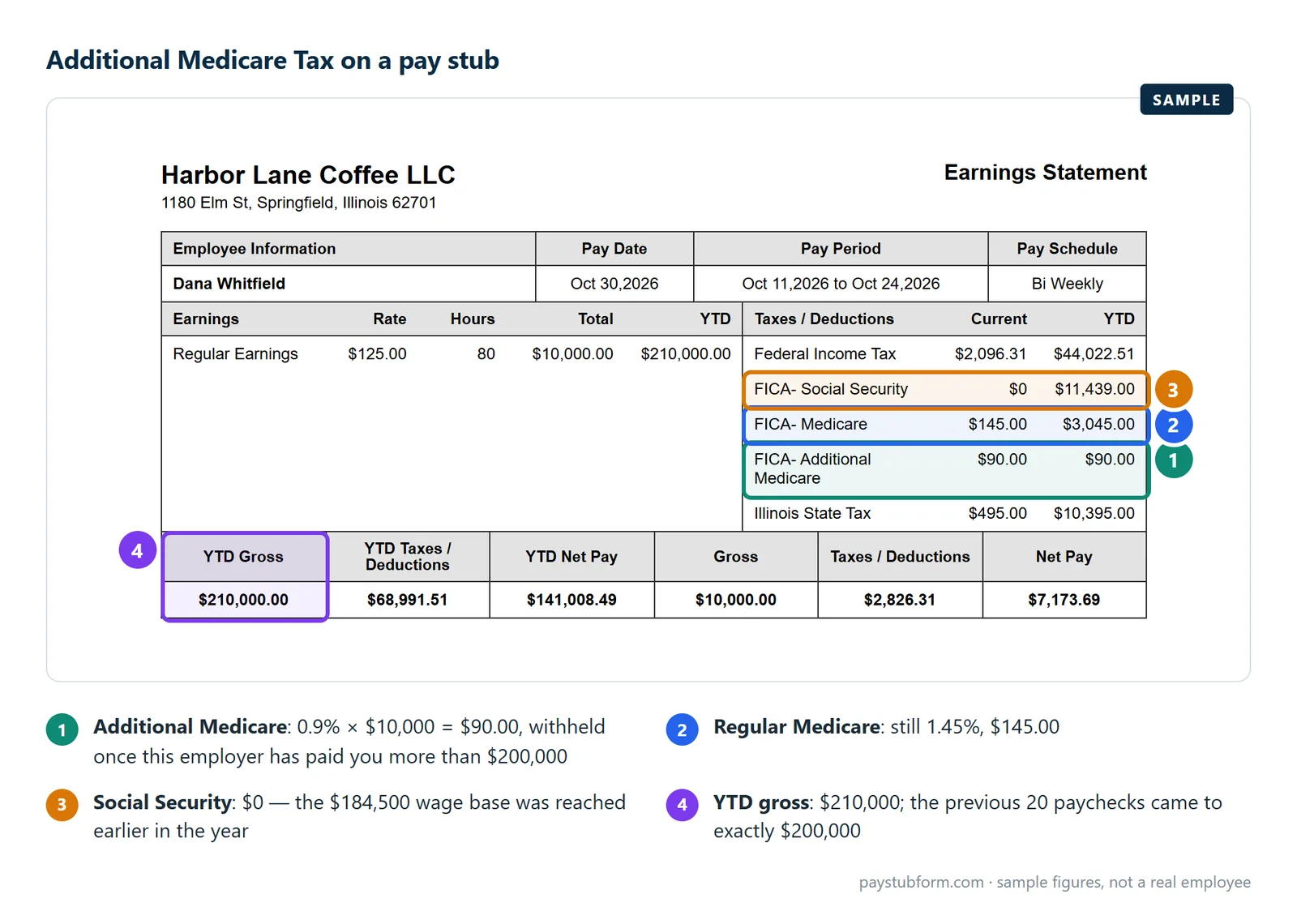
That last clause does the work. Your employer does not know whether you are married, whether your spouse works, or what you earn elsewhere, and it is not permitted to take any of it into account. The rule is deliberately mechanical: count what this employer has paid you, start withholding above $200,000, stop at the end of December.
Three consequences follow directly. The tax applies only to the employee — there is no employer match, unlike the 1.45% regular Medicare tax. Each employer counts only its own payments, so two jobs at $150,000 each trigger nothing. And the line never appears at all for most people, because most people never cross $200,000 with a single employer.
The thresholds that decide what you actually owe
When you file, a different set of numbers applies:
| Filing status | Threshold |
|---|---|
| Married filing jointly | $250,000 |
| Married filing separately | $125,000 |
| Single, head of household, qualifying surviving spouse | $200,000 |
These are statutory figures. They are not indexed for inflation and have not moved since the tax was introduced, which means that each year a slightly larger share of earners crosses them.
Four situations where withholding and liability do not match
This is where the stub stops telling you what you owe.
One high earner, married. You earn $230,000, your spouse earns nothing, you file jointly. Your employer withheld 0.9% on $30,000 — about $270 — but your joint threshold is $250,000, so you owe nothing. The over-withholding comes back as part of your refund.
Two earners, neither over $200,000. Each spouse earns $150,000. No employer withheld anything, because no employer paid over $200,000. Jointly you are $50,000 above the $250,000 threshold and owe $450 you have not paid. Nothing on either pay stub hints at it.
Married filing separately. Your threshold is $125,000 but your employer still waits until $200,000. Anyone in this position is under-withheld by design on $75,000 of wages.
Two jobs, each below the trigger. $120,000 at one employer and $110,000 at another is $230,000 of Medicare wages with no withholding at all. A single filer owes 0.9% on $30,000.
All four are reconciled on Form 8959, filed with your return. Medicare wages and self-employment income are combined to test the threshold; the Additional Medicare Tax your employer already withheld appears in Box 6 of your W-2 and is credited against the total, so you only settle the difference.
Self-employment income: the threshold shrinks
If you have both wages and self-employment income, there is a rule that catches people out badly.
The threshold for applying the tax to self-employment income is reduced — but not below zero — by the total Medicare wages you received. The wages use up the allowance first.
The IRS works through the arithmetic: a single filer with $130,000 in wages and $145,000 in self-employment income has a self-employment threshold of $70,000, not $200,000, because $200,000 minus $130,000 of wages leaves $70,000. The tax applies to $75,000 of that self-employment income. Nobody withheld anything on the wages, because the employer never paid over $200,000.
Railroad retirement (RRTA) compensation works differently again: it is tested on its own and is not combined with wages or self-employment income.
Do not confuse it with the Social Security line
The two high-earner lines on a stub behave in opposite directions, which is why they get mixed up.
- Social Security stops. In 2026 it applies to the first $184,500 of wages and then disappears for the rest of the year.
- Additional Medicare starts. It appears above $200,000 and continues to the end of the year.
Because $184,500 and $200,000 are close together, a high earner can watch 6.2% vanish from one paycheck and 0.9% appear a few weeks later. Two separate rules, two separate lines, no error. The full picture of both FICA lines is in our guide to Social Security and Medicare on a 2026 pay stub.
Tip: Regular Medicare at 1.45% never stops and is matched by your employer. The extra 0.9% is yours alone. If a stub shows an employer contribution against the additional line, that is worth questioning.
What to do if you are under-withheld
Finding out in April that you owe $450 or $2,000 is avoidable. If you expect to be over your filing-status threshold without enough withheld, you have two options, and the IRS explicitly allows either.
- Ask for extra withholding on Form W-4. Step 4(c) lets you name an additional dollar amount per pay period. It is withheld as federal income tax rather than as Additional Medicare Tax, but it counts toward the same total liability.
- Make estimated tax payments. Useful where the shortfall comes from self-employment income rather than wages.
Dividing the expected shortfall by the number of pay dates left in the year turns a filing-season surprise into a line you chose. If you are reviewing your W-4 anyway, the changes that hit paychecks in January 2026 are worth reading alongside it.
Check your own stub in three minutes
- Find year-to-date Medicare wages — not gross pay, and not Social Security wages, which stop at a cap.
- If that figure is above $200,000, confirm an Additional Medicare line exists and that it is 0.9% of the amount above $200,000.
- Add your spouse's Medicare wages, if you file jointly, and any self-employment income. Compare the total against your filing-status threshold.
- If the total is above the threshold and withholding is below 0.9% of the excess, the difference is due at filing. Decide now whether to cover it through your W-4 or an estimated payment.
- At year end, check Box 5 (Medicare wages) and Box 6 (Medicare tax withheld) on every W-2 — Box 6 includes both the 1.45% and any 0.9%.
If you need a pay stub that shows these lines calculated correctly, you can create one here, and our state pay stub requirements guide covers the state lines that sit alongside the federal ones.
Quick answers
Does my employer pay a matching 0.9%?
No. The Additional Medicare Tax is employee-only. The regular 1.45% Medicare tax is matched by your employer; this one is not.
Why is it being withheld when my spouse and I are under $250,000 jointly?
Because your employer is required to ignore filing status and withhold once it has paid you more than $200,000. If your joint income is below $250,000 you do not owe it, and the over-withholding is returned when you file Form 8959 with your return.
I have two jobs and neither withheld it. Do I owe it?
Possibly. Each employer counts only its own payments, so neither may have crossed $200,000 while your combined Medicare wages did. If the combined figure is above your filing-status threshold, the tax is due on the excess when you file.
Does the 0.9% apply to my whole salary once I cross the line?
No. It applies only to the wages above the threshold. Earn $220,000 as a single filer and the extra 0.9% applies to $20,000, not to the full amount.
How does self-employment income interact with wages?
They are combined to test the threshold, and the threshold available to your self-employment income is reduced by your Medicare wages first. With enough wages, the entire self-employment figure can be taxable even though no employer withheld anything.
Which box on my W-2 shows it?
Box 6, Medicare tax withheld, which combines the regular 1.45% and any Additional Medicare Tax. There is no separate box for the 0.9%; Form 8959 separates them using Box 5 wages.
Sources
- IRS Topic no. 560 — Additional Medicare Tax: the $250,000 / $125,000 / $200,000 filing-status thresholds and Form 8959.
- IRS Topic no. 751 — Social Security and Medicare withholding rates: the 0.9% rate and the employer's $200,000 withholding rule, applied without regard to filing status.
- IRS — Instructions for Form 8959: combining wages and self-employment income, the reduced self-employment threshold, the separate treatment of RRTA compensation, and crediting withheld tax from Box 6.
- IRS Topic no. 554 — Self-employment tax: the Medicare component of self-employment tax and the same threshold amounts.
- Social Security Administration — Contribution and Benefit Base: the $184,500 Social Security wage base for 2026.
General U.S. information, current for the 2026 tax year. Individual results depend on your filing status, your spouse's earnings and any self-employment income; for advice on your own return, speak to a tax professional.


Comments (0)
Loading comments...
Leave a Comment