FUTA is the Federal Unemployment Tax Act tax: a federal payroll tax that employers — not employees — pay to fund unemployment benefits. The rate is 6.0% of the first $7,000 each employee earns in a year, but employers that pay their state unemployment tax on time get a credit of up to 5.4%, so most pay just 0.6%, or $42 per employee per year.
Because it is an employer-only tax, FUTA should never be deducted from your paycheck. If it appears on a pay stub, it is listed for information under employer taxes. Below is how FUTA is calculated, a worked example for a small business, which states pay more, and how Form 940 and the quarterly deposits work.
Quick take: FUTA = 6.0% on the first $7,000 per employee, minus a credit of up to 5.4% for state unemployment tax paid = 0.6% net ($42 maximum per employee). Paid only by the employer. Reported once a year on Form 940 — the 2026 form is due February 1, 2027. Employers in California pay more because of a credit reduction: 1.8% for 2025.
1. What FUTA means
FUTA stands for the Federal Unemployment Tax Act. Together with each state's own unemployment tax (often called SUTA or SUI), it funds the unemployment insurance system: states pay benefits to people who lose their jobs, and FUTA pays for the program's administration, extended benefits in high-unemployment periods, and federal loans to states whose trust funds run out.
- Who pays: the employer, from its own funds.
- Who does not: employees. Nothing is withheld from wages for FUTA.
- On what: the first $7,000 of wages paid to each employee in a calendar year (the "FUTA wage base"). It has been $7,000 since 1983.
- How it is reported: once a year on IRS Form 940, with deposits during the year when the amount owed passes $500.
2. The FUTA rate in 2026
| Rate | Per employee (on $7,000) | |
|---|---|---|
| Gross FUTA rate | 6.0% | $420 |
| Maximum credit for state unemployment tax | −5.4% | −$378 |
| Net rate for most employers | 0.6% | $42 |
The 5.4% credit is the key. An employer earns the full credit by being subject to a state unemployment program and paying that state tax in full and on time. The credit is the same 5.4% even if the employer's state rate is lower, but late state payments reduce it, and an employer that does not pay state unemployment tax at all owes the full 6.0%.
3. Worked example: a small business with four employees
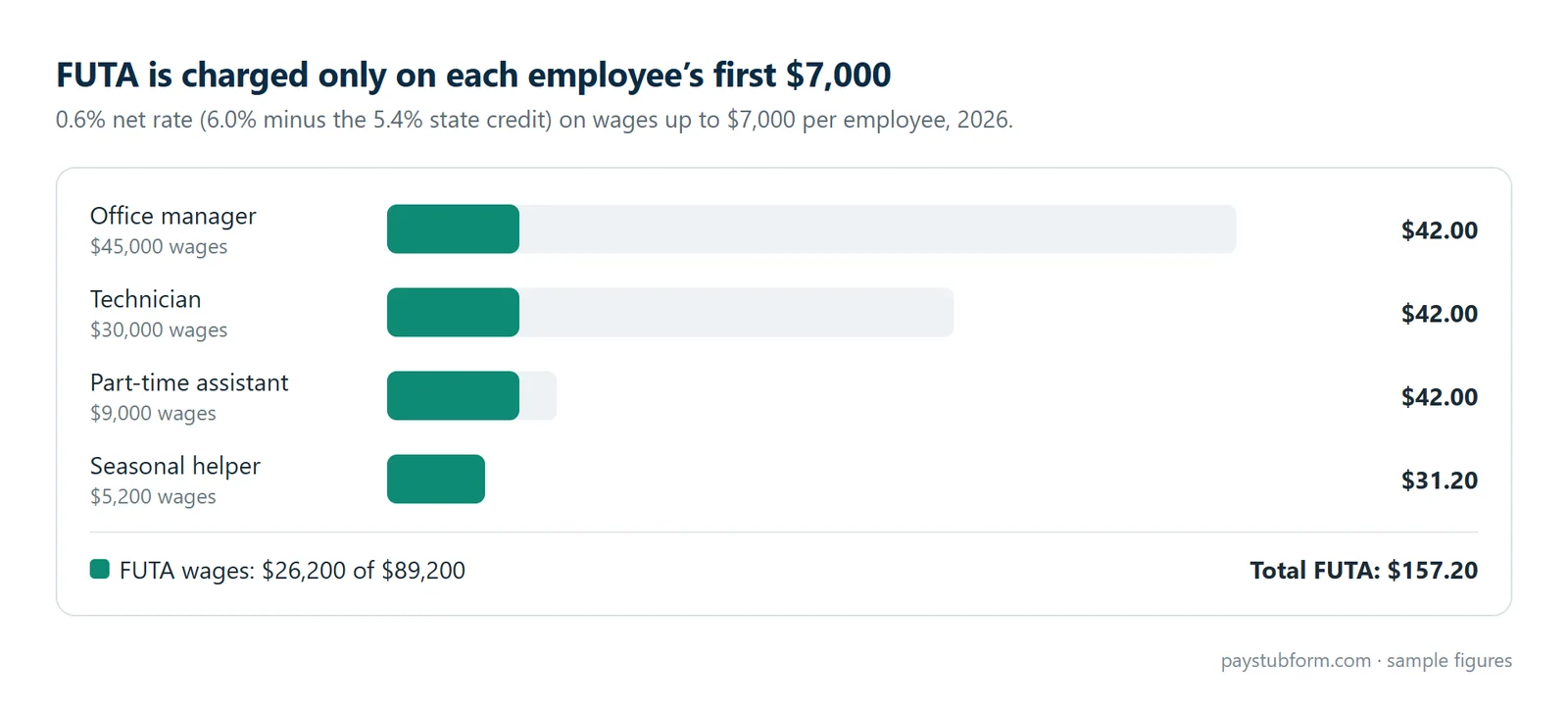
A business pays four employees in 2026, each paid evenly through the year. FUTA applies only to the first $7,000 of each person's wages:
| Employee | 2026 wages | FUTA wages (max $7,000) | FUTA at 0.6% |
|---|---|---|---|
| Office manager | $45,000 | $7,000 | $42.00 |
| Technician | $30,000 | $7,000 | $42.00 |
| Part-time assistant | $9,000 | $7,000 | $42.00 |
| Seasonal helper | $5,200 | $5,200 | $31.20 |
| Total | $89,200 | $26,200 | $157.20 |
Most of the tax falls in the first quarter, because the two full-time employees pass $7,000 by March. In this example the first quarter's FUTA is $105.30 — under the $500 deposit threshold — and the full year is only $157.20, so the business can pay the whole amount with Form 940 in January. The same business in California would owe 1.8% for 2025, or $471.60.
FUTA is calculated on taxable wages, which include most pay and taxable fringe benefits. Pre-tax 401(k) deferrals are still FUTA wages; Section 125 cafeteria-plan health premiums are not. Our guide to pre-tax vs post-tax deductions explains which deductions change which tax base.
4. Credit reduction states: who pays more
When a state borrows from the federal government to pay unemployment benefits and does not repay the loan for two consecutive January 1sts, its employers lose part of the 5.4% credit. The reduction starts at 0.3% and grows each year the loan stays open.
| Year | Jurisdiction | Credit reduction | Net FUTA rate | Per employee |
|---|---|---|---|---|
| 2025 (final) | California | 1.2% | 1.8% | $126 |
| 2025 (final) | U.S. Virgin Islands | 4.5% | 5.1% | $357 |
| 2026 (expected) | California | 1.5% | 2.1% | $147 |
The 2026 list is not final. The Department of Labor names the credit reduction states after November 10, 2026. California also faces a possible 3.8% "benefit cost rate" add-on for 2026, which would push its reduction to 5.3% unless a waiver is granted, as it was for 2025. The U.S. Virgin Islands repaid its loans in June 2026 and is expected to drop off the list. Connecticut and New York were on the early 2025 watch list but repaid in time.
The extra tax for a credit reduction year is figured on Schedule A of Form 940 and paid with the annual return, so it usually hits employers in January.
5. Who has to pay FUTA
- Most employers: anyone who paid $1,500 or more in wages in any calendar quarter, or had at least one employee for some part of a day in 20 or more different weeks, in the current or previous year.
- Household employers (nannies, housekeepers, caregivers): $1,000 or more in cash wages in any calendar quarter. FUTA is paid with your personal tax return on Schedule H rather than Form 940. See our page on pay stubs for nannies and household employees.
- Farm employers: $20,000 or more in cash wages in a quarter, or 10 or more farmworkers in each of 20 different weeks.
Not covered: 501(c)(3) charities, state and local governments, and certain family employment — a child under 21 working for a parent, a spouse working for a spouse, and a parent working for a child. Independent contractors paid on a 1099 are not employees, so no FUTA is owed on their payments.
6. Form 940 and deposit deadlines
- Each quarter, add up the FUTA owed. If it is more than $500, deposit it electronically by the last day of the month after the quarter ends: April 30, July 31, October 31 and January 31.
- If it is $500 or less, carry it forward to the next quarter and keep adding until it passes $500.
- File Form 940 once a year. The return for 2026 is due February 1, 2027, because January 31 falls on a Sunday. If every deposit was made on time, you have until February 10, 2027.
- Fourth quarter: if the remaining balance is $500 or less, you can pay it with the Form 940 instead of depositing.
- Attach Schedule A if you paid state unemployment tax in more than one state or in a credit reduction state.
FUTA is separate from Form 941, the quarterly return for withheld income tax, Social Security and Medicare. Our 2027 payroll calendar lists the federal payroll deadlines.
7. FUTA on a pay stub
Searching "FUTA on paycheck" usually means one of two things:
- It is listed under "Employer taxes" or "Company contributions". Some payroll systems show what the employer paid on your behalf — FUTA, SUTA, and the employer's share of Social Security and Medicare. These amounts were not taken from your pay, and your net pay is the same with or without them. Once you pass $7,000 for the year, the FUTA line drops to $0.00.
- It is listed under deductions and reduces your net pay. That is an error. Federal law makes FUTA the employer's cost, and it may not be taken from wages. Ask payroll to correct it and refund the amount.
Don't confuse FUTA with the state unemployment lines that some employees do pay. In Alaska, New Jersey and Pennsylvania, a small employee unemployment tax is withheld from wages, and it shows as SUI, SUTA or UI on the stub. Our pay stub abbreviations guide decodes these and the other tax codes, and FICA explained covers the Social Security and Medicare lines that are deducted from your pay.
Running payroll yourself? Our pay stub generator calculates federal and state withholding for each employee and keeps the year-to-date totals that tell you when someone has passed the $7,000 FUTA wage base.
Five-minute check
- Count the employees you paid this year and multiply by $42 for your maximum FUTA at 0.6%.
- If you are in California, budget for the higher credit reduction rate on the 2026 Form 940.
- Check each quarter's total: deposit only when it passes $500.
- Put February 1, 2027 on the calendar for the 2026 Form 940.
- As an employee, make sure FUTA does not appear in the deductions that reduce your net pay.
Quick answers
What is FUTA tax?
A federal unemployment tax paid by employers: 6.0% of the first $7,000 of each employee's annual wages, usually reduced to 0.6% by a credit for state unemployment tax paid.
Do employees pay FUTA?
No. FUTA is paid only by the employer and must not be withheld from wages. If it is deducted from your pay, ask payroll to correct it.
What is the FUTA tax rate for 2026?
6.0% gross and 0.6% net for most employers, on the first $7,000 per employee. Employers in credit reduction states, expected to be California for 2026, pay more.
What is the difference between FUTA and SUTA?
FUTA is the federal unemployment tax, with one rate and a $7,000 wage base everywhere. SUTA is each state's unemployment tax, with its own rates and wage base; paying it on time earns the FUTA credit.
How much is FUTA per employee?
At most $42 a year at the 0.6% net rate. In California for 2025, it was up to $126 per employee at 1.8%.
When is Form 940 due?
January 31 of the following year, moved to the next business day when that is a weekend. The 2026 Form 940 is due February 1, 2027, or February 10 if all FUTA deposits were made on time.
Sources
- IRS Topic no. 759 — Form 940, Federal Unemployment (FUTA) Tax Return: the 6.0% rate, $7,000 wage base, 5.4% credit, filing and deposit rules.
- IRS — About Form 940: the current form, Schedule A and instructions.
- IRS Publication 15 — Employer's Tax Guide: who must pay FUTA, household and farm thresholds, exempt family employment and the FUTA wage definition.
- PayrollOrg — California, Virgin Islands face FUTA credit reduction for 2025: the final 1.2% and 4.5% reductions and the waived add-on.
- PayrollOrg — California and Virgin Islands may face credit reduction for 2026: the potential 1.5% reduction and 3.8% benefit cost rate add-on.
- PayrollOrg — U.S. Virgin Islands pays off outstanding UI loans: why the territory is expected to avoid a 2026 reduction.
General U.S. information, current for the 2026 tax year. The 2026 credit reduction states are final only after the Department of Labor's November 2026 determination; for advice on your own payroll, speak to a tax professional.


Comments (0)
Loading comments...
Leave a Comment