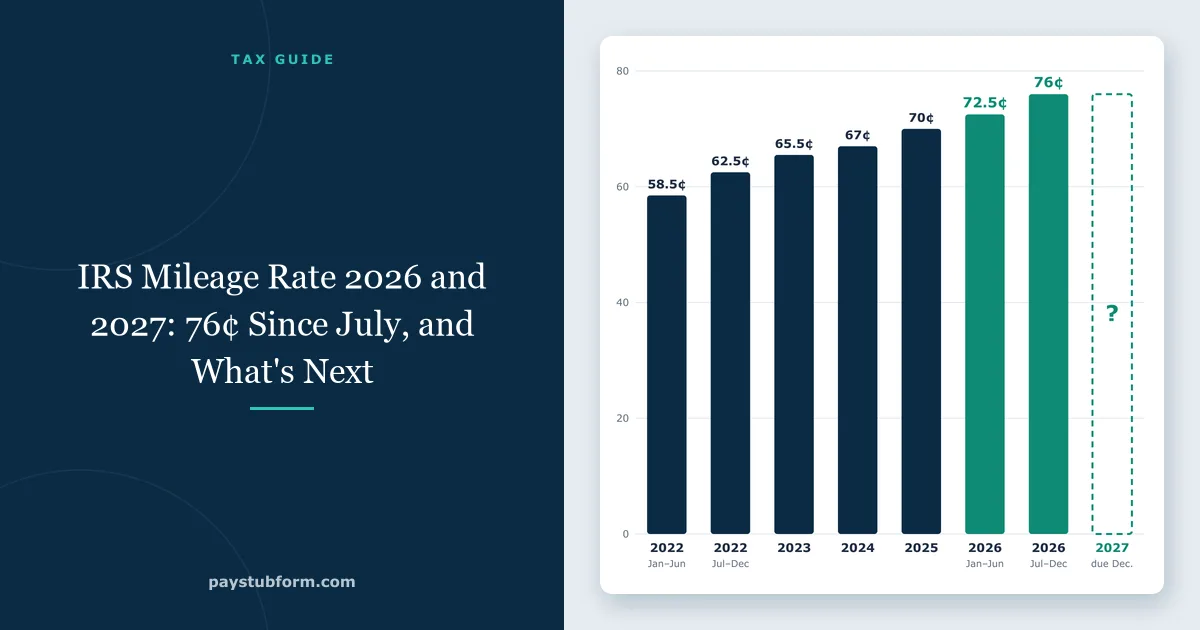
The IRS changed its mileage rate in the middle of 2026, which it rarely does. The business rate was 72.5 cents a mile from January 1. On July 1 it rose to a record 76 cents because fuel prices had climbed. So anyone who deducts or reimburses miles for 2026 has to split the year in two. The 2027 rate is next. The IRS normally announces it in the second half of December, and we will update this page the day it is published.
Quick take: For 2026, business miles driven January 1 to June 30 use 72.5 cents, and miles driven July 1 to December 31 use 76 cents. Medical and military moving miles went from 20.5 to 23.5 cents, and charity stays at 14 cents. If you are self-employed or drive for a gig app, you deduct business miles on Schedule C, which also lowers your self-employment tax. Employees cannot deduct unreimbursed miles on their federal return. A reimbursement up to the IRS rate under an accountable plan is not wages, so it is not taxed and should not appear as taxable earnings on your pay stub.
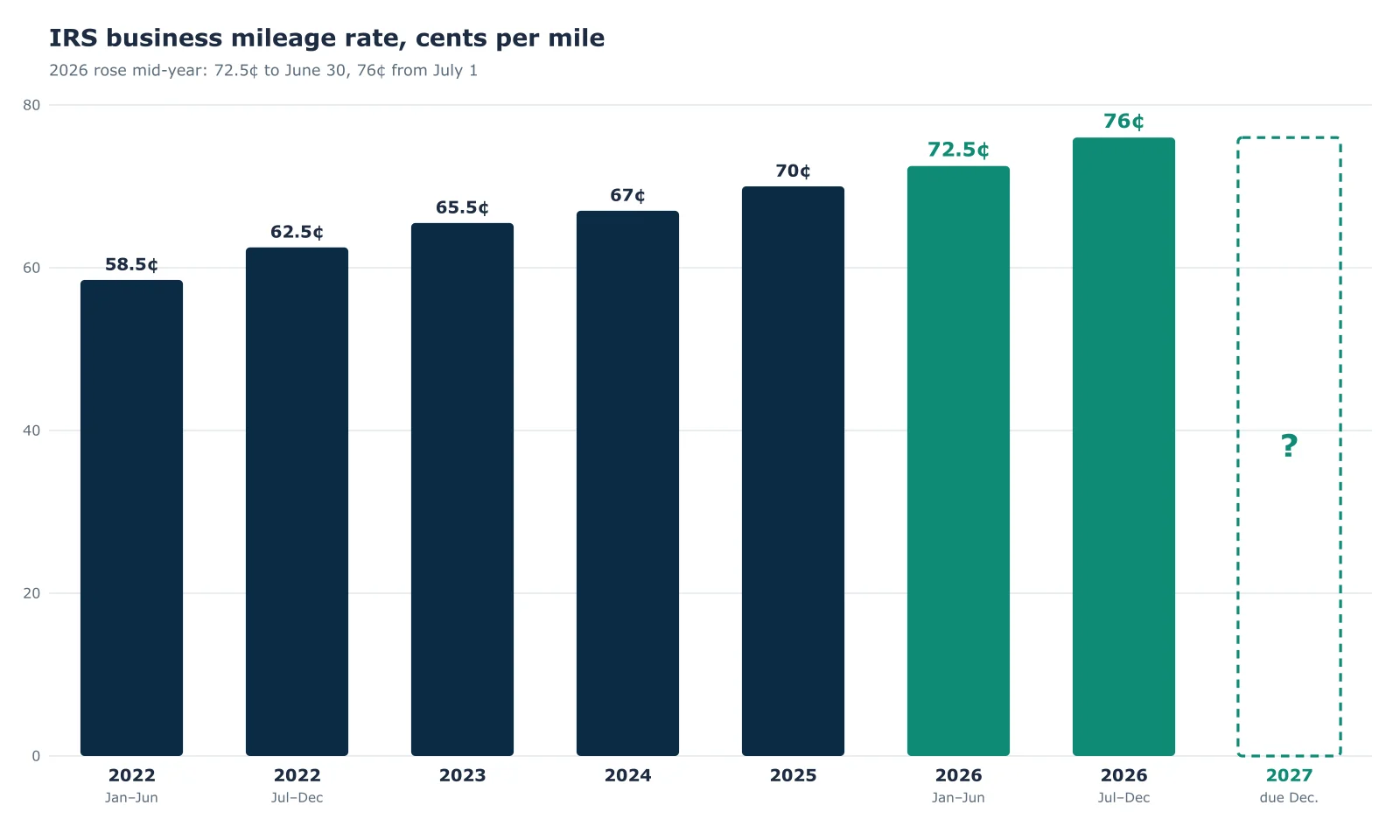
1. The 2026 mileage rates
| Purpose | Jan 1 – Jun 30, 2026 | Jul 1 – Dec 31, 2026 |
|---|---|---|
| Business | 72.5¢ per mile | 76¢ per mile |
| Medical, and moving for active-duty military | 20.5¢ | 23.5¢ |
| Charitable service | 14¢ | 14¢ (fixed by law) |
The January rates come from Notice 2026-10. The July change came in Announcement 2026-11, which says the higher rates apply to miles driven on or after July 1. It is not retroactive, so miles driven before July stay at the lower rate. The rates apply to cars, vans, pickups and panel trucks, including electric and hybrid vehicles.
2. When the 2027 rate comes out
The IRS usually announces next year's rates in the second half of December. The 2026 rates came out on December 29, 2025. The rate is based on an annual study of the fixed and variable costs of running a car: depreciation, insurance, maintenance and, above all, fuel. Whether the 2027 rate stays at 76 cents, drops or rises again depends mostly on fuel prices this fall. We are not going to guess the number. This section will carry the official 2027 rates as soon as the IRS publishes them.
Until then, for January 2027 trips, keep logging your miles as normal and apply the rate once it is out. A rate announced in late December still covers every mile from January 1.
3. A worked example: splitting 2026 for a gig driver
A delivery driver logs 14,000 business miles in 2026 in an app that records each trip:
| Period | Business miles | Rate | Deduction |
|---|---|---|---|
| January 1 – June 30 | 6,200 | 72.5¢ | $4,495.00 |
| July 1 – December 31 | 7,800 | 76¢ | $5,928.00 |
| Total on Schedule C | 14,000 | $10,423.00 |
Using 72.5 cents for the whole year would have given $10,150, which is $273 less. Business parking fees and tolls are deducted on top of the mileage rate. Because the deduction lowers net profit, it lowers both income tax and the 15.3% self-employment tax. Our guide to paying taxes when self-employed shows how net profit flows into both.
There is a catch if you use your income to rent or borrow. Landlords and lenders who check self-employment income usually look at net profit after expenses, and that includes the mileage deduction. A large mileage deduction lowers the income they see. Our guides to proof of income for gig workers and pay stubs for the self-employed explain which figure each reviewer uses.
4. Employees: mileage reimbursement and your pay stub
If your employer pays you back for driving your own car for work, how the money is paid decides whether it is taxed:
- Accountable plan, at or below the IRS rate. You report the miles (date, destination, purpose) and are paid per mile. The reimbursement is not wages, so there is no income tax, Social Security or Medicare on it, and it is not in Box 1 of your W-2. On a pay stub it should show as a separate non-taxable reimbursement, or be paid outside payroll. It should not appear under taxable earnings.
- Accountable plan, above the IRS rate. The part above the rate is taxable wages. On the W-2, the part up to the rate is shown in Box 12 with code L. The excess is in Boxes 1, 3 and 5.
- Flat car allowance with no mileage log. This is a non-accountable plan, so the whole allowance is taxable pay. It belongs with your earnings on the stub and on the W-2.
Federal law does not require an employer to reimburse mileage, unless the cost would push your pay below the minimum wage. Some states do require it. California's Labor Code section 2802 requires employers to repay necessary business expenses, including miles driven for work, and Illinois has a similar rule. If you are not reimbursed, you cannot deduct the miles on your federal return. The deduction for unreimbursed employee expenses is gone, except for a few groups such as Armed Forces reservists, some state and local officials, some performing artists and eligible educators.
5. What counts as business miles
- Counts: driving from one job site or client to another, to a supplier, to a temporary work location, and, for gig drivers, driving to a pickup and on to the drop-off.
- Does not count: commuting from home to your regular workplace, personal errands during the day, and miles while you are not working for anyone.
- The home office exception: if your home is your principal place of business, trips from home to clients or job sites are business miles.
The IRS wants a record made at or near the time of the trip: date, destination, business purpose and miles, plus odometer readings at the start and end of the year. An app log or a notebook in the car both work. A total pieced together in April does not hold up well in an audit.
6. Standard rate or actual expenses
The self-employed can deduct either the standard rate or the actual costs of the car: fuel, repairs, insurance, registration and depreciation, multiplied by the business-use share. Two rules limit the choice. If you want to use the standard rate for a car you own, you have to choose it in the first year the car is used for business. You can switch to actual costs later, but not the other way round if you started with depreciation. And you cannot use the standard rate when you run five or more vehicles for business at the same time. For most gig drivers with an efficient car, the standard rate comes out higher and is far less record-keeping.
7. Your five-minute mileage checklist
- Split 2026 at July 1 and apply 72.5¢ to the first half and 76¢ to the second.
- Check your log for date, destination, purpose and miles on every trip, and note your December 31 odometer reading.
- Employees: check that mileage reimbursements on your stub are not counted as taxable earnings. If your employer pays more than the IRS rate, expect code L and the excess as wages on your W-2.
- Employers: if your reimbursement policy is tied to "the IRS rate", make sure it moved to 76¢ on July 1, and update it again in January.
- Come back after the IRS announces the 2027 rate in December. This page will show it.
Quick answers
What is the IRS mileage rate for 2026?
72.5 cents per business mile from January 1 to June 30, 2026, and 76 cents from July 1 to December 31, 2026. Medical and military moving miles are 20.5 cents and then 23.5 cents. Charitable miles are 14 cents all year.
What is the IRS mileage rate for 2027?
Not announced yet. The IRS normally publishes it in the second half of December. The 2026 rates came out on December 29, 2025. We will add the official 2027 figure here when it is released.
Is the 76-cent rate retroactive to January?
No. It applies to miles driven on or after July 1, 2026. Miles driven before that use 72.5 cents, so a full-year figure needs two totals.
Is mileage reimbursement taxable?
Not when it is paid under an accountable plan at or below the IRS rate, with a mileage log. A flat allowance without records is taxable pay, and so is any amount above the IRS rate.
Can employees deduct mileage their employer doesn't pay back?
Not on the federal return, except for a few groups such as reservists, some state and local officials, some performing artists and eligible educators. Self-employed people and gig drivers deduct business miles on Schedule C.
Can DoorDash or Uber drivers deduct all the miles they drive?
Only business miles: driving to a pickup and on to the customer, plus the miles between orders while you are working. Driving home after your last delivery and personal trips do not count. Keep the app's mileage log or your own record.
Sources
- IRS — IR-2025-128, 2026 standard mileage rates: the January 2026 rates (72.5, 20.5 and 14 cents), the December 29, 2025 release date and the limits on deducting unreimbursed employee travel.
- Journal of Accountancy — IRS raises standard mileage rates for remainder of 2026: Announcement 2026-11, the 76-cent business and 23.5-cent medical and moving rates from July 1, 2026, and the fuel-price reason.
- IRS — Standard mileage rates: the rate table for past years, including the 2022 mid-year change.
- IRS — Publication 463, Travel, Gift, and Car Expenses: business versus commuting miles, record-keeping, the first-year rule for the standard rate and the five-vehicle limit.
- IRS — Publication 15 (Circular E): accountable and non-accountable plans and how reimbursements are reported.
- California Labor Code § 2802: the employer's duty to repay necessary business expenses.
General U.S. information for the 2026 tax year, updated November 2026. Your own deduction depends on your records and how you use your car; for advice on your return, speak to a tax professional.


Comments (0)
Loading comments...
Leave a Comment