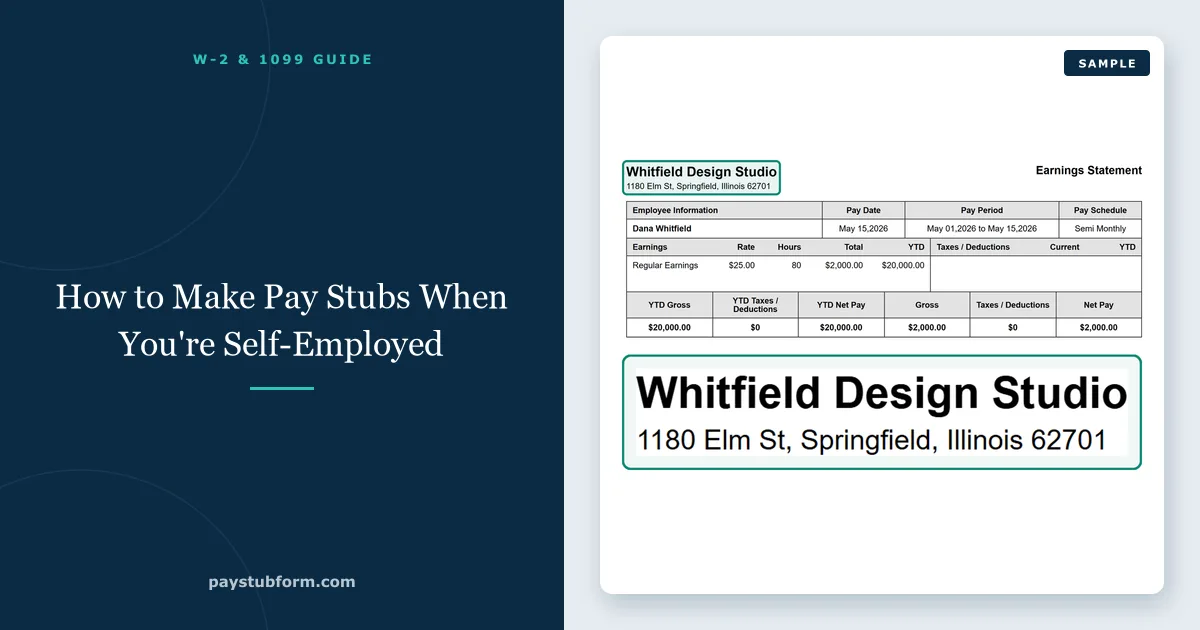
If you work for yourself, nobody hands you a pay stub — so when a landlord, lender or car dealer asks for one, you have to produce your own. That is perfectly legitimate, as long as the stub records what actually happened: money that really moved from your business to you, on the dates shown, consistent with your bank statements, invoices and tax returns. A self-made stub that matches those records helps an application; one that does not will be caught, because those records are exactly what reviewers check next.
This guide covers how pay works for each kind of self-employed person, what a credible self-employed pay stub contains, and which documents to send with it.
Quick take: Sole proprietors, single-member LLCs and freelancers do not pay themselves wages — they take owner's draws, with no tax withheld, so their pay stub shows the draw and zero withholding. S corporation owners who work in the business are on real payroll with real withholding, so their stubs are ordinary payroll records. Either way, send the stub with bank statements, a year-to-date profit and loss statement, and your recent tax returns.
1. First, what kind of self-employed are you?
| Setup | How you get paid | Tax withheld? | What the stub shows |
|---|---|---|---|
| Freelancer or 1099 contractor | Clients pay you; you move money to your own account | No | Owner's draw, no withholding |
| Sole proprietor or single-member LLC | Owner's draws from the business account | No | Owner's draw, no withholding |
| S corporation owner-employee | A salary through payroll, plus possible distributions | Yes — income tax, Social Security, Medicare | A normal payroll stub |
| Partner in a partnership or multi-member LLC | Draws and guaranteed payments | No | Draws or guaranteed payments, no withholding |
The distinction matters because a stub showing federal income tax and FICA withheld from a sole proprietor's draw describes something that did not happen. Sole proprietors pay their tax through quarterly estimated payments and the annual return instead. Our guide to 1099-NEC versus a pay stub explains why contractors have no payroll behind them.
2. Pay yourself on a schedule first
The single most useful step comes before any document: pay yourself a regular, consistent amount. Move a set sum from your business account to your personal account on the same days each month — for example $2,000 on the 1st and the 15th. A stub is then a summary of a real, repeating transfer, and your bank statements confirm it line for line.
Irregular transfers can still be documented, but a reviewer looking at three months of deposits will see a pattern or the lack of one, and a regular schedule reads as stable income. Our guide to payroll frequency covers the trade-offs between weekly, biweekly and semimonthly schedules, which apply to you as much as to any employer.
3. What a self-employed pay stub should contain
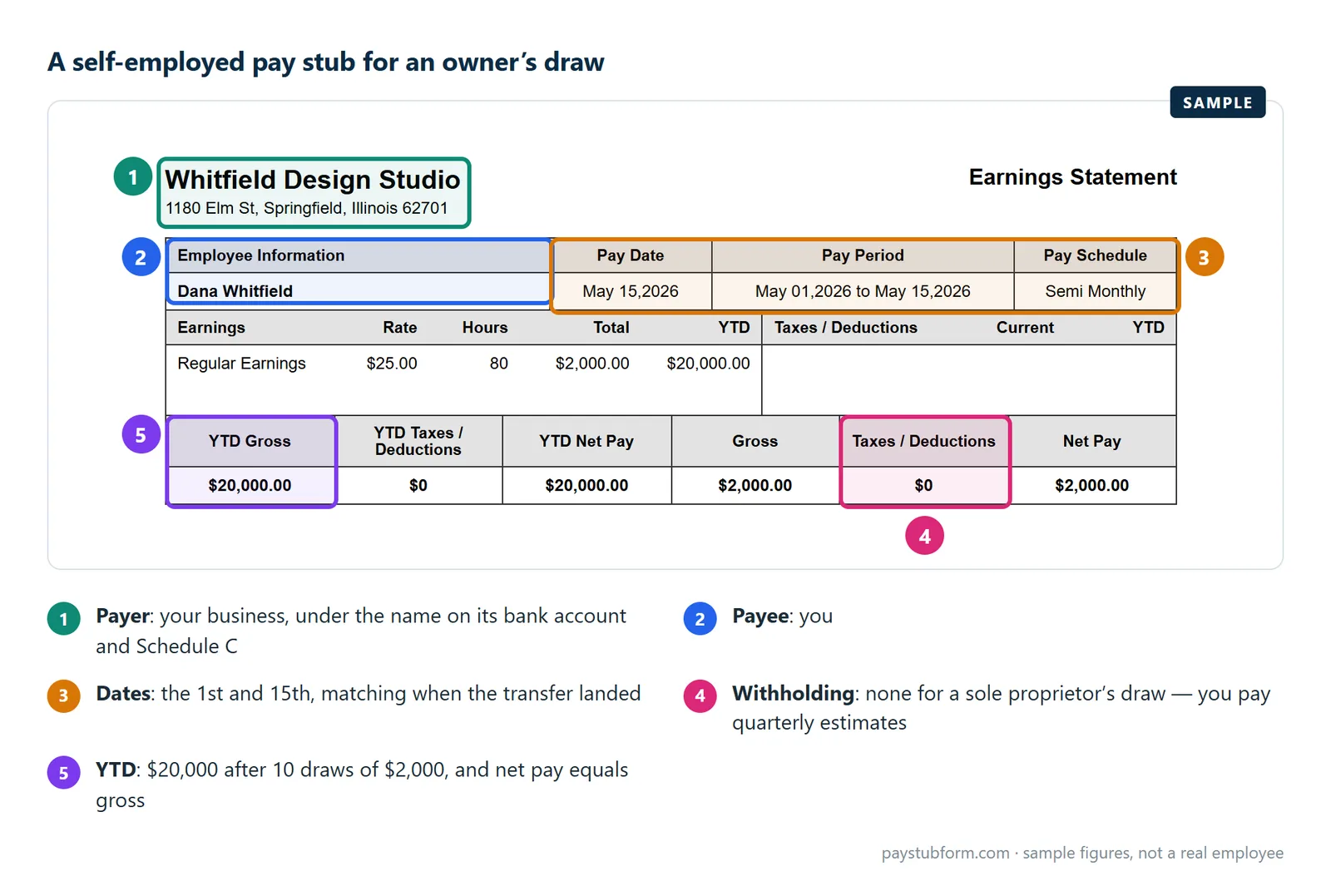
- Payer: your business's legal or trade name and address — the name on your bank account, invoices and Schedule C.
- Payee: your name and address.
- Pay period and pay date: matching the date the transfer reached your personal account. See pay period versus pay date.
- Gross amount: the draw or salary for the period, labelled honestly — "owner's draw" for a sole proprietor, regular salary for an S corporation owner.
- Withholding and deductions: only what was actually withheld or deducted. For a draw, that is usually nothing.
- Net pay: the amount that landed in your account.
- Year-to-date totals: the running total since January, which should agree with your bank records and your books. See what YTD means.
Example — freelance designer, sole proprietor: transfers $2,000 on the 1st and 15th. Each stub shows gross owner's draw $2,000, federal and state withholding $0, Social Security and Medicare $0, net pay $2,000, and a YTD total that rises by $2,000 each time. Taxes are handled separately through quarterly estimated payments.
Example — S corporation owner: a $60,000 salary paid semimonthly is $2,500 gross per check, with Social Security of $155.00 and Medicare of $36.25 withheld, plus federal and state income tax based on the owner's W-4. The corporation pays its matching share and files payroll returns. The IRS expects S corporation owner-employees to take reasonable compensation as wages before taking distributions.
4. How to create the stub
Our self-employed pay stub generator page sums up what the stub should show and how to make one in our tool; the steps below work with any tool. For the full calculation, line by line, see how to make a pay stub.
- Choose a layout. Our pay stub templates show the designs available.
- Enter your business as the employer and yourself as the employee, with the real pay date and period.
- Enter the gross amount of the draw or salary. For a sole proprietor, set withholding to zero; for an S corporation, enter what payroll actually withheld.
- Check that net pay equals the deposit on your bank statement and that YTD equals the sum of this year's payments.
- Generate one stub per pay date — usually the most recent two to three months.
You can start in our pay stub generator, and the first pay stub is free. If your state matters for the layout or tax lines, the state pay stub guides cover each state's rules.
5. The documents that make the stub believable
A self-made stub is never the whole story, and reviewers know it. Send it as part of a package:
- Bank statements — two to six months of business and personal statements showing the same transfers as your stubs.
- A year-to-date profit and loss statement — revenue, expenses and net profit since January. It shows the business earns enough to support what you pay yourself.
- Tax returns — usually the last two years, with Schedule C and Schedule SE for sole proprietors, or the business return and K-1 for S corporations and partnerships.
- 1099 forms from clients, where you received them.
- IRS transcripts — your own copies are free through IRS Get Transcript, and many lenders order them directly with your permission.
For mortgages, the stub matters least. Fannie Mae's self-employment income guidelines generally look for a two-year history documented by tax returns, with one year accepted in some cases, and lenders average the net income on those returns. If your returns show low net profit because of large deductions, a pay stub will not lift the qualifying income. Landlords and car dealers are usually more flexible and often accept stubs plus bank statements. Our guide to using pay stubs as proof of income covers what each kind of reviewer checks.
6. How to show proof of income when you're self-employed
What counts as proof depends on who is asking and how long you have been in business. Ask the reviewer which documents they accept before you send anything — the answer differs more for the self-employed than for anyone else.
| Who is asking | What usually works |
|---|---|
| Landlord or property manager | Two to three months of bank statements showing regular deposits, your pay stubs, and last year's tax return or 1099s. Some accept a letter from a client or your accountant in place of the return. |
| Auto lender | Recent bank statements and pay stubs, often with last year's return; some ask for a year-to-date profit and loss statement. |
| Mortgage lender | Usually two years of personal and business tax returns, IRS transcripts and a year-to-date P&L. Stubs count for little. |
| Benefits agency | Its own self-employment form or a monthly income and expense log, plus receipts. Ask the caseworker which they use. |
If you don't have a tax return yet
In your first year there is no Schedule C to show. Build the case from what does exist: signed contracts or statements of work with your clients, the invoices you sent and the payments that cleared, 1099-NEC forms as they arrive, a year-to-date profit and loss statement, and three to six months of bank statements. A regular owner's draw from section 2, with a stub for each one, ties those documents together into a monthly income figure a reviewer can follow. If you are also paid in cash, our guide to proving cash income covers how to document it.
A proof of income letter when you're self-employed
When a reviewer asks for an "income letter", there are three honest ways to provide one:
- A letter from a client you work for regularly, on their letterhead, confirming that you provide services to them, since when, and at what rate or average monthly amount, with a contact who can confirm it.
- A letter from your CPA or tax preparer confirming that you are self-employed and that they prepared your recent returns. Many accountants will confirm those facts but will not certify an income figure they have not audited, so ask what they can put in writing.
- Your own signed statement. Some landlords and benefits programs accept a self-declaration, always alongside bank statements or other evidence. Keep it factual: your name and business, what you do, how long you have done it, your average monthly income over a stated period and where that figure comes from, the documents attached, and your signature and date. A statement of income you did not earn is a false statement, signed by you.
7. Taxes when nothing is withheld
Because no one withholds from an owner's draw, you pay tax yourself: a 15.3% self-employment tax for Social Security and Medicare on 92.35% of your net earnings, plus income tax on your profit, sent to the IRS in quarterly estimated payments on Form 1040-ES. For the 2026 tax year the last payment is due January 15, 2027. Our guide on how to pay taxes when you're self-employed works through a full example, the safe-harbor rules and every due date.
8. The line you must not cross
A pay stub that overstates your income, invents an employer, or shows withholding that never happened is a false document, and using one to obtain a loan or a lease can be fraud. In practice it also fails: lenders match stubs against bank deposits and IRS transcripts, and a mismatch ends the application. Make the stub reflect your records, and if the records do not show enough income, the fix is in the records — a regular pay schedule, clean books, a P&L — not in the stub. Our editorial standards explain how we approach this.
The five-minute version
- Work out your setup: draw (sole proprietor, freelancer, partner) or payroll salary (S corporation).
- Pay yourself a fixed amount on fixed dates from your business account.
- Create one stub per pay date, with real amounts and only real withholding.
- Check net pay against your bank statement and YTD against your books.
- Send the stubs with bank statements, a YTD P&L and recent tax returns.
- Keep making quarterly estimated tax payments — next due January 15, 2027.
Quick answers
Can I make my own pay stubs if I'm self-employed?
Yes. When you are your own payer, a pay stub you prepare is a legitimate record of what you paid yourself, provided it matches your bank deposits, books and tax returns.
Should a self-employed pay stub show taxes withheld?
Only if taxes were actually withheld. Owner's draws for sole proprietors and freelancers have no withholding; S corporation salaries do, because they run through payroll.
Will a lender accept a self-employed pay stub?
Mortgage lenders rely mainly on tax returns — usually two years — and treat stubs as supporting documents at most. Landlords and auto lenders are more likely to accept stubs together with bank statements.
What is the best proof of income for self-employed people?
Tax returns with Schedule C or K-1s, IRS transcripts, recent bank statements and a year-to-date profit and loss statement. Pay stubs and 1099s support those documents rather than replace them.
How do I show proof of income if I'm self-employed and have no tax return yet?
Send bank statements for the last three to six months, client contracts and paid invoices, any 1099-NEC forms you have received, a year-to-date profit and loss statement, and a pay stub for each owner's draw. A letter from a regular client can confirm the work.
Can I write my own proof of income letter?
Yes, if the reviewer accepts a self-declaration: a signed, factual statement of what you do and your average monthly income, with bank statements or other evidence attached. A letter from a client or your accountant usually carries more weight.
How much should I pay myself?
For a sole proprietor, an amount your business's profit can sustainably support, leaving room for estimated taxes. For an S corporation owner, at least reasonable compensation for the work you do, paid as wages through payroll.
Do 1099 contractors get pay stubs?
Not from their clients. Clients may send a 1099-NEC — required once they pay you $2,000 or more in 2026 — but any pay stub is one you prepare yourself. Our 1099 pay stub generator page shows a sample contractor stub.
Sources
- IRS — Self-employment tax (Social Security and Medicare taxes): the 15.3% rate, the 92.35% factor and the $400 filing threshold.
- IRS — About Form 1040-ES: quarterly estimated tax payments and due dates.
- IRS — S corporation compensation: reasonable compensation for owner-employees.
- IRS — Get Transcript: free copies of your tax return and wage and income transcripts.
- Fannie Mae Selling Guide — Self-employment income: how mortgage lenders document self-employed borrowers.
- IRS — Instructions for Forms 1099-MISC and 1099-NEC: the $2,000 threshold for payments made after 2025.
General U.S. information, current for 2026. This is not legal, tax or lending advice; requirements vary by lender, landlord and state.


Comments (0)
Loading comments...
Leave a Comment