When you are self-employed, no one withholds tax from your pay, so you pay it yourself: income tax plus a 15.3% self-employment tax for Social Security and Medicare. During the year you send the IRS four estimated payments with Form 1040-ES, and after the year ends you settle up on your Form 1040 with Schedule C and Schedule SE.
Below is what you owe, a full worked example for a freelancer with $60,000 profit, how to size the quarterly payments so you avoid a penalty, the 2026–2027 due dates, and which forms you file.
Quick take: Set aside about 25–30% of your profit (more in a high-tax state). Pay it in four installments — the last one for 2026 is due January 15, 2027. Paying 100% of last year's total tax (110% if your AGI was over $150,000) in four equal parts protects you from the underpayment penalty, even if you end up owing more in April.
1. The two taxes you pay
| Tax | Rate | Applies to | Form |
|---|---|---|---|
| Self-employment tax | 15.3% (12.4% Social Security + 2.9% Medicare) | 92.35% of net earnings; the Social Security part stops at $184,500 for 2026 | Schedule SE |
| Federal income tax | 10%–37% brackets | Taxable income after deductions | Form 1040 |
| State income tax | Varies; none in nine states | Your state's taxable income | State return and state estimates |
Self-employment tax is the same Social Security and Medicare an employee pays through FICA, except you pay both halves: the employee's 7.65% and the employer's 7.65%. It applies once your net self-employment earnings reach $400 for the year, even if you owe no income tax.
Two deductions soften it. You deduct half of your self-employment tax from income, and most sole proprietors also get the qualified business income (QBI) deduction, which can take up to 20% of business profit off taxable income.
2. Worked example: $60,000 profit in 2026
A single freelance designer earns $72,000 from clients and has $12,000 of business expenses, for a net profit of $60,000 on Schedule C. No other income, standard deduction.
| Step | Calculation | Amount |
|---|---|---|
| Net profit (Schedule C) | $72,000 − $12,000 | $60,000.00 |
| Net earnings for SE tax | $60,000 × 92.35% | $55,410.00 |
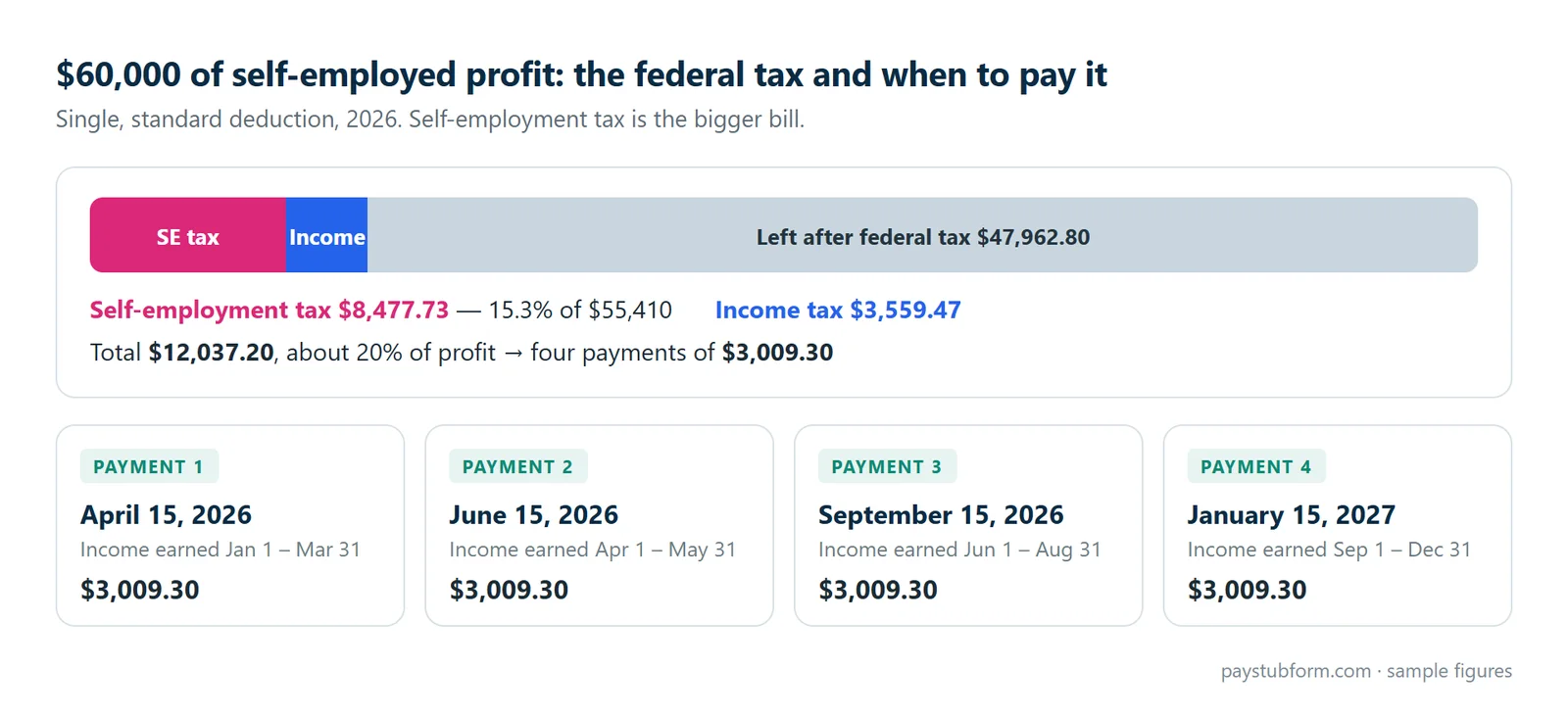
| Self-employment tax | $55,410 × 15.3% | $8,477.73 |
| Deduct half of SE tax | $60,000 − $4,238.87 | $55,761.13 |
| Standard deduction (single, 2026) | − $16,100 | $39,661.13 |
| QBI deduction | 20% of $39,661.13 (the lower limit applies) | − $7,932.23 |
| Taxable income | $31,728.90 | |
| Federal income tax | 10% of $12,400 + 12% of $19,328.90 | $3,559.47 |
| Total federal tax | SE tax + income tax | $12,037.20 |
| Per quarterly payment | ÷ 4 | $3,009.30 |
That is about 20% of profit in federal tax alone. Notice that the self-employment tax is more than twice the income tax: at modest incomes it is the bigger bill, which is why people who only budget for "income tax" come up short. Add your state's income tax on top; that is why a 25–30% set-aside is the usual rule of thumb.
3. How much to pay each quarter
You have to make estimated payments if you expect to owe $1,000 or more when you file. To avoid the underpayment penalty, your four payments together need to reach the smaller of:
- 90% of this year's tax, or
- 100% of last year's total tax — 110% if last year's adjusted gross income was over $150,000 ($75,000 if married filing separately).
The prior-year rule is the easy one when your income is growing: take the total tax line from last year's return, divide by four, and pay that each quarter. If last year's total tax was $10,000, four payments of $2,500 keep you penalty-free even if you owe $14,000 this year — you simply pay the rest by April 15. If your income dropped, the 90% rule lets you pay less, based on this year's estimate.
Uneven income? Freelance and gig income often arrives in bursts. Instead of equal payments, you can pay based on what you actually earned in each period (the annualized method on Form 2210), or simply pay more often — the IRS accepts weekly or monthly payments as long as enough has been paid by each due date.
4. Estimated tax due dates
| Income earned | 2026 tax year | 2027 tax year |
|---|---|---|
| January 1 – March 31 | April 15, 2026 | April 15, 2027 |
| April 1 – May 31 | June 15, 2026 | June 15, 2027 |
| June 1 – August 31 | September 15, 2026 | September 15, 2027 |
| September 1 – December 31 | January 15, 2027 | January 18, 2028 |
The "quarters" are not equal: the second covers only two months and the fourth covers four. When a due date falls on a weekend or holiday, the next business day counts. You can skip the January payment if you file your full return and pay the balance by February 1.
5. How to pay
- IRS Direct Pay at IRS.gov/payments — free, from a bank account, no sign-up. Choose "Estimated Tax" and "1040ES" and the tax year.
- IRS Online Account — the same, and it shows every payment you have made, which helps at filing time.
- EFTPS — the Treasury's payment system; useful if you also run payroll.
- Debit or credit card through an IRS-approved processor, for a fee.
- Check by mail with a Form 1040-ES voucher.
Most states with an income tax have their own estimated payments, usually on the same dates. Paying the state is a separate step.
6. The forms you file
- Form 1040-ES — the worksheet and vouchers for estimated payments during the year.
- Schedule C — your business income and expenses; the bottom line is your net profit.
- Schedule SE — turns net profit into self-employment tax.
- Form 1040 — brings everything together, credits your estimated payments, and shows the refund or balance due.
- Form 8995 — the QBI deduction.
Where 1099s fit. Clients who pay you $2,000 or more in 2026 send a Form 1099-NEC by February 1, 2027 (the threshold was $600 for 2025 payments), and payment apps send a 1099-K above $20,000 and 200 transactions. You report all of your income on Schedule C, with or without a 1099. You do not issue a 1099 to yourself — if you hire other contractors, you issue one to them, which our 1099-NEC generator handles. See 1099-NEC vs pay stub for what a contractor should expect from clients.
7. Deductions that lower the bill
- Business expenses on Schedule C: equipment, software, supplies, a home office used regularly and only for work, business mileage at the IRS standard rate, and similar costs.
- Half of self-employment tax, automatically.
- Self-employed health insurance for you and your family, if you are not eligible for an employer plan.
- Retirement contributions to a SEP-IRA or solo 401(k), which reduce income tax (not self-employment tax).
- The QBI deduction, up to 20% of qualified business income.
Every dollar of business expense saves you both income tax and the 15.3% self-employment tax, so keeping receipts matters more than for an employee.
8. Paying yourself and keeping records
The simplest system is to pay yourself on a schedule and move a fixed share of every payment into a separate tax savings account the day it arrives. Our guide on making pay stubs when you're self-employed shows how to turn that schedule into regular stubs, and our self-employed pay stub generator page covers what the stubs should show. A stub records what you paid yourself; the estimated payments above are made separately, and nothing is withheld on a self-employed stub unless you choose to show your set-aside.
Records are also what landlords and lenders ask for. If you need to show your income, see proof of income for an apartment, gig worker proof of income, or proof of income when paid in cash.
Five-minute check
- Find the "total tax" line on last year's Form 1040 and divide it by four — that is your safe-harbor payment.
- Estimate this year's profit and multiply by 25–30% to sanity-check the set-aside.
- Put January 15, 2027 on your calendar for the last 2026 payment.
- Pay through IRS Direct Pay or your IRS Online Account, and save the confirmation.
- Check whether your state requires its own estimated payments.
Quick answers
How much should I set aside for taxes when self-employed?
About 25–30% of your net profit covers federal income tax, the 15.3% self-employment tax and a typical state tax. At lower incomes or in a no-income-tax state, 20–25% is often enough.
Do I have to pay quarterly taxes?
Yes, if you expect to owe $1,000 or more when you file. If you also have a job, you can instead raise your W-4 withholding there to cover the self-employment tax.
What happens if I miss a quarterly payment?
The IRS charges an underpayment penalty, calculated like interest on the amount that was late and for how long. Pay as soon as you can — the penalty stops growing when the payment arrives.
What tax form do self-employed people use?
Schedule C for business income and expenses, Schedule SE for self-employment tax, both attached to Form 1040, plus Form 1040-ES for the estimated payments during the year.
Do I pay taxes if I didn't get a 1099?
Yes. All self-employment income is taxable whether or not a client sends a 1099. The 1099 is a report to the IRS, not what makes the income taxable.
When is the last estimated tax payment for 2026?
January 15, 2027. You can skip it if you file your 2026 return and pay everything owed by February 1, 2027.
Sources
- IRS — Estimated taxes: the $1,000 rule, the 90%/100% safe harbor, payment options and the option to pay more often.
- IRS — About Form 1040-ES: the estimated tax worksheet, vouchers and payment periods.
- IRS Publication 505 — Tax Withholding and Estimated Tax: the 110% rule above $150,000 AGI, the annualized method and the January exception.
- IRS — Self-employment tax: the 15.3% rate, the 92.35% base, the $400 threshold and the deduction for half.
- Journal of Accountancy — Annual inflation adjustments for tax year 2026: the $16,100 standard deduction and the 2026 brackets used in the example.
General U.S. information for the 2026 tax year. The example is simplified (no credits, other income or state tax); your figures depend on your own return. For advice on your situation, speak to a tax professional.


Comments (0)
Loading comments...
Leave a Comment