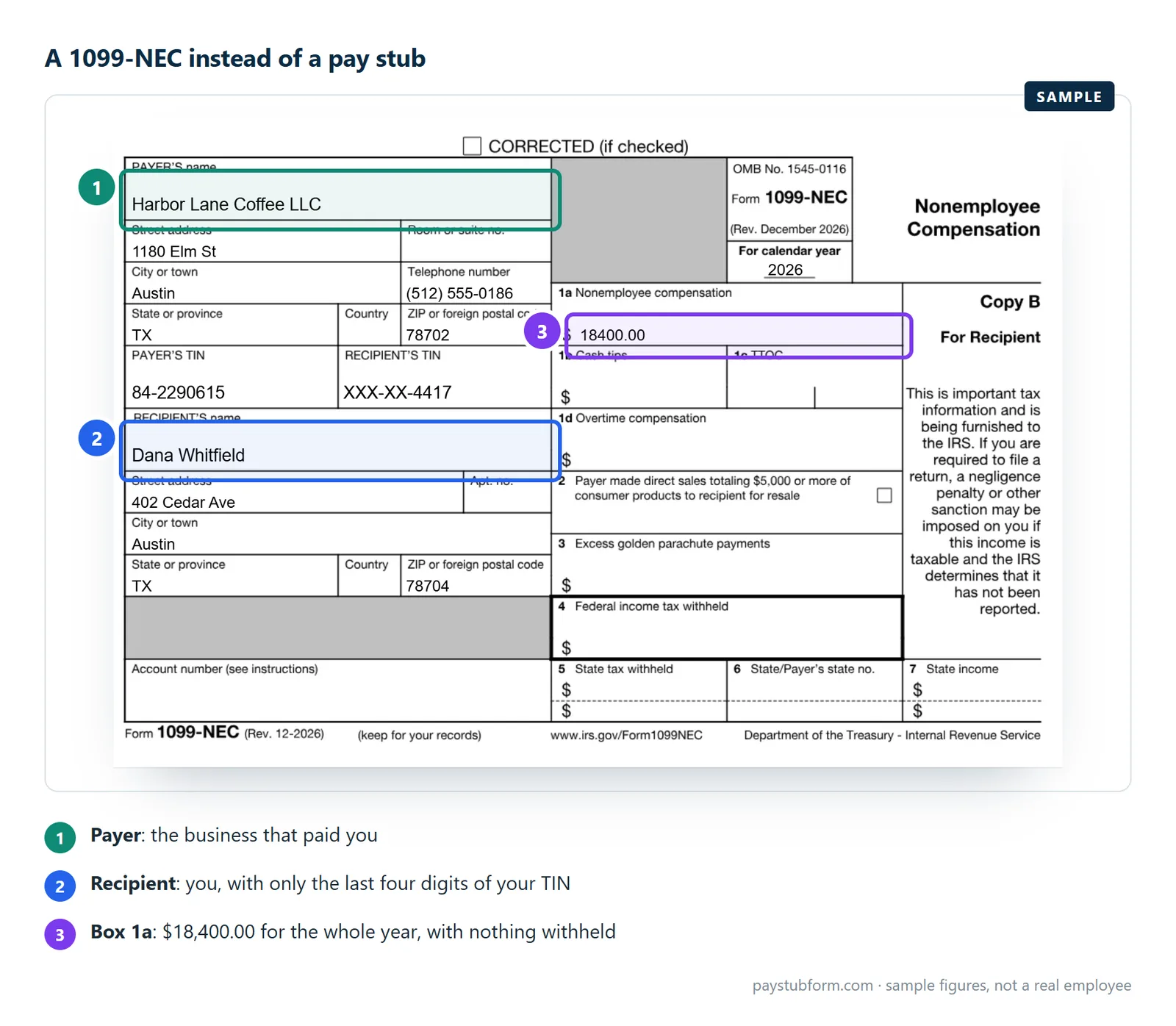
The first time a contractor is asked for a pay stub, there is a short pause while they work out that they do not have one and never will. There is no payroll department, no withholding, no net pay figure — just an invoice that was paid in full and, in January, a Form 1099-NEC summarising the year.
That is not a gap in your paperwork. It is a different arrangement, and it changes three things: what you owe, when you pay it, and what you hand over when somebody asks you to prove your income. All three are manageable once you know what replaces what.
Quick take: A pay stub exists because an employer withheld money. Nobody withholds from a contractor, so the equivalent records are your invoices, your 1099-NEC forms and your own profit-and-loss summary — and you pay 15.3% self-employment tax on top of income tax, in quarterly instalments.
Why there is no pay stub
A pay stub is a withholding statement. It exists to show what an employer took out of your gross pay and why — federal income tax, Social Security, Medicare, state tax, benefits — and to leave you with a net figure.
None of that machinery applies to a contractor. You invoice, the client pays the invoice in full, and no tax is deducted on the way. The money is yours before any tax has been dealt with, which feels generous in March and much less so in April.
One exception is worth knowing. If you did not give the payer a valid taxpayer identification number, they are required to apply backup withholding at 24% and report it in box 4 of your 1099. That is the only circumstance in which a contractor sees tax taken out at source — and it is avoided by returning a Form W-9 before the first payment.
What you pay instead
An employee and their employer split Social Security and Medicare down the middle: 6.2% and 1.45% each. A contractor is both parties, so you pay both halves.
Self-employment tax is 12.4% for Social Security plus 2.9% for Medicare — 15.3% in total, on your net earnings from self-employment. The Social Security portion stops once you reach the annual maximum, which is $184,500 of earnings for 2026. The Medicare portion never stops, and the Additional Medicare Tax thresholds apply on top: $250,000 for married filing jointly, $125,000 for married filing separately, $200,000 for everyone else.
Income tax sits on top of that, and nobody is withholding it for you either, which is why contractors generally make quarterly estimated payments rather than settling once a year. See how to pay taxes when you're self-employed for the amounts and due dates.
The practical consequence: the headline rate on a contract is not comparable to a salary. Our guide to gross pay versus net pay shows what an employee actually keeps; for a contractor the equivalent calculation has to include both halves of FICA and your own expenses.
Tip: Set aside a fixed percentage of every payment the day it arrives, in a separate account you do not touch. A quarter to a third is the usual starting point. The tax bill is not a surprise; the cash flow is.
The records that replace a pay stub
Nothing single-handedly replaces a pay stub, but four documents together do the same job and more.
- Your invoices. Numbered, dated, naming the client and the work. These are your earnings record and the equivalent of an employee's earnings lines.
- Form 1099-NEC. Each client who paid you $2,000 or more for services in the calendar year issues one by January 31, with the total in box 1a.
- A business bank account. Separate from personal. It turns "trust my spreadsheet" into a verifiable record, and it makes the expense side defensible.
- Schedule C and your own profit-and-loss summary. Gross receipts minus expenses equals net profit — the figure self-employment tax is calculated on, and the number that most closely corresponds to an employee's income.
The $2,000 threshold does not change what you owe
This is the most expensive misunderstanding in contracting, and it got more tempting in 2026.
The reporting threshold rose from $600 to $2,000 for tax years beginning after 2025. So a client who paid you $1,500 this year is not required to issue a 1099-NEC at all, and several small clients can now add up to real money with no forms behind it.
That changes nothing about your liability. Income is taxable whether or not a form is issued; the threshold is a rule about the payer's paperwork. The only thing that changes is that your own records are now the primary evidence rather than a back-up to the forms — which is exactly why the invoice file and the separate bank account matter more than they used to. Our guide on which payments go on a 1099-NEC and which on a 1099-MISC covers the thresholds box by box.
Proving your income without a pay stub
Landlords and lenders ask for pay stubs because they are standardised, recent and hard to fake. A contractor substitutes a package:
- Two years of tax returns, including Schedule C. This is what mortgage underwriting actually works from for self-employed applicants.
- Your 1099-NEC forms for those years, which corroborate the returns from the payers' side.
- Three to six months of business bank statements, showing money arriving at the rate you claim.
- A year-to-date profit-and-loss summary, bridging the gap between your last return and today.
- Signed contracts or engagement letters for ongoing work, which speak to continuity — the thing a lender is really asking about.
Lead with the tax return. An applicant who offers invoices first and returns reluctantly reads as someone whose invoices and returns might disagree.
If you pay yourself a fixed amount on a schedule, you can also add self-prepared pay stubs that mirror those transfers. Our guide to making pay stubs when you are self-employed explains how to keep them consistent with your bank statements and returns.
If someone still insists on a pay stub, our 1099 pay stub page for contractors shows how to build one from the payments you actually received, with a sample stub.
If you think you should be an employee
Sometimes a 1099 is simply wrong. Being paid as a contractor while being treated as an employee shifts 7.65% of payroll tax onto you and removes overtime, unemployment insurance and benefits.
The IRS looks at three categories of evidence:
- Behavioral control: does the business control what you do and how you do it — set hours, required methods, training, supervision?
- Financial control: who provides the tools, who bears the expenses, are you free to seek other clients, how is payment structured?
- Type of relationship: is there a written contract, are there employee-type benefits, is the arrangement indefinite, and is your work central to the business?
There is no magic number of factors that settles it — the whole relationship is weighed. If you want an official answer, Form SS-8 asks the IRS for a determination and can be filed by either the worker or the business, though it typically takes at least six months. If you believe you were misclassified, Form 8919 is how you report and pay only the employee's share of Social Security and Medicare rather than the full 15.3%.
If the answer turns out to be that you are an employee, you should be receiving a pay stub — this guide covers what one has to show, and our state-by-state requirements guide sets out what your state obliges an employer to provide.
A contractor's year, in order
- Send a W-9 to every new client before the first invoice.
- Invoice consistently and keep the file; set aside tax from each payment as it lands.
- Pay quarterly estimates rather than waiting for April.
- In January, reconcile the 1099-NEC forms you receive against your own records — and expect small clients not to send one at all.
- File Schedule C with Schedule SE, keeping the profit-and-loss summary for the next time someone asks what you earn.
If a client or an agency needs a formal pay record for work where you are genuinely an employee, you can create a correctly calculated pay stub here.
Quick answers
Can I get a pay stub as a 1099 contractor?
Not from the client — there is no withholding to report. If you are paid through your own company as its employee, that company runs payroll and issues you a stub. Producing a stub for money paid to you as a contractor would describe withholding that never happened.
What do I give a landlord instead?
Tax returns with Schedule C, your 1099-NEC forms, recent business bank statements and a year-to-date profit-and-loss summary. Lead with the return.
A client paid me $1,500 and sent no 1099. Is it taxable?
Yes. For 2026 the payer only has to issue a form at $2,000 or more, but the income is taxable regardless. Your own records are the evidence.
Why is my tax bill higher than a salaried friend's on the same money?
Because you pay both halves of Social Security and Medicare — 15.3% rather than 7.65% — with no employer covering the other half. Business expenses reduce the net profit that rate applies to, which is why tracking them matters.
Why did a client withhold 24% from my payment?
Backup withholding, applied when the payer does not have a valid taxpayer identification number for you. Return a Form W-9; the amount already withheld appears in box 4 of your 1099 and counts toward your tax.
I was given a 1099 but I work set hours under supervision. What now?
That pattern points toward employee status under the behavioral control factors. Form SS-8 requests an IRS determination, and Form 8919 lets you pay only the employee's share of Social Security and Medicare in the meantime.
Sources
- IRS Topic no. 554 — Self-employment tax: the 12.4% and 2.9% components, the annual Social Security maximum, and the Additional Medicare thresholds.
- IRS — Independent contractor (self-employed) or employee?: the behavioral, financial and relationship factors, Form SS-8 and Form 8919.
- IRS — Instructions for Forms 1099-MISC and 1099-NEC: the $2,000 reporting threshold for tax years beginning after 2025 and the January 31 recipient deadline.
- IRS Publication 15 (Circular E), Employer's Tax Guide for 2026: the 24% backup withholding rate.
- Social Security Administration — Contribution and Benefit Base: the $184,500 maximum for 2026.
General U.S. information, current for the 2026 tax year. Worker classification depends on the facts of your own arrangement; for advice on your situation, speak to a tax professional.


Comments (0)
Loading comments...
Leave a Comment