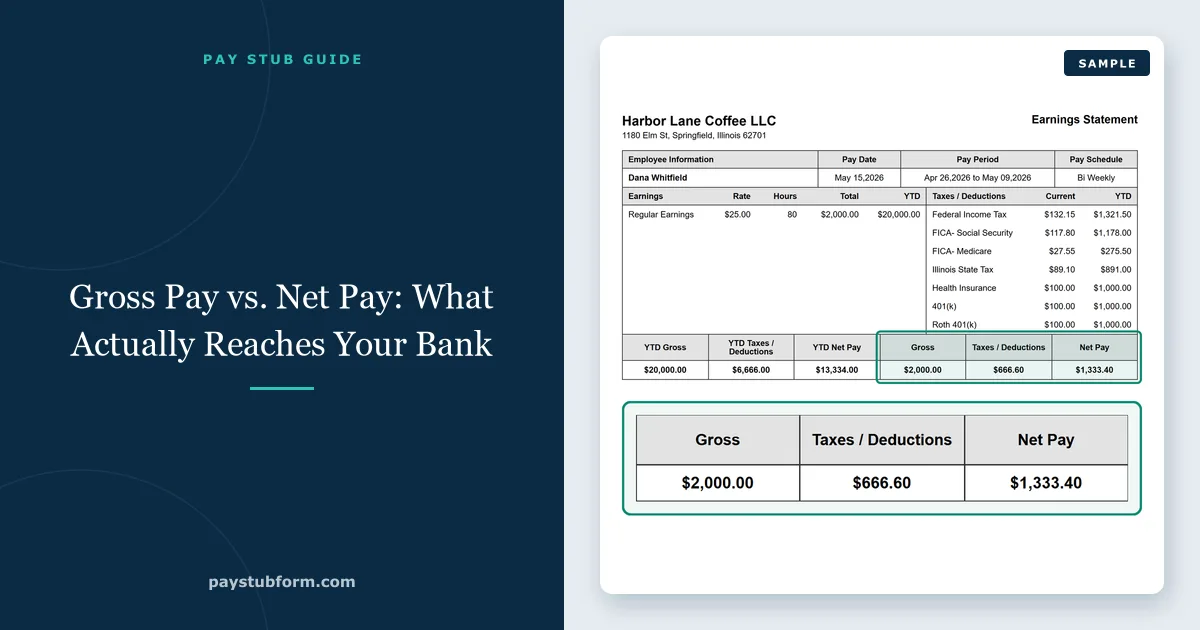
You negotiated a salary. Your bank shows something smaller, every time, and the gap is wider than the tax rate you expected. Gross pay is what you earned. Net pay — "take-home pay" — is what survives the deductions. Between them sit four layers, applied in a specific order, and knowing that order is the difference between reading your pay stub and guessing at it.
The gap is rarely a mystery once the lines are laid out. It is also rarely the same two months running, which is the part that worries people. Here is what each layer is, why the same gross pay can produce a different net, and which of the two figures you should hand over when a landlord or a lender asks.
Quick take: Gross pay is earnings before anything is removed. Net pay is what lands in your account. A third figure — disposable earnings — sits between them and is the one that matters if your wages are ever garnished.
What gross pay actually includes
Gross pay is everything you earned in the pay period, before a single deduction. For an hourly employee that is hours multiplied by rate, plus overtime at the higher rate, plus any shift differential. For a salaried employee it is the annual salary divided by the number of pay periods.
Several things people forget also belong in gross pay:
- Bonuses and commission, which are taxed as supplemental wages and often withheld at a flat rate that makes the check look worse than it is.
- Paid time off and holiday pay, usually broken out as their own earnings lines.
- Imputed income — the taxable value of a benefit you receive rather than cash, such as employer-paid group-term life insurance over $50,000 or personal use of a company car. It raises gross pay and raises your taxes without adding anything to your net.
What is not in gross pay: your employer's share of payroll taxes, its 401(k) match, and its share of your health premium. Those are real money spent on you, but they were never your wages, so they cannot be deducted from them.
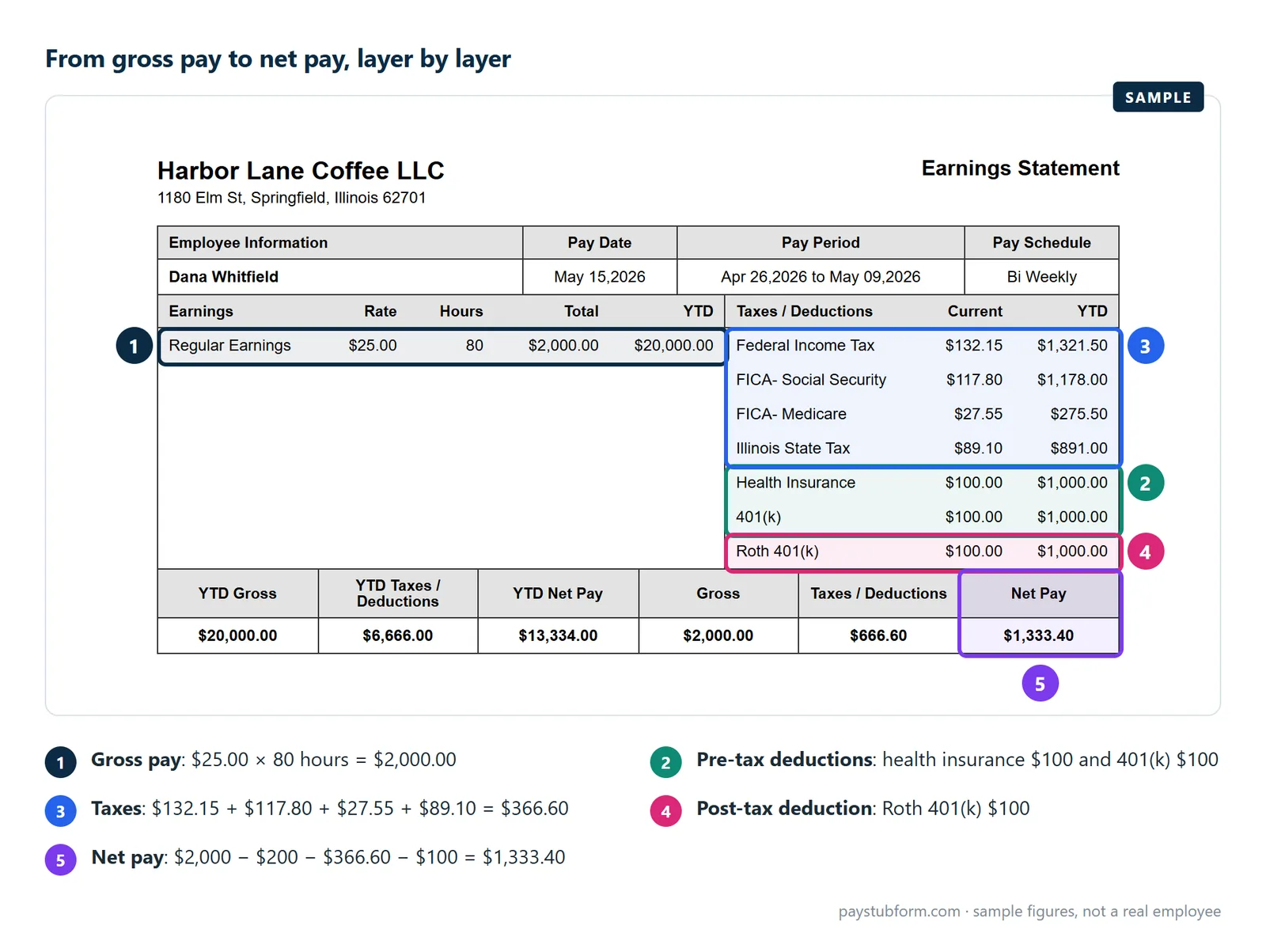
The four layers between gross and net, in order
Order matters, because each layer changes the base the next one is calculated on.
- Pre-tax deductions. Health, dental and vision premiums under a Section 125 plan, HSA and FSA contributions, traditional 401(k) deferrals, commuter benefits. These come out first and reduce the wages that get taxed — though not all of them reduce the same taxes, which is the catch covered below.
- Taxes. Federal income tax withholding, Social Security at 6.2%, Medicare at 1.45%, and state and sometimes local income tax. Our guide to Social Security and Medicare on a 2026 pay stub covers the two FICA lines and the wage base in detail.
- Post-tax deductions. Roth 401(k) contributions, union dues, life insurance above the pre-tax limit, charitable giving through payroll, loan repayments to the employer.
- Garnishments and child support orders. Legally mandated, taken last, and subject to their own federal ceilings.
The same gross, a different net — here is why
This is the question behind most pay stub complaints, and there are usually only a handful of answers.
- Social Security stopped. In 2026 the 6.2% applies only to the first $184,500 of wages. High earners see their net pay jump late in the year and fall again in January. See what OASDI tax is.
- A benefit election changed. Open enrolment, a new dependent, a plan year that restarts mid-calendar-year.
- A bonus pushed you into a higher withholding bracket for one period. Withholding tables annualise each paycheck; one large check can be withheld as though you earn that much every period.
- Three-paycheck month. On a biweekly schedule two months a year have three pay dates, and fixed monthly deductions like health premiums are usually not taken from the third.
- A 401(k) rate change, or hitting the annual deferral limit, which stops the deduction entirely for the rest of the year.
How heavy the tax layer is depends a great deal on where you work. In Texas there is no state income tax line at all, so the only income tax on the stub is federal. In New York there are three extra lines rather than one: state income tax, a Paid Family Leave contribution and a Disability Benefits deduction, with a separate city tax again for New York City residents. Ohio sits in between, with a low flat state rate but municipal and sometimes school district tax withheld on top of it. Two people on identical salaries can take home meaningfully different amounts for no reason other than the state line on their stub.
If none of those explain it, the stub itself usually does — comparing two periods line by line finds it faster than asking payroll cold. Our guide on the pay stub mistakes worth catching early covers what to look for.
Disposable earnings: the figure between gross and net
There is a third number almost nobody knows about until it matters. The Department of Labor defines disposable earnings as the amount of earnings left after legally required deductions — federal, state and local taxes, Social Security, Medicare and state unemployment insurance.
Note what is not in that list. Your health premium, your 401(k), your union dues and your life insurance are voluntary, so they do not reduce disposable earnings. Disposable earnings are therefore almost always higher than your net pay.
That distinction decides how much of your pay a creditor can take. Under the Consumer Credit Protection Act, for an ordinary debt the ceiling is the lesser of 25% of disposable earnings, or the amount by which disposable earnings exceed 30 times the federal minimum wage — $217.50 a week at the current $7.25 federal minimum. Different rules apply elsewhere:
- Child support and alimony: up to 50% of disposable earnings if you support another spouse or child, up to 60% if you do not, plus another 5% when payments are more than twelve weeks in arrears.
- Defaulted federal student loans: up to 15% of disposable earnings.
- Federal or state tax debt: the ordinary 25% ceiling does not apply at all.
If a garnishment on your stub looks larger than 25% of what you take home, that may well be correct — it is a percentage of a bigger number than your net pay.
Which figure do lenders and landlords want?
Almost always gross. Mortgage underwriting, rental affordability rules and most income verification work from gross monthly income, because it is the figure that does not move when you change your 401(k) rate. The common "rent should be a third of income" rule is a third of gross.
Budget on net, though. Gross income never reaches you, and a budget built on it is short by a quarter or more every month. Our guide on building a budget from take-home pay works through that properly.
Tip: When someone asks for proof of income, send stubs showing both gross and year-to-date totals rather than a bank statement. A deposit proves an amount arrived; a pay stub proves who paid it, for what period, and what was withheld.
Why gross pay does not match Box 1 of your W-2
At the end of the year a fourth figure appears and matches neither of the first two. Box 1 of your W-2 is federal taxable wages: gross pay minus the pre-tax deductions that reduce federal income tax.
Box 3 (Social Security wages) and Box 5 (Medicare wages) are different again, because the deductions that reduce them are not the same set. Traditional 401(k) deferrals reduce Box 1 but not Boxes 3 and 5 — you pay Social Security and Medicare on money you deferred. Section 125 health premiums reduce all three. Box 3 also stops at the annual wage base; Box 5 never stops.
Four different figures, all correct, all describing the same salary. The one thing none of them is, is your net pay.
Check your own stub in three minutes
- Add every earnings line. The total should equal the gross pay figure printed on the stub.
- Add every deduction and tax line. Gross minus that total should equal net pay to the cent. If it does not, a line is missing or mislabelled.
- Separate the deductions into pre-tax and post-tax, then check that taxable wages equal gross minus the pre-tax group — remembering that the 401(k) reduces the federal figure but not the FICA ones.
- Compare this stub against the previous one and circle only the lines that changed. That is almost always where the answer is.
State rules add their own lines on top of the federal ones — state income tax where it applies, and in some states disability or paid family leave contributions. Our state-by-state pay stub requirements guide sets out what each state requires an employer to show. If you need an accurate stub of your own with every one of these lines calculated properly, you can create one here.
Quick answers
Is net pay the same as take-home pay?
Yes. Net pay, take-home pay and "the amount deposited" all mean the same figure: gross earnings after every tax and deduction. Your stub may label it net pay while your bank simply shows the deposit.
Can net pay change when gross pay stays the same?
Routinely. A benefit election change, hitting the Social Security wage base, reaching the annual 401(k) limit, a different number of pay periods in the month, or a new tax year's withholding tables will all move net pay while gross stays put.
Are my employer's contributions subtracted from my net pay?
No. The employer's half of Social Security and Medicare, its 401(k) match and its share of your health premium are paid on top of your wages. Some stubs list them for information, which is why they are sometimes mistaken for deductions.
Why is my bonus check so much smaller than I expected?
Supplemental wages like bonuses are often withheld at a flat rate rather than through your usual tables, so the withholding is higher than your actual tax rate. It is withholding, not extra tax — the difference is settled when you file. See why so much tax is withheld from a bonus check.
What are disposable earnings, and why are they higher than my net pay?
Disposable earnings are gross pay minus only the legally required deductions — taxes, Social Security, Medicare and state unemployment insurance. Voluntary deductions like health premiums and retirement contributions are not subtracted, so the figure sits above your net pay. It is the base used to calculate garnishment limits.
Should I give a landlord my gross or net income?
Give gross unless they ask specifically for take-home. Affordability rules are written against gross monthly income, and supplying net makes you look like you earn less than you do.
Sources
- U.S. Department of Labor — Fact Sheet #30, Wage Garnishment Protections of the CCPA: the definition of disposable earnings, the 25% and 30-times-minimum-wage limits, and the child support and student loan ceilings.
- IRS Topic no. 751 — Social Security and Medicare withholding rates: the 6.2% and 1.45% employee rates.
- Social Security Administration — Contribution and Benefit Base: the $184,500 wage base for 2026.
- IRS — 401(k) limit increases to $24,500 for 2026: the annual deferral limit that stops the deduction once reached.
General U.S. information, current for the 2026 tax year. Individual results depend on your pay, your benefit elections and applicable state or local rules.


Comments (0)
Loading comments...
Leave a Comment