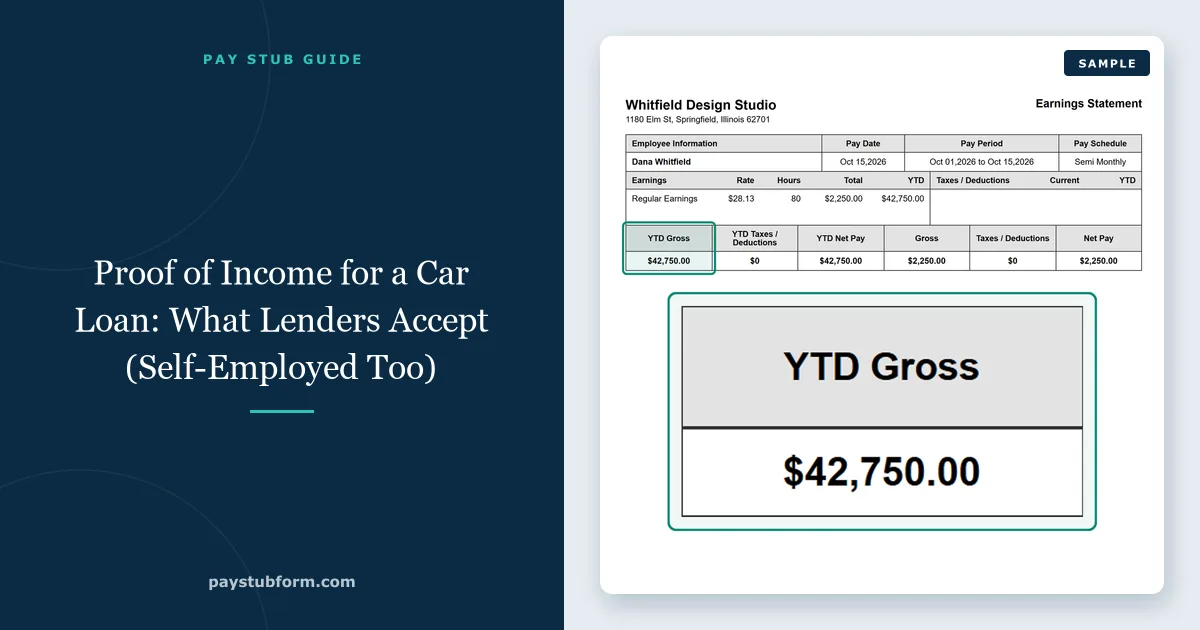
Proof of income for a car loan is the paperwork that shows a lender you earn what you wrote on the credit application. For most employees, that means one or two recent pay stubs that show year-to-date earnings. If you are self-employed, a contractor or a gig driver, it usually means your last two tax returns and a few months of bank statements. Lenders ask for it after they approve the application but before they fund the loan. If you can't provide it, the deal can be cancelled even after you have driven the car home.
This guide covers what lenders accept in each situation, how much income you need for a given payment, how the self-employed figure is worked out, and how lenders check what you send.
Quick take: Lenders look at gross monthly income and usually want the car payment at or below about 15% to 20% of it, with all your monthly debts at or below about 45% to 50%. Employees send their most recent pay stubs, usually covering 30 days, with year-to-date totals. The self-employed send two years of tax returns with Schedule C, and the lender uses net profit after expenses, not what clients paid you. Some lenders also want bank statements or a year-to-date profit and loss statement. Every figure has to match your bank deposits and tax records, because lenders check.
1. What lenders accept as proof of income
| Your situation | What lenders usually ask for | Good to know |
|---|---|---|
| Employee (W-2) | Most recent pay stub or stubs covering the last 30 days, with year-to-date earnings | Stubs should be computer-generated. Handwritten stubs usually need a signed letter from the employer. |
| New job | A signed offer letter with salary and start date, then your first pay stub | Many lenders want you to have started the job, or to start within a few weeks |
| Self-employed or 1099 contractor | Two years of personal tax returns with all schedules, often with bank statements or a year-to-date P&L | The lender uses Schedule C net profit, averaged over the two years |
| Gig driver or courier | Tax returns, plus annual and recent earnings summaries from each app, and bank statements | Mileage and other deductions lower the income the lender counts |
| Cash or tip income | Tax returns that report it, and bank statements that show regular deposits | Income you didn't report on a return is hard to count |
| Retired or on benefits | Social Security benefit letter, pension statement, award letters | Amount and payment schedule must be stated on the letter |
| Other regular income | Court orders for child support or alimony, disability, rental income on Schedule E | Usually counted only if it will continue for the length of the loan |
The dealer's finance office passes these requests on from the lender as "stipulations", or stips. A typical stip list asks for proof of income, proof of residence (a utility bill or bank statement with your address), a driver's license, references and, for some loans, proof of insurance. Ask what is on yours before you visit, so you can bring everything at once. Our general guide to using pay stubs as proof of income covers what you can redact before you hand anything over.
2. How much income you need for the payment
Car lenders look at two ratios, both based on gross monthly income, which is your pay before taxes and deductions.
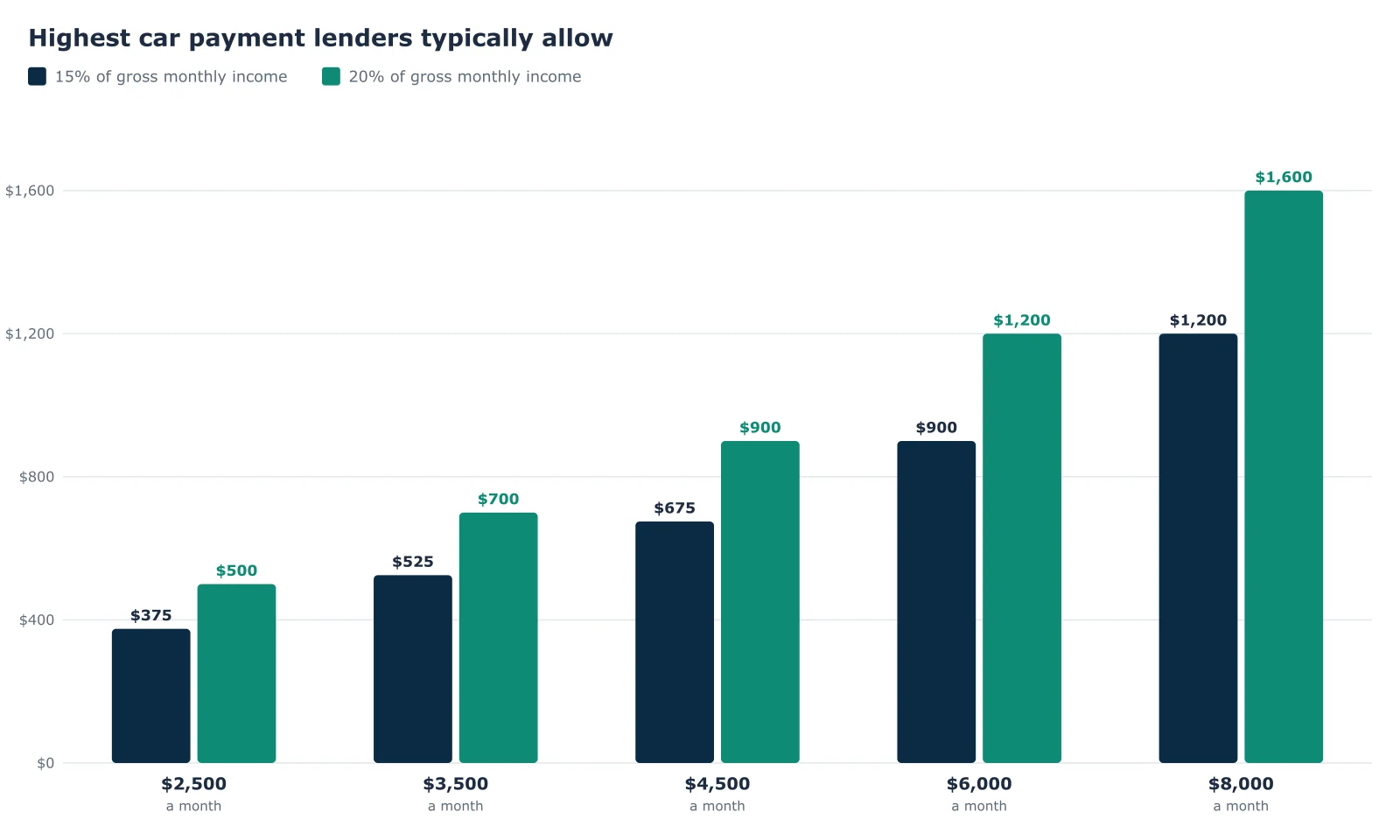
- Payment-to-income (PTI): the new car payment divided by gross monthly income. Many lenders want it at or below 15% to 20%.
- Debt-to-income (DTI): all monthly debt payments, including rent or mortgage, cards, student loans and the new car, divided by gross monthly income. Many lenders cap it at around 45% to 50%.
Lenders also set a minimum income. Capital One, for example, says its pre-qualification needs $1,500 or $1,800 a month, depending on your credit. Here is what the PTI rule allows at different income levels:
| Gross monthly income | Payment at 15% | Payment at 20% | Loan it supports at 15%* |
|---|---|---|---|
| $2,500 | $375 | $500 | about $18,100 |
| $3,500 | $525 | $700 | about $25,400 |
| $4,500 | $675 | $900 | about $32,700 |
| $6,000 | $900 | $1,200 | about $43,500 |
| $8,000 | $1,200 | $1,600 | about $58,100 |
*Over 60 months at 8.81% APR, the average used car rate for prime borrowers in the second quarter of 2026 according to Experian. With weaker credit the rate is higher, so the same payment buys less car. Paid by the hour? Our hourly to salary calculator gives you the monthly gross figure. The paycheck calculator shows your take-home pay, which is what the payment really comes out of.
3. If you are an employee
Bring your most recent pay stubs. Many lenders want stubs that cover the last 30 days, which means two biweekly stubs or four weekly ones. Some accept a single recent stub if it shows year-to-date earnings. The stubs should show your name, the employer, the pay period, gross pay and the year-to-date column. If your pay varies with hours or overtime, the lender usually divides your year-to-date gross by the months worked so far, rather than taking your best check. Our guide to the YTD figures on a pay stub shows that calculation.
Some lenders also call your employer to confirm that you work there, or check through an employment verification service. Use your employer's main number on the application, not a coworker's cell, and let HR know a call may come. If you can't find your stubs, they are usually in your employer's payroll portal, and HR can reissue them.
4. If you are self-employed: the number lenders use
This is where self-employed buyers get caught out. The lender does not use what your clients paid you. It uses net profit from Schedule C, the figure after business expenses, and it usually averages your last two years. A worked example for a freelance designer applying in November 2026:
| 2024 return | 2025 return | |
|---|---|---|
| Gross receipts from clients (1099s and direct payments) | $66,000 | $72,000 |
| Business expenses, including mileage | $18,000 | $18,000 |
| Schedule C net profit | $48,000 | $54,000 |
The two-year average is $51,000, which is $4,250 a month. At a 15% payment-to-income ratio, the lender will allow a payment of about $637. Over 60 months that supports a loan of about $30,800 at 8.81%, or about $27,400 at the near-prime rate of 13.93%. If the lender had used gross receipts, the designer would have qualified for a payment of about $900. It won't.
Three things change the figure:
- Deductions lower your loan income. Every dollar you deduct for tax, including the mileage deduction, reduces the income a lender sees. That is a fair trade on your taxes, but it is worth knowing before a large purchase. Our post on the 2026 IRS mileage rate shows how large that deduction can get for drivers.
- A falling year counts against you. If your latest year is lower than the year before, many lenders use only the lower year, or ask why it fell.
- A rising year may need backup. If 2026 is going much better than your returns show, a year-to-date profit and loss statement and bank statements that support it can help. Not every lender will count income that isn't on a filed return yet.
Self-employed pay stubs can sit alongside the returns as a monthly record of what you pay yourself, as long as the amounts match your bank deposits. Our guide to pay stubs for the self-employed explains how to set them up, and paying taxes when self-employed covers the Schedule C figures behind them.
5. Gig drivers, contractors and cash earners
- Gig drivers and couriers: download the annual tax summary and the last few weekly or monthly earnings statements from each app, and bring the bank statements that show the payouts. Our guide to proof of income for gig workers lists where each app keeps them.
- New contractors with under two years of history: some lenders accept one year of returns plus a contract or a steady year-to-date record, especially if you did the same work as an employee before. Others will need a larger down payment or a co-signer.
- Cash income: it counts when you report it on your tax return and deposit it regularly. Our guide to proving cash income covers what helps when there is no pay stub from an employer.
6. How lenders verify your income
Income is checked far more often than it used to be, because it is the most common problem on auto loan applications. Fraud analytics firm Point Predictive has reported that most auto lending fraud risk now comes from applicants who use their own name and overstate their income. Expect one or more of these checks:
- Document screening software that flags edited PDFs, mismatched fonts and figures that don't add up. One example is Social Security that isn't 6.2% of gross, or a year-to-date total that doesn't match the number of pay periods.
- Bank statement matching: the net pay on your stubs should arrive in your account on the pay dates shown.
- IRS transcripts: some lenders, mostly for self-employed borrowers, ask you to sign IRS Form 4506-C, which lets them pull your return figures straight from the IRS and compare them with the copies you sent.
- Employer calls and payroll verification services, as in section 3.
- Bank or payroll connections that read your deposits with your permission.
Some dealers have also been caught writing a higher income on the application than the buyer gave, so the deal gets approved. Read the finished credit application before you sign it. If the income on it is wrong, ask for it to be corrected. You are the one who signs it, so you are responsible for what it says.
7. "Car loan with no proof of income": your real options
If you have no income you can document, the options are limited, but they are honest ones:
- A larger down payment reduces the loan, and some lenders relax income checks on small loans with a lot of equity.
- A co-signer with documented income shares responsibility for the loan, and their income is what gets the approval.
- Pre-approval from a credit union or your bank before you visit a dealer. They know your deposit history and may count it.
- Buy-here-pay-here dealers lend in-house and often check less, but their rates are much higher and some install payment trackers. Read the contract carefully.
- Wait and document: three to six months of consistent deposits, or filing a return that reports your income, often changes the answer.
What you must not do is make up income. A pay stub with inflated figures, an employer who doesn't exist or a letter you wrote in someone else's name is a false document. Using it to get a loan is fraud, and the lender can call the loan due or repossess the car once it finds out. A stub you make for your own business has to show money you actually paid yourself, matching your deposits and your return.
8. Your five-minute checklist
- Ask the dealer or lender for the stip list before you go.
- Work out 15% of your gross monthly income. That is roughly the most payment a lender will approve.
- Employees: bring stubs covering the last 30 days with year-to-date totals.
- Self-employed: bring two years of returns with Schedule C, three months of bank statements and a year-to-date P&L.
- Get pre-approved by a credit union or bank so you have a rate to compare.
- Check the income on the final credit application before you sign.
Quick answers
How many pay stubs do I need for a car loan?
Usually enough to cover the last 30 days: two if you are paid every two weeks, four if weekly. Some lenders accept one recent stub that shows year-to-date earnings.
Do car dealerships verify income?
The lender does, through the dealer. Many approvals come with a condition that you provide proof of income before the loan is funded, and lenders increasingly check stubs with screening software, bank deposits and employer calls.
Can I get a car loan if I'm self-employed?
Yes. Expect to show two years of tax returns, and the lender will use your average Schedule C net profit, not your gross receipts. Bank statements and a year-to-date profit and loss statement help, especially if your income is rising.
Is car loan income based on gross or net pay?
Gross pay for employees, meaning before taxes and deductions. For the self-employed it is net profit after business expenses, which is the figure on Schedule C.
How much car can I afford on $4,000 a month?
At a 15% payment-to-income ratio, about $600 a month. Over 60 months at about 9% APR, that supports a loan of roughly $29,000, before your down payment and trade-in.
Can I use bank statements instead of pay stubs?
Some lenders accept two to six months of bank statements, mostly from self-employed or gig borrowers, and usually together with tax returns. Employees with a regular paycheck are normally asked for pay stubs.
Sources
- Capital One — Auto Navigator pre-qualification requirements: the $1,500 or $1,800 minimum monthly income, and final financing that depends on the documents the lender requires.
- Experian — Average car payment: Q2 2026 averages of $765 for new and $542 for used, and APRs by credit tier, including 8.81% and 13.93% for used cars.
- CFPB — What is a debt-to-income ratio?: how DTI is calculated from gross monthly income.
- CFPB — Auto loans: shopping for financing, pre-approval and reviewing the contract before you sign.
- IRS — Income Verification Express Service for taxpayers: how lenders use Form 4506-C to request your return transcripts, and how to approve or reject a request in your IRS account.
- IRS — About Schedule C: the profit or loss form whose net profit line lenders use for self-employed income.
General U.S. information, current for November 2026. Ratios, minimum incomes and the documents required vary by lender and credit tier. This is not financial or legal advice.


Comments (0)
Loading comments...
Leave a Comment