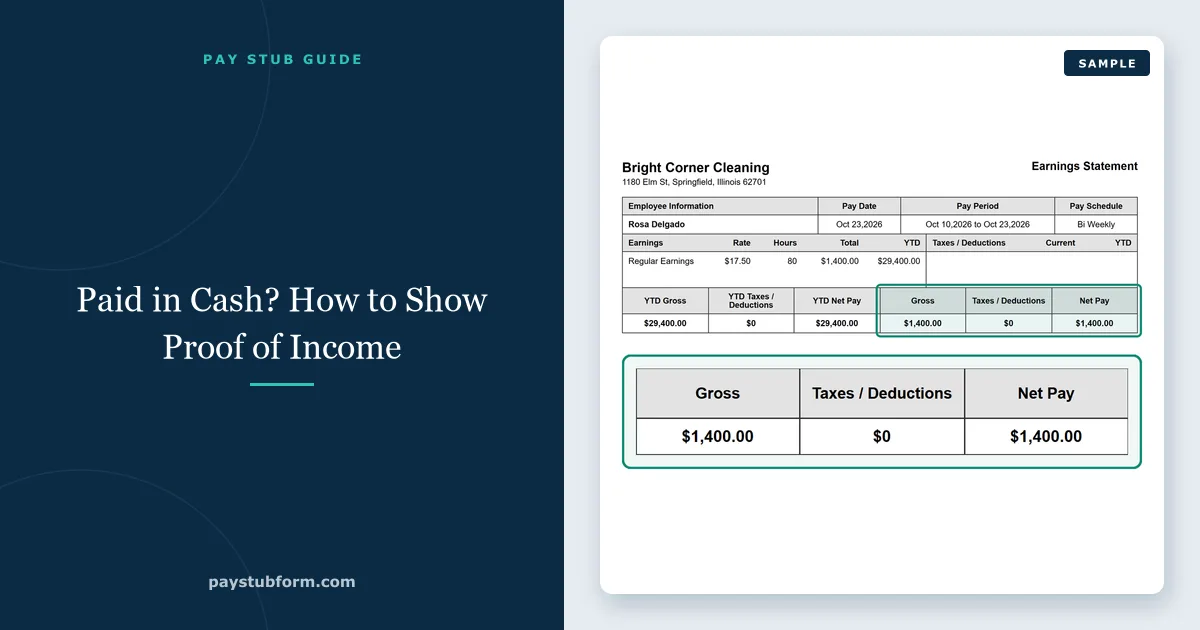
Cash income counts as income, and you can prove it — but not with the cash itself. A landlord, lender or benefits office needs a paper trail: deposits in a bank account, a record of who paid you and when, and a tax return that reports the same money. If you are paid in cash and have none of those yet, you can start building them this week, and two to three months of consistent records is usually enough for a rental or car application.
What you need depends on one question most guides skip: are you an employee whose boss pays in cash, or are you self-employed and paid in cash by customers? The documents are different, and so is who is responsible for producing them.
Quick take: If you are an employee, your employer still owes you a pay statement in most states and a W-2 in January, however the wages are handed over — ask for them. If you are self-employed, deposit your cash on a regular schedule, keep a dated log of every payment, pay yourself a fixed amount, and report the income on Schedule C. A pay stub you prepare is a summary of those records, not a substitute for them.
1. Employee or self-employed? It changes everything
| Employee paid in cash | Self-employed, paid in cash | |
|---|---|---|
| Typical jobs | Restaurant and bar staff, construction crews, farm work, retail, household staff | Cleaners, barbers renting a chair, handymen, landscapers, market sellers, tutors |
| Who sets hours and methods | The employer | You |
| Who should withhold tax | The employer | Nobody — you pay estimated tax yourself |
| Who produces the pay stub | The employer | You, from your own records |
| Year-end form | W-2 | Possibly a 1099-NEC from business clients; nothing from household customers |
| Strongest proof of income | Employer pay stubs, W-2, employer letter | Tax return with Schedule C, bank statements, income log |
The label your boss uses does not decide this. The IRS looks at who controls the work, and its page on employee versus independent contractor lists the tests. Someone who works set shifts under a supervisor is generally an employee, even if every payday is an envelope.
2. If you are an employee paid in cash
Paying wages in cash is legal. What does not change is everything around the payment: the employer must still withhold income tax, Social Security and Medicare, pay its own share, keep records of your hours and pay under the federal recordkeeping rules, and send you a W-2. Most states also require a written or electronic pay statement each payday regardless of how you are paid — our state-by-state guide shows what yours requires.
Example — line cook, $18 an hour, 40 hours: gross pay is $720. An employer running real payroll withholds $44.64 for Social Security and $10.44 for Medicare, plus federal and any state income tax, and the envelope holds what is left. If the envelope holds a flat $720 and no statement comes with it, nothing was withheld and probably nothing was reported.
What to do, in order:
- Ask for pay statements in writing. A short message to the owner or manager creates a record that you asked. Many small employers are paying properly and simply never print the stubs.
- Ask for an employment letter on the business's letterhead stating your start date, job title, hours and gross pay, signed with a phone number a reviewer can call.
- Keep your own log from today: date, hours worked, amount received. Photograph any schedule or timesheet.
- Deposit your pay soon after each payday, so your bank statement shows a regular amount on a regular day.
- If the employer refuses, your state labor department handles pay statement complaints, and Form SS-8 asks the IRS to rule on your status. Form 8919 covers the Social Security and Medicare tax on wages an employer did not withhold from.
Do not write a pay stub in your employer's name yourself. A stub is the employer's statement, and one prepared by the employee shows withholding and a payroll run that the employer never made. An employer letter plus your bank deposits is honest and usually enough.
Tips are a special case
Cash tips of $20 or more in a month must be reported to your employer by the 10th of the following month, according to IRS Topic 761. Reported tips then appear on your pay stub and your W-2, which is exactly what makes them usable as proof of income. There is a second reason to report: the federal deduction for qualified tips, up to $25,000 a year for tax years 2025 through 2028, applies only to tips that were reported. Tips you kept off the books count for neither purpose.
3. If you are self-employed and paid in cash
Here the paper trail is yours to build, and it has four parts.
- Deposit on a schedule. Put your takings into a bank account on the same day each week. A statement showing 12 weekly deposits is evidence; a shoebox of notes is not.
- Log every payment. Date, customer, what the work was, amount. A receipt book with carbon copies, a spreadsheet or an invoicing app all work. For larger jobs, ask the customer to sign the receipt.
- Pay yourself a fixed amount. Move a set sum from the account you use for work to your personal account on fixed dates. That transfer is your owner's draw, and it is what a self-employed pay stub records. Our guide to self-employed pay stubs explains the draw in detail.
- Report it. Cash income goes on Schedule C like any other business income, and self-employment tax applies once net earnings reach $400. The tax return is the document lenders trust most, because it is the one you signed for the IRS.
A worked example: one month for a house cleaner
| Week ending | Collected in cash (from log) | Deposited Friday | Draw to personal account |
|---|---|---|---|
| Oct 2 | $850 | $850 | $700 |
| Oct 9 | $920 | $920 | $700 |
| Oct 16 | $780 | $780 | $700 |
| Oct 23 | $900 | $900 | $700 |
| Month | $3,450 | $3,450 | $2,800 |
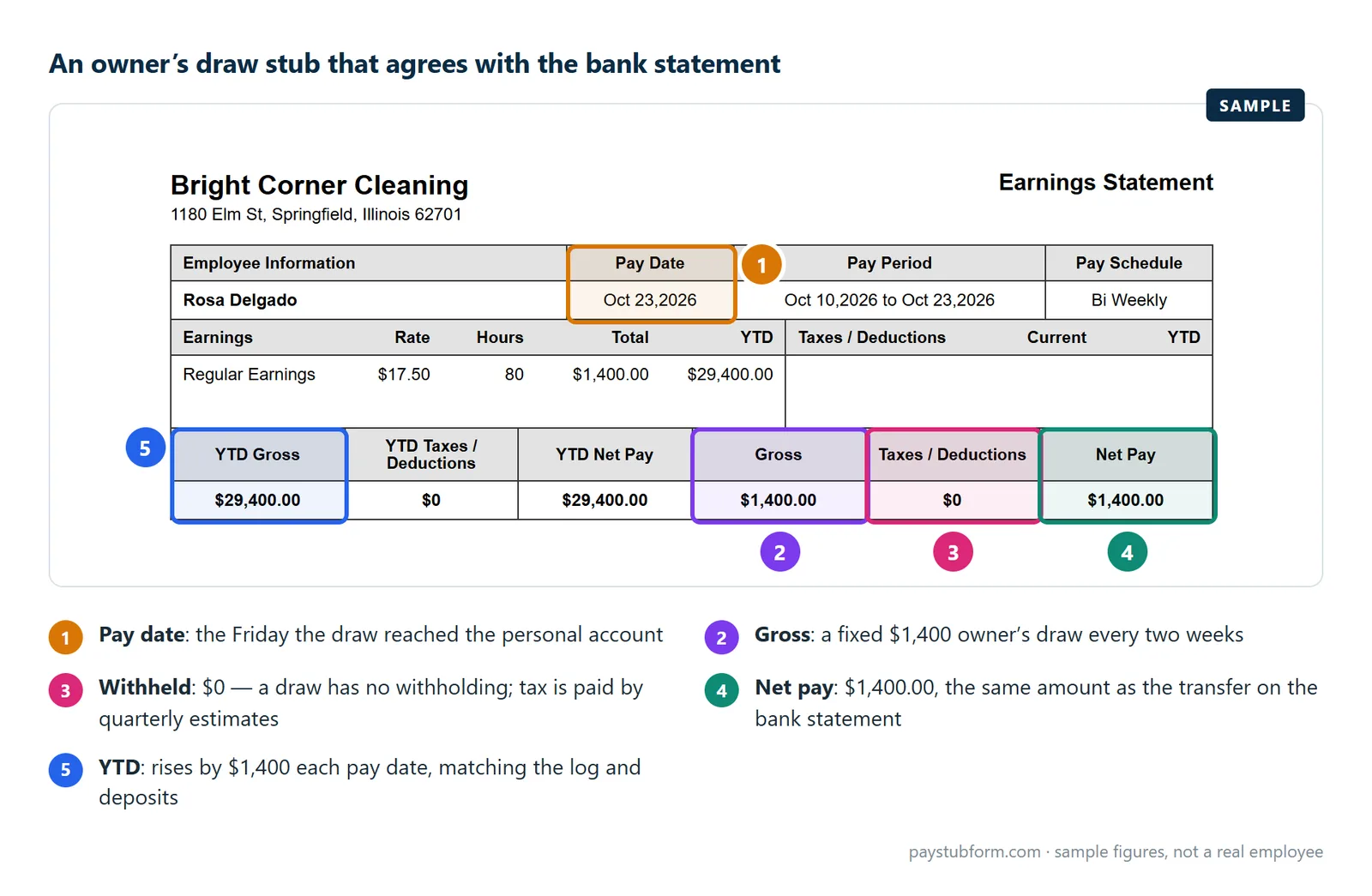
Three documents now agree with each other. The log shows $3,450 earned, the bank statement shows $3,450 deposited on four Fridays, and a biweekly pay stub shows an owner's draw of $1,400 with no withholding and a year-to-date total that rises by $1,400 each time. The $650 left in the account covers supplies and the next estimated tax payment. A reviewer who checks any one of the three against the others finds the same numbers — which is the whole test. Our annotated pay stub example shows how each line of a stub reads.
4. Depositing cash: the $10,000 rule people get wrong
Banks file a Currency Transaction Report for cash transactions over $10,000 in a day. That report is routine and is not an accusation. What is illegal is splitting deposits into smaller amounts to stay under the threshold — called structuring — and it is a federal offence even when the money was earned legally, as FinCEN's notice to customers explains. Deposit what you earned when you earned it and let the bank file whatever it files.
The mirror rule applies to you as a business: if one customer pays you more than $10,000 in cash, in one payment or related payments, you file Form 8300 within 15 days.
5. What to send, by who is asking
Renting? Proof of income for an apartment explains the 3x rent rule landlords apply. Earning through Uber, DoorDash or Instacart as well? See gig worker proof of income.
| Who is asking | What usually works for cash income |
|---|---|
| Landlord | Two to three months of bank statements with regular deposits, plus an employer letter or your pay stubs and income log; last year's tax return if you have one |
| Auto lender | Bank statements and pay stubs or an employer letter; some ask for a tax return when income is self-employed |
| Mortgage lender | Tax returns, usually two years, and IRS transcripts. Cash income that was not reported will not be counted |
| Benefits agency | Each program has its own form — often an employer statement or a self-employment ledger. Ask the caseworker which they accept |
Ask before you send anything. "Which documents do you accept for cash or self-employed income?" saves an application fee. Our guide to pay stubs as proof of income covers what reviewers check and what to redact, and free copies of your past returns are available through IRS Get Transcript.
6. The line you must not cross
Recording income you really earned is legitimate. Writing down income you did not earn, naming an employer who did not pay you, or showing tax withheld that nobody withheld is a false document, and using it to get a lease or a loan can be fraud. It also tends to fail, because the next thing a reviewer asks for is the bank statement. If your records do not yet show enough income, the answer is more weeks of deposits, not a better-looking stub. Our editorial standards set out how we approach this.
The five-minute version
- Work out whether you are an employee or self-employed — control over the work decides, not the payment method.
- Employee: ask the employer in writing for pay statements and an employment letter.
- Self-employed: log every payment and deposit your takings on the same day each week.
- Pay yourself a fixed draw on fixed dates and make one stub per draw, with no withholding shown.
- Never split deposits to stay under $10,000.
- Report the income on your tax return; next year it becomes your strongest proof.
If you are self-employed and your records are in order, you can turn them into stubs in our pay stub generator — the first one is free.
Quick answers
Is it legal to be paid in cash?
Yes. Cash is a lawful way to pay wages or a contractor. It becomes a problem only when the employer skips withholding and reporting, or when the person paid leaves the income off their tax return.
Can I make my own pay stub if I'm paid in cash?
If you are self-employed, yes — it records the draw you paid yourself and must match your deposits. If you are an employee, no: the stub has to come from your employer. Use an employer letter and bank statements instead. See how to make a pay stub for the steps.
My employer pays cash and gives no pay stub. What can I do?
Ask in writing first. If that fails, your state labor department takes pay statement complaints in states that require one, and IRS Form SS-8 and Form 8919 deal with wages that had no tax withheld.
Will a landlord accept bank statements for cash income?
Many will, when the statements show regular deposits over two to three months and something explains where they came from — an employer letter, an income log or pay stubs.
I never deposited my cash. How do I prove past income?
A filed tax return reporting it is the best evidence, followed by signed receipts or letters from the people who paid you. For anything recent, start depositing now; a few months of records is often enough for a rental.
Do I pay tax on cash income nobody reported?
Yes. Income is taxable whether or not a W-2 or 1099 was issued. Reporting it is also what makes it count toward a loan, Social Security credits and unemployment eligibility. Our guide on how to pay taxes when you're self-employed covers the quarterly payments.
Sources
- IRS — Independent contractor (self-employed) or employee?: the control tests that decide a worker's status.
- U.S. Department of Labor — Fact Sheet #21, Recordkeeping Requirements under the FLSA: the hours and pay records every covered employer must keep.
- IRS Topic no. 761 — Tips: withholding and reporting: the $20 monthly threshold and the 10th-of-the-month deadline.
- IRS — Tax deductions for working Americans and seniors: the qualified tips deduction, its $25,000 cap and the reporting condition.
- IRS — About Form 8919 and About Form SS-8: uncollected Social Security and Medicare tax on wages, and requesting a status determination.
- IRS — Self-employment tax: the $400 threshold for self-employed earners.
- FinCEN — Notice to customers: a CTR reference guide: the $10,000 cash report and why structuring deposits is illegal.
- IRS — Form 8300 and reporting cash payments of over $10,000: the rule for businesses that receive large cash payments.
General U.S. information, current for 2026. This is not legal, tax or lending advice; pay statement rules vary by state and document requirements vary by landlord, lender and agency.


Comments (0)
Loading comments...
Leave a Comment