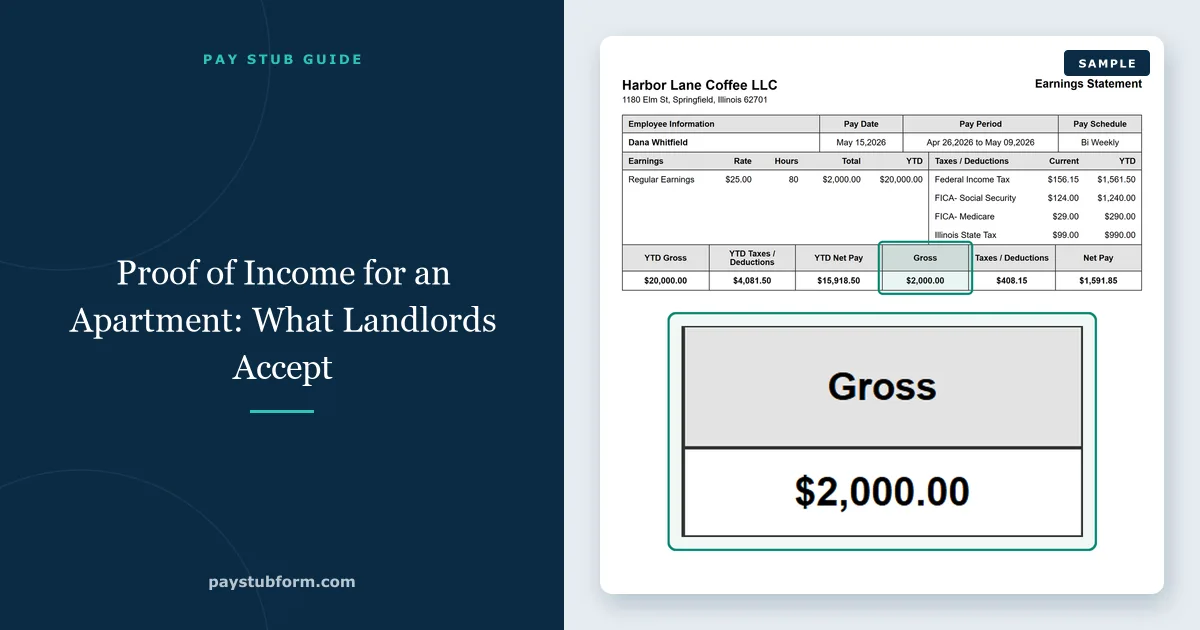
Proof of income for an apartment is any document that shows a landlord you earn enough to pay the rent — most often your two or three most recent pay stubs, an offer letter if you are starting a new job, or bank statements and a tax return if you are self-employed. Most landlords want gross monthly income of about three times the rent, so a $1,500 apartment usually needs $4,500 a month before tax.
This guide covers what landlords accept in each situation, how the income rule is calculated, how landlords check what you send, and what to do if your income falls short.
Quick take: Ask the landlord or property manager for their income requirement and their list of accepted documents before you pay an application fee. Employees send recent pay stubs; new hires send a signed offer letter; the self-employed send tax returns, bank statements and a profit and loss statement; retirees send a benefit letter. If you are below the requirement, a co-signer or guarantor, a roommate or documented savings can close the gap. Every document must be real — landlords verify.
1. What counts as proof of income for an apartment
| Document | What it shows the landlord | Good to know |
|---|---|---|
| Recent pay stubs | Current gross pay, pay frequency, employer and year-to-date earnings | The most requested document. Usually the last two or three, or the last month's worth |
| Offer letter | A new job's salary and start date | On the employer's letterhead and signed; see section 4 |
| Employment verification letter | That you work there, since when, and at what pay | Written by your employer or HR, with a contact the landlord can call |
| Bank statements | Regular deposits and savings | Two to three months; often required alongside other documents rather than alone |
| W-2, 1099 or tax return | Last year's total income | The main proof for the self-employed; less useful if your pay has changed since |
| Social Security or pension letter | Monthly benefit amount | Social Security's benefit verification letter can be downloaded from a my Social Security account |
| Other regular income | Child support or alimony orders, disability, unemployment, financial aid, housing vouchers | Bring the award letter or court order that states the amount and schedule |
Landlords usually count every reliable source together, so list all of them. Our general guide to using pay stubs as proof of income covers what to redact before you send anything.
2. The 3x rent rule, worked out
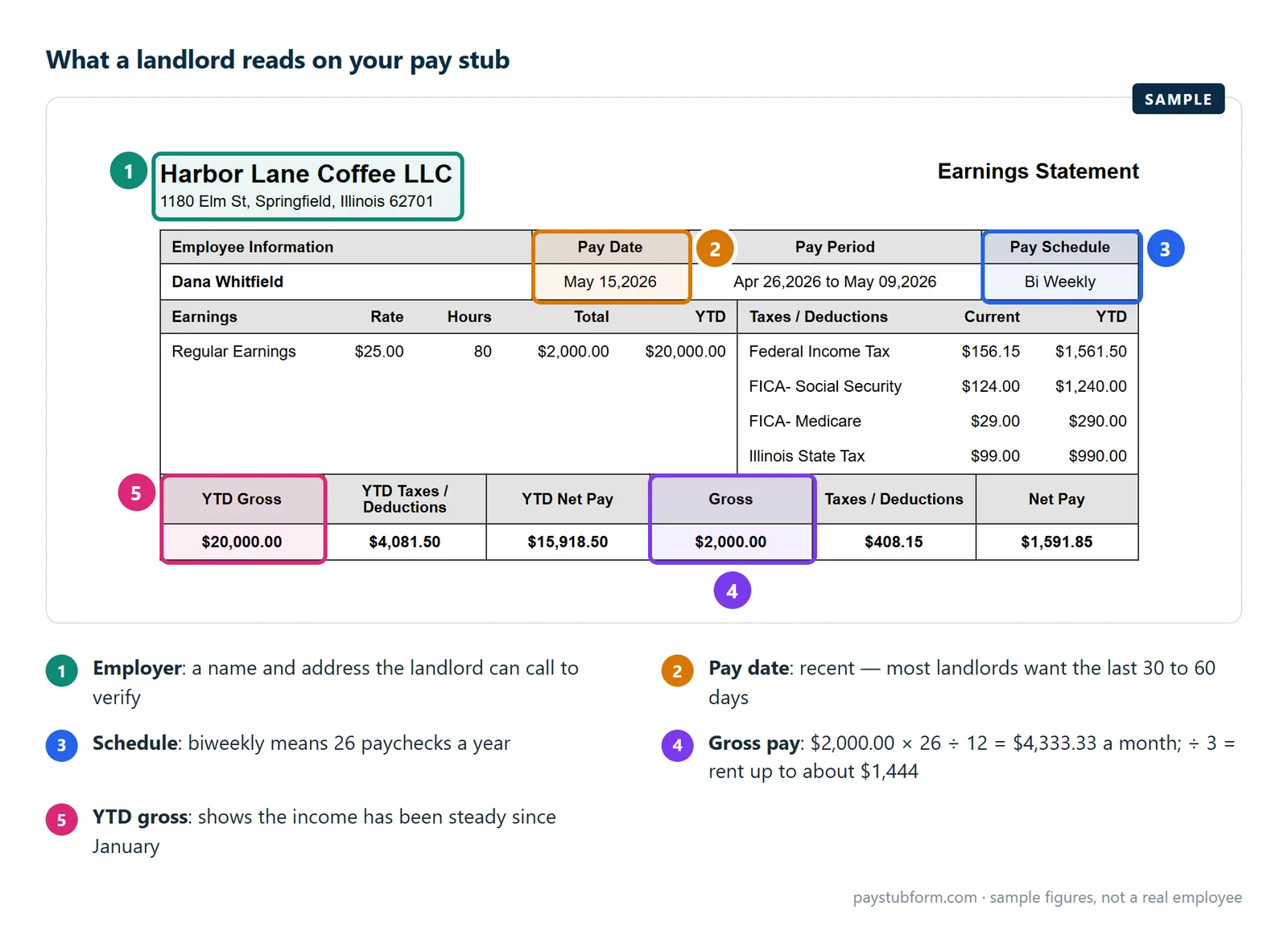
The most common requirement is gross monthly income of at least three times the monthly rent. Gross means before taxes and deductions — the top line of your pay stub, not the amount that reaches your bank. Expressed the other way round, rent should be no more than about 33% of gross income, which is the rent-to-income ratio a landlord is checking. Some landlords use 2.5 times; in some high-cost markets, New York City among them, the same idea is written as an annual income of 40 times the monthly rent.
| Monthly rent | Gross monthly income at 3x | Annual income | Hourly, full time (2,080 hours) |
|---|---|---|---|
| $1,000 | $3,000 | $36,000 | $17.31 |
| $1,250 | $3,750 | $45,000 | $21.63 |
| $1,500 | $4,500 | $54,000 | $25.96 |
| $1,750 | $5,250 | $63,000 | $30.29 |
| $2,000 | $6,000 | $72,000 | $34.62 |
| $2,500 | $7,500 | $90,000 | $43.27 |
To check your own number, divide your gross monthly income by three — that is the highest rent most landlords will approve. Paid by the hour? Our hourly to salary calculator converts your rate, and the paycheck calculator shows what you would take home, which is what your budget actually runs on.
Roommates: policies differ. Some landlords add everyone's income together; others want each tenant to qualify for their share, or one person to qualify for the whole rent. Ask before you apply together.
3. If you are an employee
Send your most recent pay stubs — two or three if you are paid every two weeks, four if weekly. They should be consecutive and show the year-to-date column, because a reviewer uses it to confirm your pay has been steady since January. If your pay varies with hours or overtime, the YTD total divided by the months so far is the figure many landlords use. Our guide to the YTD figures on a pay stub explains how to read it.
No stubs to hand? Most employers post them in a payroll portal, and HR can reissue them. If your employer pays in cash and gives no statement, our guide to proving cash income covers what to ask for instead.
4. If you are starting a new job: the offer letter
Landlords commonly accept a signed offer letter in place of pay stubs when the job starts soon — many want the start date within 30 to 60 days of the lease. To be accepted, the letter should be:
- On the employer's letterhead, signed by someone in HR or the hiring manager.
- Specific: your name, job title, start date, and salary or hourly rate with expected hours.
- Clear that the offer is accepted or final — not "pending background check," if you can avoid it.
- Accompanied by a contact name and phone number the landlord can call.
Once you have your first paycheck, send that stub as well. If you are moving for the job with no income yet, bank statements showing savings help cover the first months.
5. If you are self-employed, a contractor or a gig worker
Landlords know there is no employer behind your income, so they look for consistency across documents: last year's tax return with Schedule C or your 1099 forms, two to three months of bank statements, and a year-to-date profit and loss statement. Gig drivers and couriers can add the earnings statements from each app — our guide to gig worker proof of income shows where to find them in Uber, Lyft, DoorDash and Instacart. Pay stubs you make for your own owner's draws help only when they match the bank deposits exactly. Our guide to proof of income when you're self-employed walks through the full package, including a proof of income letter.
6. Retirees, students and people between jobs
- Retirees: a Social Security benefit verification letter, pension statements and, if you draw on savings, account statements showing the balance.
- Students: financial aid award letters, part-time pay stubs, and usually a guarantor.
- Between jobs: an unemployment benefits letter, bank statements showing savings, and an offer letter as soon as you have one. Some landlords accept proof of savings that covers a year's rent, or a larger upfront payment where state law allows it.
- Housing voucher holders: many states and cities prohibit landlords from refusing tenants because their rent is paid with a voucher or other assistance. These source of income protections vary by state and jurisdiction, so check yours.
7. How landlords verify income
Expect at least one of these checks, which is why every document you send must be genuine:
- A call or email to your employer, using the contact on your offer letter or the company's public number, or a lookup through an employment verification service.
- Bank statement matching: the deposits should equal the net pay on your stubs, on the pay dates shown.
- Income verification tools that connect to your bank or payroll account with your permission.
- Document screening software that flags edited PDFs, inconsistent fonts and figures that do not add up — for example Social Security that is not 6.2% of gross.
- A tenant screening report with your rental and credit history. Under the Fair Credit Reporting Act, if a landlord turns you down because of one, you are entitled to know which company supplied it and to get a free copy — the FTC's guide to tenant background checks explains how to dispute errors.
8. If your income is below the requirement
- A co-signer signs the lease with you and is equally responsible for the rent. Usually a family member with good credit.
- A guarantor does not live there but promises to pay if you don't. Landlords usually want a guarantor's income to be well above the tenant requirement. Paid guarantor companies exist for people without a qualifying family member; read their fees and terms carefully.
- Documented savings or a larger deposit, where the landlord accepts it and your state's deposit limits allow.
- A roommate or a cheaper unit — often the simplest way to meet the rule.
- Count everything: overtime, regular bonuses, a side business and benefits all count if you can document them.
9. The line you must not cross
Every document in an application has to describe income you really receive. A pay stub with inflated figures, an employer who does not exist or a letter you wrote in someone else's name is a false document, and using it to get a lease can be fraud — with the added risk of eviction once it is found, and screening software is built to find it. If you are self-employed, a stub you make for your own real draws is legitimate; if you are an employee, your stubs must come from your employer. Our editorial standards explain how we approach this.
The five-minute version
- Ask the landlord for the income requirement and the documents they accept.
- Divide your gross monthly income by three to see what rent you qualify for.
- Employees: send two or three recent consecutive pay stubs.
- New job: send a signed offer letter with salary and start date.
- Self-employed: tax return, bank statements and a year-to-date P&L.
- Short of the rule: add a co-signer, guarantor, roommate or savings.
Quick answers
How many pay stubs do I need for an apartment?
Usually the two or three most recent, consecutive stubs, or a full month's worth if you are paid weekly. Some landlords ask for up to three months.
Is the 3x rent rule based on gross or net income?
Gross — your pay before taxes and deductions. Your take-home pay will be noticeably lower, so check that the rent also fits your budget.
Can I use an offer letter as proof of income for an apartment?
Often, yes, if it is signed, on the employer's letterhead, states your salary and start date, and the job starts soon. Send your first pay stub once you have it.
What counts as proof of income if I'm self-employed?
Your latest tax return with Schedule C or your 1099s, two to three months of bank statements, and a year-to-date profit and loss statement. Pay stubs for your owner's draws can support them if they match your deposits.
Can a landlord call my employer?
Yes. Verifying employment is a routine part of screening, and many applications ask for permission to contact your employer. Give HR a heads-up so the call is answered.
What is a good rent-to-income ratio?
Most landlords want rent at or below about 33% of gross monthly income, which is the 3x rule. Some accept up to 40% with strong credit or savings.
Sources
- Social Security Administration — Get a benefit verification letter: how retirees and other beneficiaries get proof of income online, by phone or by mail.
- HUD — Source of income protections: state and local laws on refusing tenants who use vouchers or other assistance.
- FTC — Tenant background checks and your rights: adverse action notices, free copies and disputing errors.
- IRS — Get Transcript: free copies of past tax returns for applicants who need them.
General U.S. information, current for 2026. This is not legal advice; income requirements, accepted documents and deposit limits vary by landlord, city and state.


Comments (0)
Loading comments...
Leave a Comment