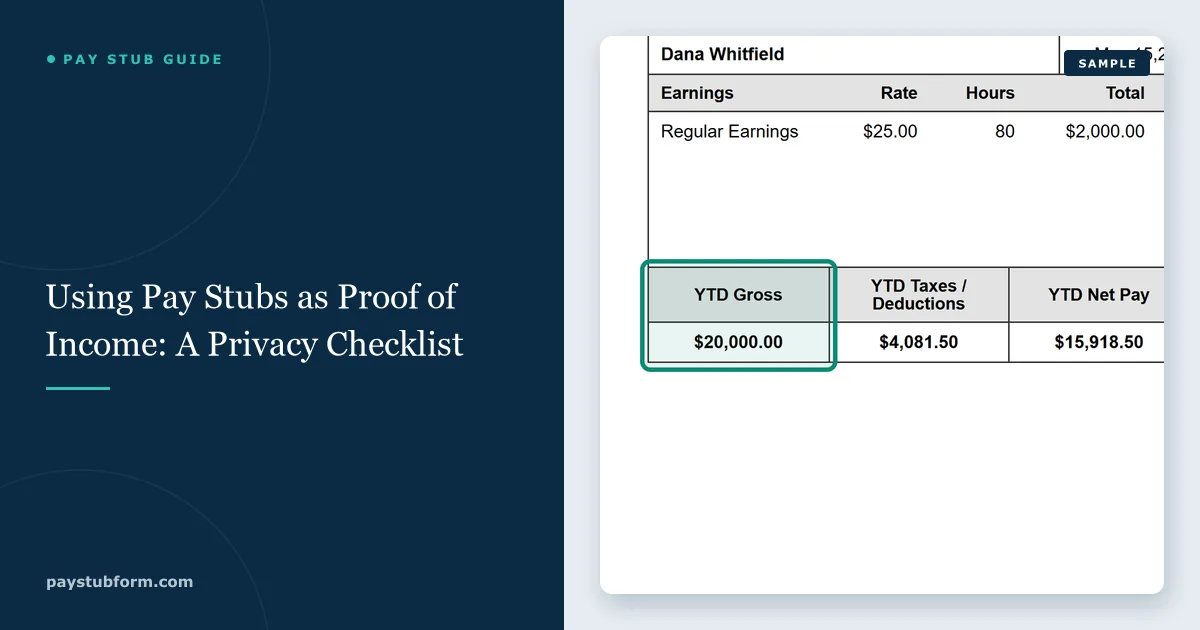
A landlord asks for "the last two pay stubs" and most people send exactly that — whole documents, unredacted, by email, to someone they met once. A pay stub is a convenient proof of income precisely because it carries so much: your name, your address, your employer, your rate of pay, your deductions, often part of your Social Security number, and sometimes a garnishment order you would rather not discuss.
You can satisfy the request and hand over a good deal less than that. Here is what the person asking actually needs, what they do not, and what to take off before you send anything.
Quick take: Send the fewest stubs that show a pattern, lead with gross and year-to-date rather than net, and redact anything that is not about income — your full Social Security number above all.
For a specific situation, see our guides to proof of income for an apartment, proof of income for a car loan, proof of income when you are paid in cash, proof of income for gig workers and pay stubs when you are self-employed.
What they are actually verifying
Three things, in this order: that the income exists, that it is stable, and that it comes from where you say it does.
That is why a single stub rarely satisfies anyone and why the year-to-date column matters more than the current period. One stub proves a week. A YTD figure proves a pattern, which is the thing being assessed. If your income is uneven — overtime, commission, shift differentials — lead with the year-to-date totals and let the current period support them rather than the other way round.
Almost everyone works from gross income, not net. Rental affordability rules and mortgage underwriting are written against gross monthly income because it does not move when you change your 401(k) rate. Sending net makes you look like you earn a quarter less than you do. Our guide on gross versus net pay covers the gap.
What to redact before you send
None of the following is relevant to whether you can afford the rent.
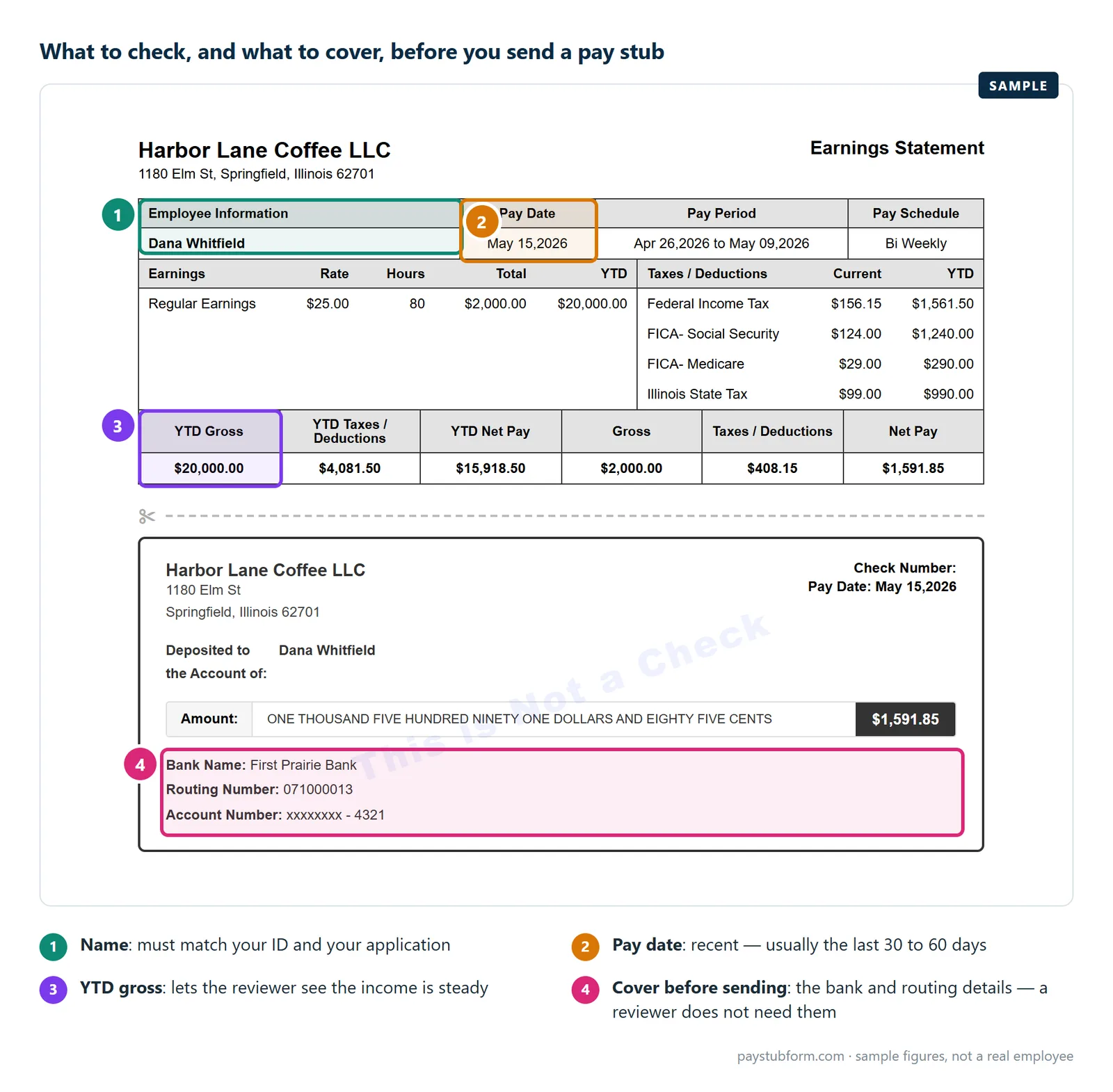
- Your Social Security number. The most important one. Some states already limit what may be printed — California, for instance, requires an itemised wage statement to show only the last four digits of the SSN, or an employee ID number instead. If your stub shows more than four digits, cover the rest.
- Your bank account and routing numbers, where the stub shows direct deposit detail.
- Your home address, if the recipient already has it or does not need it.
- Dependant and beneficiary names appearing in benefit lines.
- Medical and benefit detail — which health plan you chose, whether you contribute to an HSA, union membership, charitable giving. These say things about you that have nothing to do with income.
- Garnishments and child support orders. They reduce net pay, which is one more reason to present gross.
What to leave visible: your name, your employer's name, the pay period dates, gross pay for the period, year-to-date gross, and the pay rate. That set answers every legitimate question.
Tip: Redact by covering, not by cropping. A cropped stub looks like something was removed to hide a number; a stub with a black box over the SSN and the benefit lines reads as ordinary caution, and nobody questions it.
How many stubs, and which ones
Two to three consecutive recent stubs is the usual ask and is usually enough. Renting? Our guide to proof of income for an apartment covers the 3x rent rule and what landlords accept when you have no stubs. A few practical points:
- Send recent ones, not the oldest you can find. The YTD column grows through the year, so a November stub makes a stronger case than a February one.
- Send consecutive periods. Gaps invite the question of what was in the missing one.
- If a period was unusual — a bonus, unpaid leave, a short week — include the period either side of it so the pattern is visible rather than the anomaly.
When a pay stub is not the right document
A stub proves current income. Several situations call for something else, or something more.
You are self-employed or paid on a 1099. There is no pay stub, because nobody withheld anything. The substitute is two years of tax returns including Schedule C, your 1099-NEC forms, business bank statements and a year-to-date profit-and-loss summary. Lead with the tax return — see what a contractor provides instead. If you pay yourself on a regular schedule, self-prepared stubs that match those deposits can support the package; see pay stubs for the self-employed.
You just started a job. An offer letter stating salary and start date does the work a stub cannot yet do, ideally with the first stub once it exists.
The request is for a whole year. That is a W-2 question, not a pay stub question. Be aware the figures will not match your stub's gross — Boxes 1, 3 and 5 are tax bases rather than gross pay, so expect to explain the difference.
You have more than one job. Send stubs from each, and say which is which. A reviewer adding two unlabelled stubs from different employers may assume a duplicate.
Why a bank statement is weaker
People often offer a bank statement instead, reasoning that the deposit proves the money arrived. It does — and nothing else. It does not show who paid it, what period it covered, what was withheld, or whether it was wages at all.
A pay stub answers all four, which is why it is asked for by name. It also exposes far more, which is why redacting it properly matters. If the deposit and the stub disagree, there are ordinary reasons for that — a split deposit being the most common — and it is worth knowing which applies before someone asks.
Before you send
- Decide gross or net — it is almost always gross. Make the gross and YTD figures the ones the eye lands on.
- Pick two or three consecutive recent periods.
- Redact the SSN beyond the last four digits, bank details, and every benefit, union and garnishment line.
- Export as a flattened PDF rather than a screenshot, so the redaction cannot be undone and the document still looks official.
- Send through the application portal where one exists, rather than email. If it must be email, say in the message which periods you have sent and why anything is covered.
- Keep your own unredacted copies. You will need them for your W-2 check in January.
What a stub has to show in the first place is set by your state — New York specifies eleven items, while North Carolina requires only an itemised statement of deductions. Our state-by-state guide covers the rest, and you can create an accurate pay stub here if you need a clean record of a period.
Quick answers
Should I send gross or net income?
Gross, unless they specifically ask for take-home. Affordability rules are written against gross monthly income, and sending net understates what you earn.
How many pay stubs do I need?
Two to three consecutive recent ones is the common requirement. Recent matters, because the year-to-date figure is stronger later in the year.
Can I black out my Social Security number?
Yes, and you should. Nobody verifying income needs it. Some states already limit stubs to the last four digits — California requires only those, or an employee ID number instead.
Is a bank statement enough instead?
Usually not. It proves an amount arrived but not who paid it, for what period, or what was withheld. A stub answers all of those, which is why it is the document named.
What if I'm self-employed?
There is no stub to send. Use two years of tax returns with Schedule C, your 1099-NEC forms, business bank statements and a year-to-date profit-and-loss summary, leading with the returns.
My stub shows a garnishment. Do I have to disclose it?
Not as part of proving income. A garnishment reduces net pay, and you are presenting gross — covering that line is reasonable redaction, not concealment of income.
Sources
- U.S. Department of Labor — Fact Sheet #30, Wage Garnishment Protections of the CCPA: disposable earnings and why a garnishment line reflects a figure other than net pay.
- IRS — General Instructions for Forms W-2 and W-3 (2026): why the W-2 boxes report tax bases rather than gross pay.
- IRS Topic no. 554 — Self-employment tax: the position of a worker with no pay stub to produce.
- IRS — Instructions for Forms 1099-MISC and 1099-NEC: the forms a contractor receives in place of a wage statement.
General U.S. information, current for 2026. What a particular landlord, lender or agency requires is set by them; this covers what the documents can and cannot show.


Comments (0)
Loading comments...
Leave a Comment