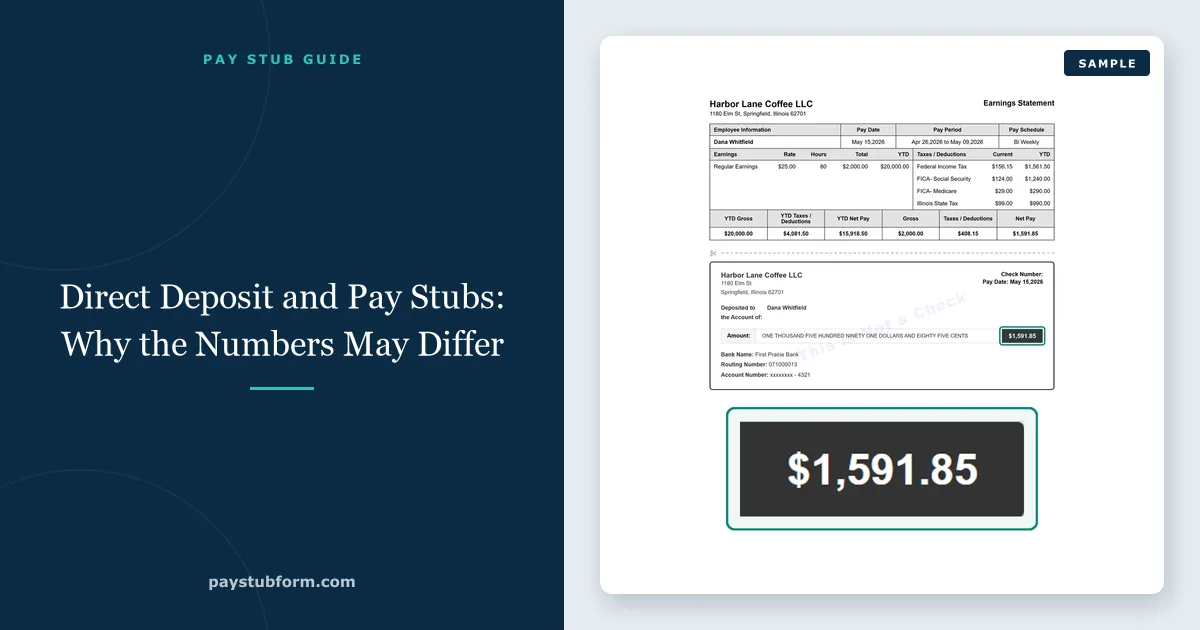
The stub says $2,143.67. The bank says $1,893.67. Neither figure is wrong, and the $250 is not missing — but nothing on the deposit notification explains where it went, and that is the whole problem with direct deposit: it tells you an amount arrived, never what happened to the rest.
Most of the gaps have the same handful of causes, and all of them can be identified from the stub itself. Here is how to reconcile the two figures, and what your employer can and cannot require about how you are paid.
Quick take: Net pay on the stub should equal the deposit to the cent. When it does not, the usual causes are a split deposit, a garnishment, a mid-cycle account change, or a pay card with fees — in that order of likelihood.
Reconcile the two figures first
Before assuming an error, confirm you are comparing the right things. Compare net pay for that pay period against the deposit for that pay date — not against the balance, and not against a deposit from a different week. On a biweekly schedule two deposits can land in the same calendar month as a third from the previous period, and it is easy to line the wrong pair up.
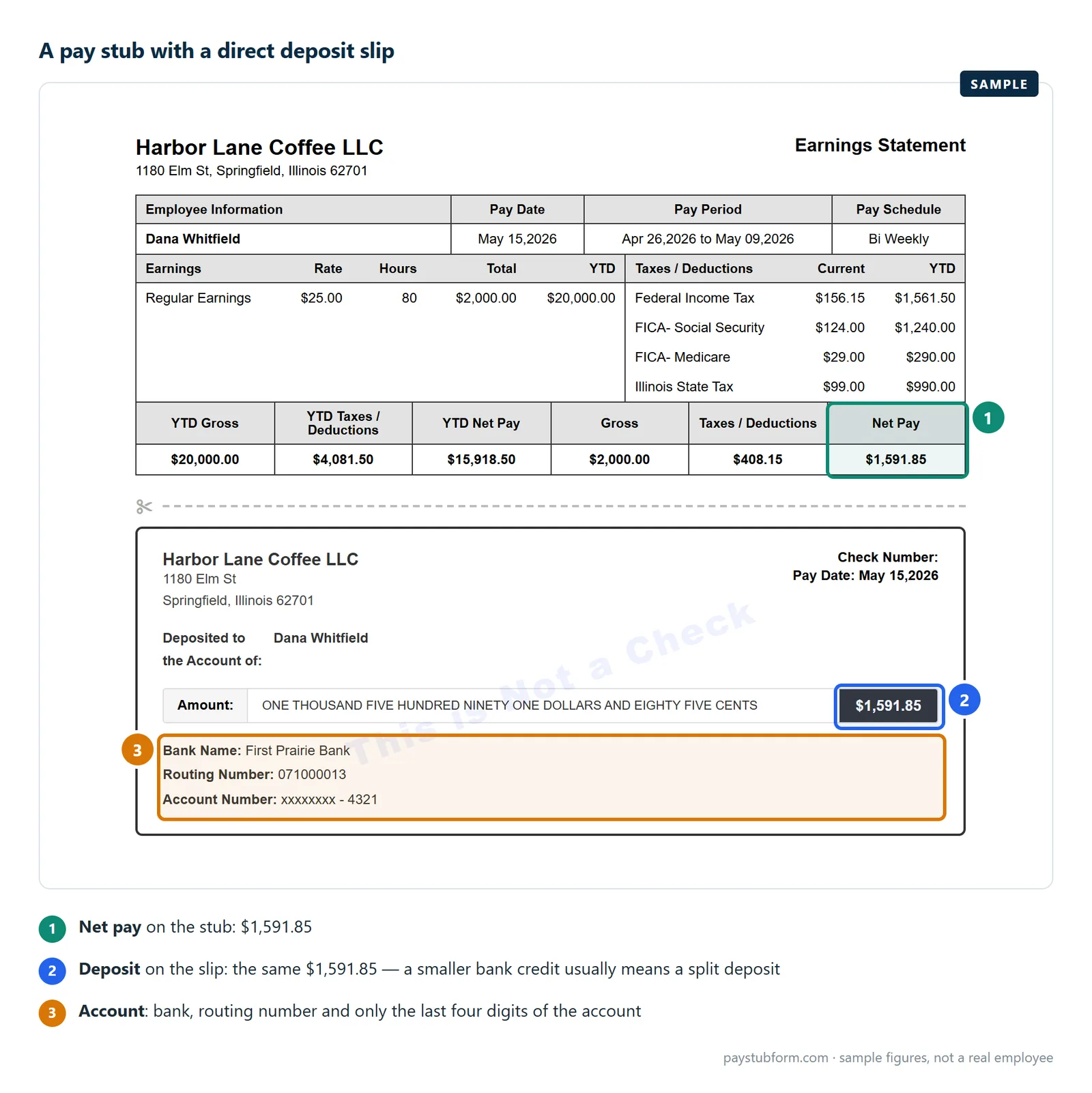
Once you have the right pair, work down this list.
The five reasons the deposit is smaller
1. A split deposit. The most common answer by a distance. Many employers let you route a fixed amount or a percentage to a second account — savings, a joint account, a credit union. The stub shows total net pay; the account you are looking at received only part of it. The stub usually lists each destination by the last four digits of the account number, often near the bottom.
2. A garnishment or support order. This appears as a deduction on the stub and reduces net pay, so it should not create a discrepancy — but if you are comparing against last month's net pay rather than this period's, it looks like one. Worth knowing: garnishment ceilings are calculated on disposable earnings, which are gross pay less only legally required deductions, so they are a percentage of a larger figure than your take-home. For an ordinary debt the limit is the lesser of 25% of disposable earnings or the amount above 30 times the federal minimum wage.
3. An account change mid-cycle. Payroll files are usually submitted two to four days before the pay date. Change your bank details the day before payday and the money has already been sent to the old account. Most employers hold the following check or issue a paper one while the new details prenote.
4. A pay card's fees. If you are paid onto a card rather than into a bank account, the balance can be lower than the deposit because of out-of-network ATM fees, balance enquiry fees, paper statement fees or per-purchase fees. The deposit was correct; the card took a cut afterwards.
5. A reversal or correction. An employer that overpaid a previous period may recover it, and depending on timing that can appear as a reduced deposit rather than as a clearly labelled line.
When the deposit is larger, or late
A deposit bigger than net pay usually means an expense reimbursement was paid through payroll. Reimbursements are not wages, so they are not taxed and not part of net pay, but they arrive in the same transfer — which is why the deposit exceeds the stub.
A late deposit is usually the banking calendar rather than the employer. ACH transfers do not settle on weekends or federal holidays, so a pay date falling on one typically lands the preceding business day or the following one, depending on when the employer submits the file. Banks also differ in when they make a pending credit available.
Tip: Save the stub as a PDF each pay period rather than relying on the portal. A bank statement proves an amount arrived; a pay stub proves who paid it, for what period, and what was withheld — which is what a landlord or lender actually needs.
What your employer can and cannot require
Being paid electronically is normal, but being forced onto a specific product is not. The CFPB is direct about this: your employer cannot require you to receive your wages on a payroll card. It has to offer at least one alternative and let you choose.
Two further points worth knowing:
- You choose the institution. An employer cannot require that your wages go to one particular bank or card programme. Which alternatives are offered — direct deposit to your own account, a payroll card, a paper check — varies by state.
- Fees have to be disclosed before you choose. The CFPB's prepaid rule requires a short form listing key fees and a long form with the full schedule, provided before you agree to be paid by card.
If you are on a card and it is costing you, the alternative is available by law, and the fee schedule you were given is the document to read first.
Direct deposit does not replace the stub
An electronic payment does not remove an employer's obligation to tell you what you were paid and what was withheld. What form that takes — paper, portal, emailed PDF — and whether you have to be able to print it are set state by state, and the range is wide. New York specifies eleven items that must appear with every payment of wages and attaches damages of $250 for each work day a compliant statement is missing. North Carolina is at the other end: it requires only written notice of your wages when you are hired and an itemized statement of deductions, with gross pay, hours and net pay not mandated at all. Ohio sat outside the question entirely until April 2025, when it finally enacted a pay stub statute of its own.
Our state-by-state pay stub requirements guide sets out what each state obliges an employer to provide, and this guide covers what a complete stub shows.
Check it in three minutes
- Open the stub for the pay period matching the deposit date, not the most recent one.
- Find net pay. Compare it to the deposit amount, to the cent.
- If the deposit is smaller, look for a second destination account on the stub — split deposits explain most gaps.
- If there is no split, check for a garnishment, support order or repayment line you had not noticed.
- If the figures still disagree, note the pay date, the net pay and the deposited amount, and take those three numbers to payroll. Specific beats vague.
For the full breakdown of how gross becomes net in the first place, see gross pay versus net pay; if the net itself changed rather than the deposit, the common causes are here. You can also create an accurate pay stub if you need a clean record of a period.
Quick answers
Why is my deposit less than the net pay on my stub?
Most often a split deposit routing part of your pay to another account. Check the stub for a second account listed by its last four digits. Failing that, look for a garnishment, a repayment, or a bank change that landed after the payroll file was sent.
Can my employer make me use a payroll card?
No. The CFPB states that an employer cannot require you to receive wages on a payroll card and must offer at least one alternative for you to choose from.
Why did my pay arrive a day late?
ACH transfers do not settle on weekends or federal holidays. A pay date on one of those usually moves to the adjacent business day, and banks differ on when they release a pending credit.
Do I still get a pay stub with direct deposit?
Yes. Electronic payment does not remove the obligation to tell you what was withheld. The format and access rules are set by your state.
My deposit was more than my net pay. Is that a mistake?
Usually not. An expense reimbursement paid through payroll is not wages, so it is untaxed and sits outside net pay while travelling in the same transfer.
I changed banks and the money went to the old account. What now?
Tell payroll immediately. If the old account is closed the transfer is normally returned to the employer, who reissues it. If it is still open, the funds are there and the bank is the faster route. Allow one full cycle for new details to take effect.
Sources
- Consumer Financial Protection Bureau — If my employer offers me a payroll card, do I have to accept it?: that an employer cannot require payment on a payroll card, must offer an alternative, and must disclose fees in short and long form.
- U.S. Department of Labor — Fact Sheet #30, Wage Garnishment Protections of the CCPA: disposable earnings and the 25% / 30-times-minimum-wage ceiling.
- IRS Topic no. 751 — Social Security and Medicare withholding rates: the withholding that produces net pay.
General U.S. information, current for 2026. Rules on payment method and pay statements vary by state; check yours alongside the federal position.


Comments (0)
Loading comments...
Leave a Comment