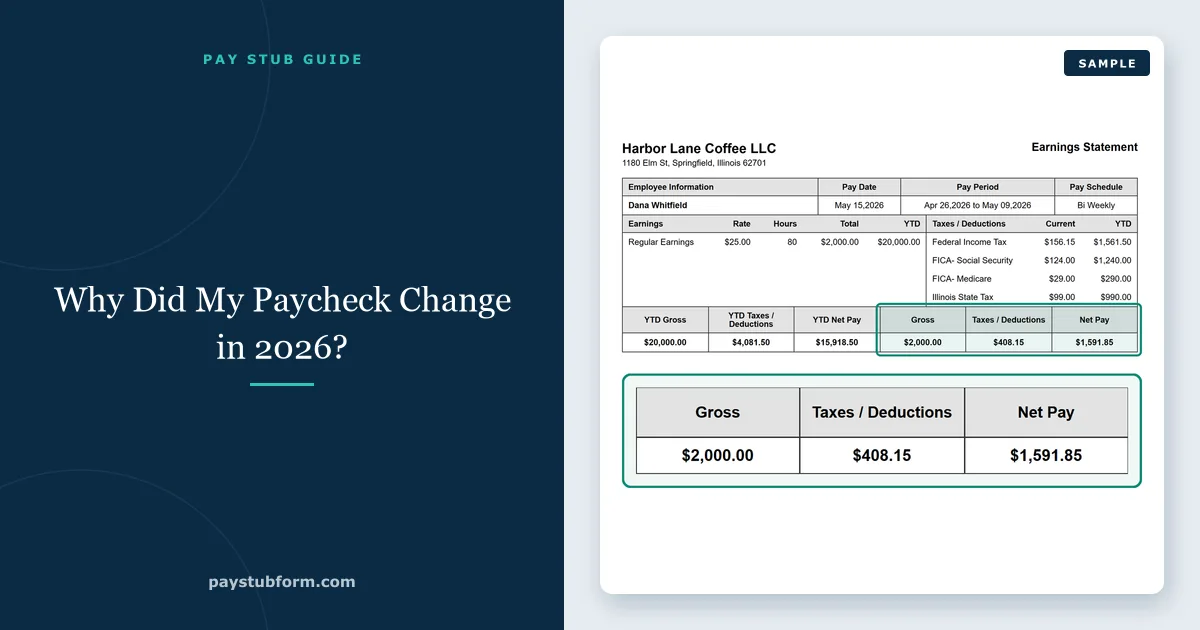
Your salary can stay exactly the same while your take-home pay moves. A change in hours, in tax withholding, in health coverage or in what you put into retirement is usually behind it. Put your latest pay stub next to the previous one and work through the check below — it takes about five minutes and almost always lands on the answer.
Quick take: When your salary is the same but your net pay moved, the cause is almost always one of eight things: hours, a bonus, withholding, benefits, retirement contributions, the Social Security wage base, state or local taxes, or the number of pay dates. Compare two stubs line by line and the changed line tells you which.
Tip: compare two periods of the same frequency and similar hours. Comparing a two-week stub against a monthly one will show a difference that means nothing.
Start with the take-home pay equation
Gross pay − employee taxes − employee deductions = net pay. Gross is what you earned before anything comes out; net is what reaches your account. Benefits your employer pays for on your behalf are not amounts taken from your check, even when they are printed on the stub.
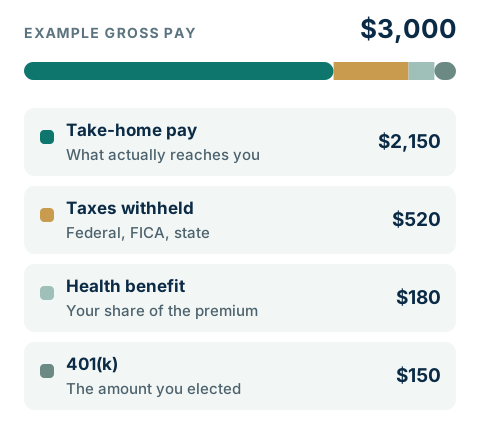
One label trips people up constantly: YTD means year to date. It is the running total for the calendar year, not an extra deduction from this particular paycheck.
Compare these five lines first
Work down the list and stop at the first line that differs. Stubs use slightly different wording for the same item, so match on meaning rather than exact labels.
| Line | What to compare | Next move |
|---|---|---|
| Gross pay | Hours, hourly rate, salary, bonus and overtime. | Check the pay period dates and your time record first. |
| Federal income tax | The amount withheld on each check. | Review your W-4 and run the IRS withholding estimator. |
| Social Security and Medicare | The two FICA lines, especially late in the year. | Compare year-to-date taxable wages against the wage base below. |
| Benefits and 401(k) | Your share of premiums and the contribution you elected. | Check whether open enrolment or a contribution change took effect. |
| State and local taxes | State withholding and any local payroll items. | Ask payroll which rule or election changed. |

Eight common reasons a paycheck changes
- Different hours or pay type. Fewer regular hours, overtime in one week, or paid time off replacing worked hours all change gross pay. Overtime is counted per workweek, so two biweekly stubs with the same total hours can still differ — see overtime on a pay stub and PTO and holiday pay.
- A bonus or commission. Supplemental pay is often withheld at a flat 22% federal rate, so a bonus check can look heavily taxed. See why bonus checks are taxed differently.
- A new W-4 or new withholding tables. A W-4 change moves only the federal income tax line, and new IRS tables each January can shift it slightly. See how a W-4 change affects your paycheck.
- Benefits and open enrolment. Premiums often change on 1 January or at the start of a plan year. See health insurance on a pay stub.
- Retirement contributions. A new percentage, an automatic escalation, or reaching the annual limit all move the 401(k) line. See 401(k) contributions on a pay stub.
- The Social Security wage base. High earners see the 6.2% line stop late in the year and restart in January — covered below.
- State and local taxes. A move, a new worksite, a new state program or a wage ceiling being reached. See state and local taxes on a pay stub.
- The calendar. Biweekly pay produces two months a year with three paychecks, and semimonthly pay divides the same salary differently. See payroll frequency explained and pay period versus pay date.
Working through the table above tells you which of these applies. If you are new to reading the lines themselves, start with what a pay stub is and what each line means or gross pay versus net pay.
Two 2026 numbers worth knowing
Most year-to-year surprises trace back to one of these.
The Social Security wage base is $184,500 for 2026. Employee Social Security tax is 6.2% of covered wages up to that limit, so higher earners see the line shrink and then stop once year-to-date wages pass it. Medicare's 1.45% has no cap at all, which is why one FICA line can disappear while the other keeps going. The base rises again in 2027 — see what changes on your paycheck in 2027.
The employee 401(k) deferral limit is $24,500 for 2026. This is a ceiling, not a deduction: a higher limit does not change your paycheck by itself. Your stub moves only if you changed the amount or percentage you elected.
Federal income tax withholding works on different logic again. Employers calculate it from your W-4 using the IRS withholding methods in Publication 15-T, so the amount can move even when your base salary has not — a bonus, a schedule change or a mid-year W-4 update all shift it.
What to do when a number looks wrong
- Confirm the period. Check the dates, the pay frequency, the hours, and any bonus or overtime on both stubs before anything else.
- Find the line that changed. Compare both the current amount and the year-to-date total, and note the exact pay date and the label as printed.
- Use the right source. For federal withholding, the IRS Tax Withholding Estimator; for missing overtime, the Department of Labor's overtime guide.
- Ask payroll a precise question. "Why did my health deduction rise from $180 to $210 on the September 25 check?" gets an answer; "my paycheck is wrong" gets a queue. Do not email your full Social Security number.
If the stub itself looks off rather than just different, our guide to pay stub mistakes that cause real problems covers the errors worth catching and how to raise them.
Quick answers
Why is federal withholding different from my final tax bill?
Withholding is an instalment toward a bill that is settled when you file. Your actual liability depends on your whole year — other income, deductions, credits, filing status — so the two are rarely identical. The IRS estimator is the tool for deciding whether to adjust your W-4.
Does a higher 401(k) limit automatically lower my check?
No. The limit is the maximum you are allowed to defer. Nothing changes on your stub unless you change your election, or your employer changes a default.
My Social Security line dropped to zero. Is that an error?
Usually not, late in the year. Once year-to-date taxable wages pass the wage base, Social Security tax stops for the rest of the calendar year and restarts in January. If it happens early in the year, ask payroll.
Which figure should I give a lender — gross or net?
Gross, and the year-to-date column alongside it. Lenders annualise gross pay; net pay reflects your own elections and tells them little about what you earn.
Why is my first paycheck of the year smaller?
Usually because several things reset on 1 January: Social Security withholding restarts if you passed the wage base last year, benefit premiums change with the new plan year, and new withholding tables take effect. Compare the January stub line by line with December's.
Why did I get a bigger paycheck this month?
Common reasons are overtime, a bonus, a third biweekly pay date in the month, Social Security withholding stopping after you passed $184,500, or a lower benefit deduction. If none applies, ask payroll before spending it — an overpayment is normally recovered later.
My hours were the same but my gross pay changed. Why?
Check whether overtime was split across workweeks differently, whether a shift differential or paid leave replaced worked hours, and whether a rate change took effect midperiod. Our hourly pay stub checklist walks through each.
Sources
- Social Security Administration — contribution and benefit base
- IRS — 2026 retirement plan contribution limits
- IRS Publication 15-T — federal withholding methods
- Department of Labor — overtime pay under the FLSA
This is general U.S. payroll information. What lands on your own stub depends on your wages, your elections, your benefits and your state and local rules.


Comments (0)
Loading comments...
Leave a Comment