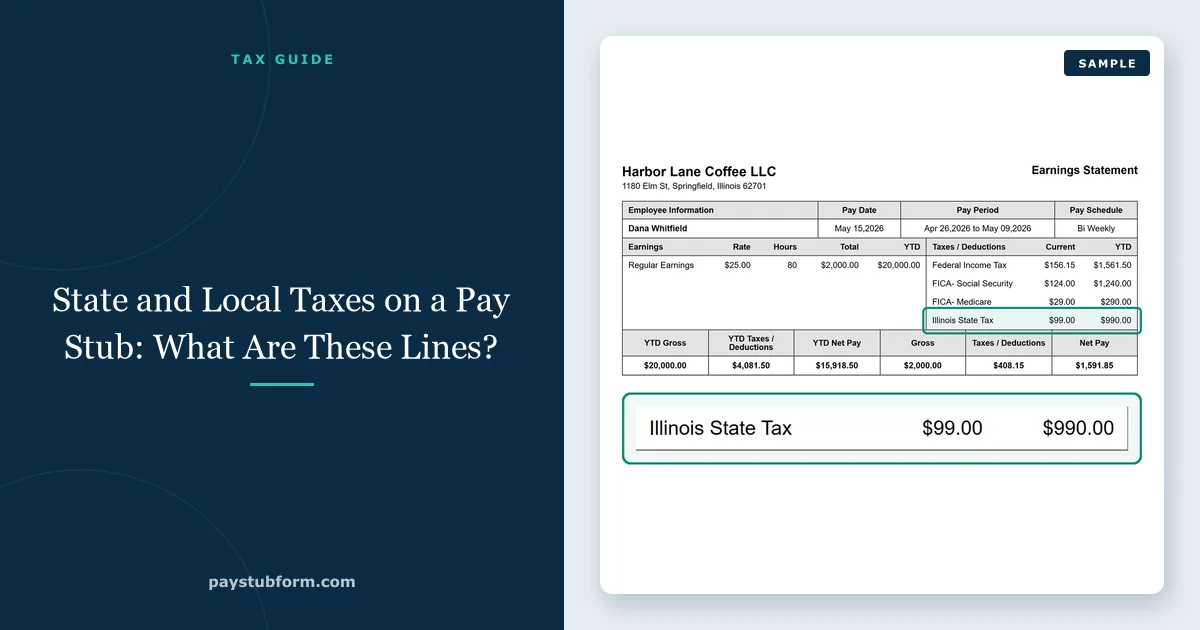
Federal lines on a pay stub look the same everywhere: federal income tax, Social Security, Medicare. The state and local section is where stubs start to differ — two employees with identical salaries can have completely different lines depending on where they work, where they live, and which programs their state runs. A short code like SDI, PFL, LST or EIT is rarely explained on the stub itself.
This guide decodes the common state and local lines, explains why they change, and shows what to check when one looks wrong.
Quick take: State and local lines fall into three groups — state income tax, local income tax, and state insurance or leave programs. They have different rates, different wage bases and different agencies behind them. Identify which group a line belongs to before deciding whether it is correct.
1. State income tax: SIT, SWT or the state's code
Most states tax wages, and the employer withholds it each pay period based on the state's own tables and, usually, a state withholding form. Nine states do not tax wage income: Alaska, Florida, Nevada, New Hampshire, South Dakota, Tennessee, Texas, Washington and Wyoming. If you work in one of them and see no state income tax line, that is correct.
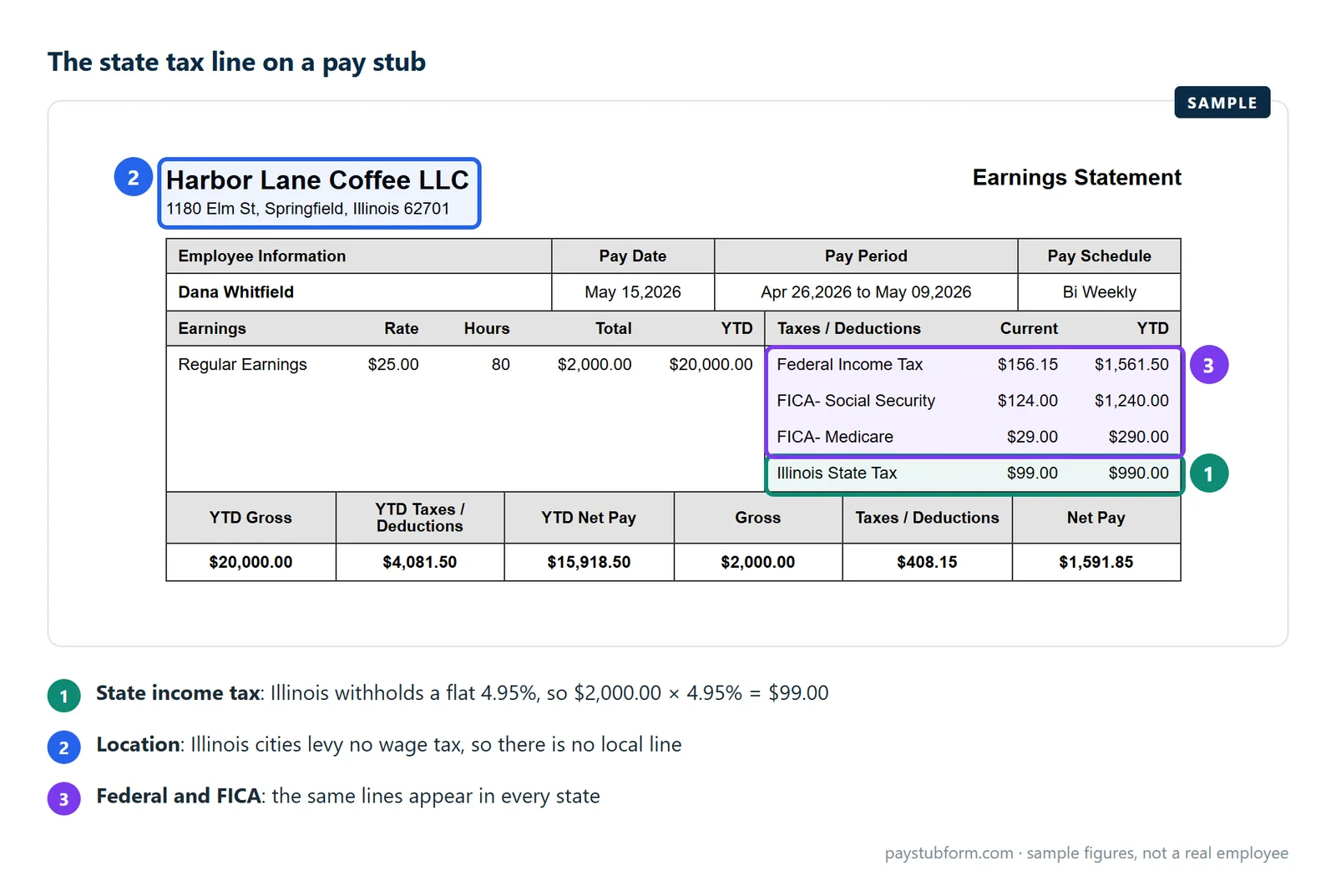
Elsewhere, the amount depends on the state's structure — some use a flat rate, others graduated brackets — and on the withholding form you filed. Many states have their own version of the W-4, such as California's DE 4 or New York's IT-2104. Changing your federal W-4 does not necessarily change your state withholding; our guide to how a W-4 change affects your paycheck covers that separately.
2. Local income tax: city, county and school district
In some states, local governments tax wages too. These lines are easy to miss and easy to get wrong when you move or change worksites:
- Pennsylvania — nearly every resident pays a local Earned Income Tax (EIT), and many workers also see a Local Services Tax (LST) of up to $52 a year, based on where they work.
- Ohio — most cities and many villages levy a municipal income tax, and some school districts levy their own.
- New York — residents of New York City and Yonkers pay a local income tax, usually withheld alongside the state line.
- Others — several Michigan cities including Detroit, Kansas City and St. Louis in Missouri, local occupational taxes in Kentucky, and county taxes in Indiana and Maryland.
Local tax often depends on both where you live and where you work, and the rules for which one takes priority differ by state.
3. State insurance and leave programs
These are not income taxes. They fund disability, paid family leave, long-term care or unemployment benefits, and they usually have their own rate and wage ceiling.
| Typical label | What it funds | Examples |
|---|---|---|
| SDI / CASDI | State disability insurance, often including paid family leave | California — no wage ceiling since 2024 |
| PFL / FLI / PFML | Paid family and medical leave | New York, New Jersey, Massachusetts, Washington, Colorado, Oregon |
| DBL / TDI | Temporary disability | New York, New Jersey, Rhode Island, Hawaii |
| WA Cares / LTC | Long-term care insurance | Washington |
| SUI / UI (employee share) | Unemployment insurance | New Jersey, Pennsylvania, Alaska |
Because these programs have their own wage bases, a line can stop partway through the year when you reach the ceiling — the same way Social Security stops at $184,500 for 2026. A line that disappears in October is often a sign you have hit a cap, not an error.
Tip: If you cannot identify a code, ask payroll for the full name of the tax or program, the agency it is paid to, and the date it started on your stub.
4. Working in one state, living in another
When your work state and home state differ, the usual pattern is that the work state taxes your wages and your home state gives you a credit for that tax on your return. Some neighbouring states have reciprocal agreements instead: you pay tax only to your home state, provided you give your employer the right exemption certificate. Pennsylvania and New Jersey have one; Illinois has them with Iowa, Kentucky, Michigan and Wisconsin.
Remote work adds another layer. A few states, New York among them, may tax a non-resident's wages from a home-state office when the remote arrangement is for the employee's convenience rather than the employer's need. If you work remotely across a state line, check both states' rules rather than assuming only your home state applies.
If you see two state income tax lines, that is not automatically double taxation. It may be correct withholding that you reconcile on your returns — or a payroll setup that still lists a state you no longer work in.
5. Why a state or local line suddenly changed
- You moved or changed worksite, and payroll updated your locality — or did not.
- A new tax year brought new withholding tables, rates or wage bases on 1 January.
- You filed a new state withholding form.
- You reached a program's wage ceiling, and the line stopped until next year.
- A new program started, as several states have phased in paid leave contributions.
Compare the current stub with the previous one, line by line, and note the first pay date where the change appeared. Our guide to every paycheck deduction covers the federal lines in the same way.
The five-minute version
- Confirm your work address and home address in the payroll portal are current.
- List every state and local line with its code and amount.
- Sort each one: state income tax, local income tax, or state program.
- If you live and work in different states, check for a reciprocal agreement and file the exemption form if one applies.
- If a line is new, missing or changed, find the pay date it changed and ask payroll why.
- At year-end, check that the state and local totals match Boxes 15 to 20 of your W-2.
Our state-by-state guide covers the withholding rules and pay stub requirements for every state, and you can create a pay stub with state and local taxes calculated for your location.
Quick answers
What does SDI mean on my pay stub?
State Disability Insurance. It funds short-term disability benefits, and in California it also funds paid family leave. It is a state program contribution, not income tax.
Which states have no state income tax on wages?
Alaska, Florida, Nevada, New Hampshire, South Dakota, Tennessee, Texas, Washington and Wyoming. Some still run payroll programs — Washington, for example, has paid family leave and long-term care premiums.
Why am I paying tax to two states?
Usually because you work in one state and live in another. The work state withholds, and your home state normally gives a credit for that tax. If the states have a reciprocal agreement, you may only need to pay your home state after filing an exemption form with your employer.
Will moving automatically update my withholding?
Not always. Update your address through your employer's payroll process, file any new state withholding form, and check the first stub after the move.
What is LST on a Pennsylvania pay stub?
The Local Services Tax, a flat local tax of up to $52 a year based on where you work, usually withheld in equal amounts across the year's pay periods.
Why did a state deduction stop partway through the year?
Many state programs have an annual wage ceiling. Once your year-to-date wages pass it, the deduction stops until 1 January.
Sources
- IRS — State Government Websites: links to each state's tax agency for current withholding rules.
- California EDD — Rates and Withholding: the SDI rate and the removal of the SDI wage ceiling.
- New York State — Paid Family Leave: how the employee contribution appears on New York pay stubs.
- Pennsylvania DCED — Local Income Tax Information: the Earned Income Tax and the Local Services Tax.
- IRS — 2026 General Instructions for Forms W-2 and W-3: where state and local wages and taxes are reported.
General U.S. information, current for 2026. State and local rates and wage bases change every year — check the current figures for your jurisdiction alongside this.


Comments (0)
Loading comments...
Leave a Comment