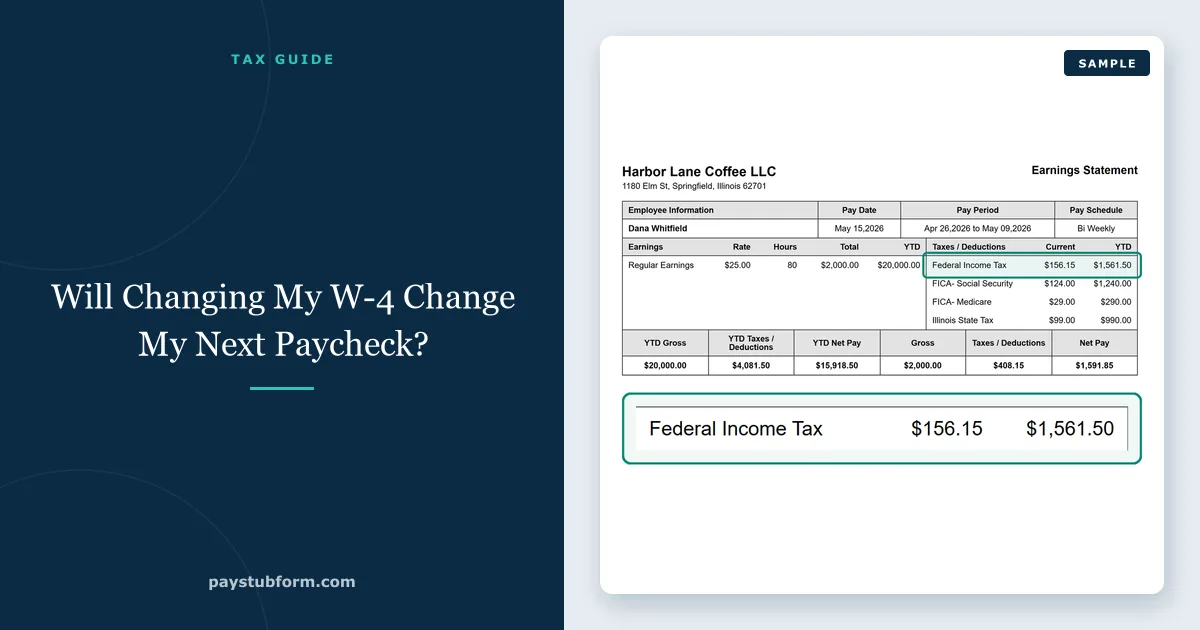
Yes — a new Form W-4 will usually change your next paycheck, or the one after it. But it changes only one line: federal income tax withholding. Your gross pay, Social Security, Medicare and, in most states, your state income tax stay exactly where they were. Knowing that makes it easy to check whether the change was applied correctly and whether it did what you wanted.
This guide explains which pay stub line moves, when the change takes effect, how each step of the form affects withholding, and how to decide whether to change it at all. For how the W-4 relates to the form you get in January, see W-2 vs W-4.
Quick take: A W-4 changes federal income tax withholding and nothing else on your stub. Your employer must apply it no later than the first payroll period ending on or after the 30th day after you submit it. Withholding is a prepayment, not your final tax — more take-home now can mean a smaller refund later.
1. Which pay stub line should change
Put a stub from before the change next to the first one after it:
| Line | Changed by a W-4? | What to check |
|---|---|---|
| Gross pay | No | Hours or salary should be the same |
| Federal income tax | Yes | The only line that should move |
| Social Security (6.2%) | No | Fixed rate up to $184,500 for 2026 |
| Medicare (1.45%) | No | Fixed rate, no cap |
| State income tax | Usually no | Most states use their own form |
| Net pay | Yes | Moves by the same amount as federal tax |
If federal tax moved and nothing else did, the W-4 was applied. If several lines moved, something else changed in the same period — hours, a bonus, a benefit election — and the comparison needs to account for it. Our guide to gross pay versus net pay shows how the lines connect.
2. When the change takes effect
Employers do not have to apply a new W-4 on the next paycheck. The IRS rule is that it must take effect no later than the start of the first payroll period ending on or after the 30th day from the date the employer received it. Most payroll systems apply it sooner, but if you submit a form two days before payday, do not expect to see it on that check.
Tip: Ask payroll for the date your new W-4 became effective, then compare the first full pay period after that date — not the first paycheck after you submitted it.
3. How each step of the W-4 affects withholding
The current W-4 has not used allowances since 2020. Instead, it asks for dollar amounts, and each step pushes withholding in a predictable direction:
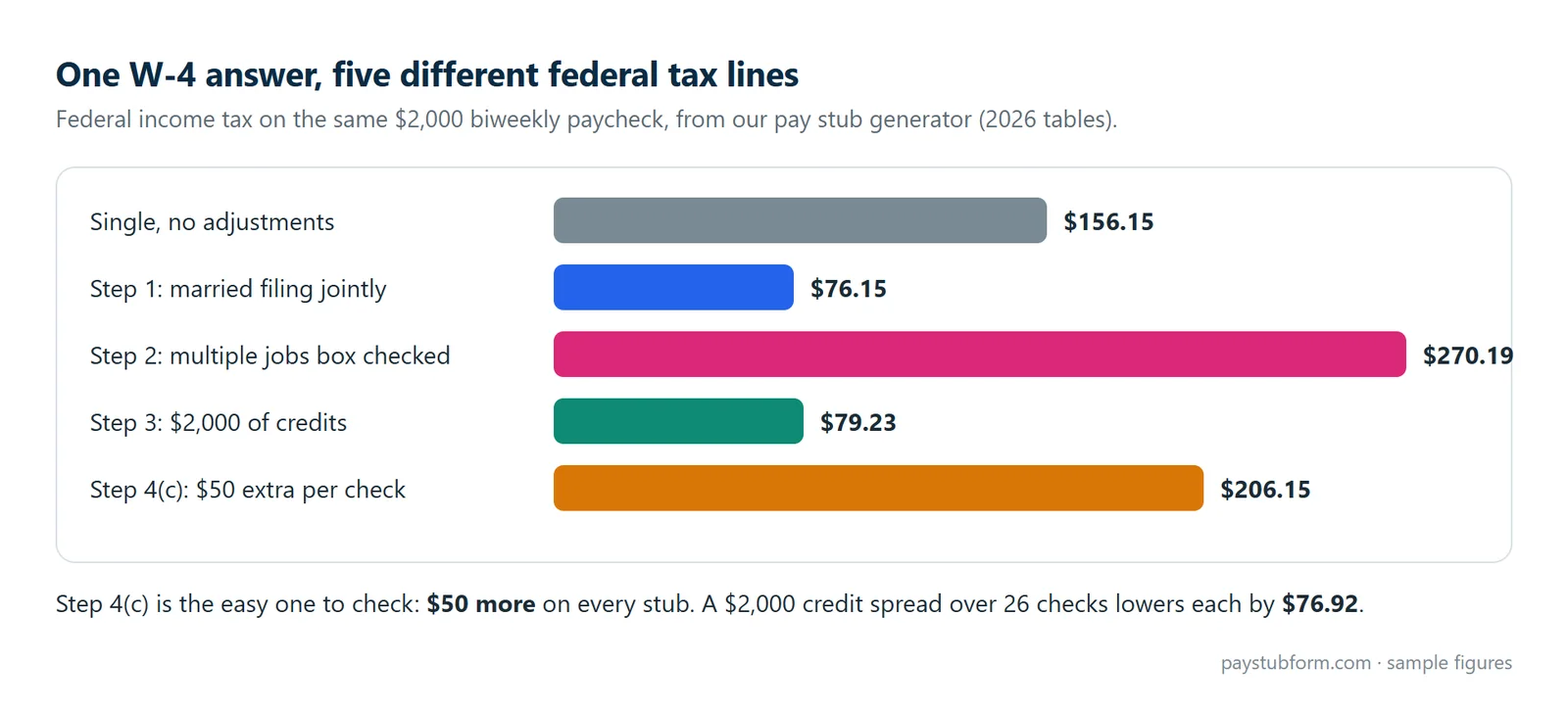
- Step 1 — Filing status. Single or married filing separately withholds more than married filing jointly; head of household sits between them.
- Step 2 — Multiple jobs or a working spouse. Checking the box or using the worksheet increases withholding, so that two incomes are not each withheld as if they were the only one.
- Step 3 — Dependents and credits. Lowers withholding by the annual credit amount, spread across your pay periods.
- Step 4(a) — Other income. Increases withholding to cover income with no tax taken out, such as interest or side work.
- Step 4(b) — Deductions. Lowers withholding if you expect deductions above the standard deduction.
- Step 4(c) — Extra withholding. A fixed dollar amount added to every paycheck.
Step 4(c) is the simplest to check. Adding $50 per pay period should raise the federal tax line by exactly $50 on each check — $1,300 over a year if you are paid biweekly. Steps 1 to 4(b) run through the IRS withholding tables in Publication 15-T, so their effect varies with your pay.
If you have not filed a W-4 since before 2020, your employer still uses your old form. You do not need to replace it unless you want to change your withholding — but if you do, you must use the current form.
4. State withholding is usually separate
Most states with an income tax have their own withholding form — California's DE 4 and New York's IT-2104, for example. A federal W-4 change does not update them. If you want your state withholding to change too, file the state form as well. States with no wage income tax, such as Texas and Florida, have no state line to change. Our guide to state and local taxes on a pay stub covers the state side.
5. Bonuses and supplemental pay
Bonuses, commissions paid separately and other supplemental wages are often withheld at a flat 22% federal rate, regardless of most of your W-4 entries. So a new W-4 may change your regular paychecks but have little visible effect on a bonus check. See why bonus checks are taxed differently.
6. Should you change your W-4?
Consider updating it when something changes your tax picture for the year:
- Marriage, divorce, or a new child.
- A second job, or a spouse starting or stopping work.
- Significant income outside your paycheck.
- A large refund or a balance due last year that you want to avoid repeating.
Before changing it, run the IRS Tax Withholding Estimator with your most recent pay stub. It uses your year-to-date figures to show whether your current withholding is on track for the full year and what to enter on the new form. Changing withholding late in the year has a bigger per-check effect, because the adjustment is spread over fewer paychecks.
If you claim exemption from withholding, that status lasts only for the calendar year. You must give your employer a new W-4 by 15 February of the following year to keep it.
The five-minute version
- Run the IRS Tax Withholding Estimator with your latest pay stub.
- Submit a current W-4 through your employer's process, and a state form if you want state withholding to change too.
- Ask payroll which pay period the new form takes effect in.
- Compare that stub with the previous one: only federal income tax and net pay should change.
- If you used Step 4(c), check that federal tax rose by exactly that amount.
- Recheck with the estimator after any major life or income change.
Want to see the effect before you submit it? You can create a pay stub with your current pay and compare the withholding.
Quick answers
How long does it take for a W-4 change to show on my paycheck?
Your employer must apply it no later than the first payroll period ending on or after the 30th day after receiving it. Most do it on the next payroll run or the one after.
Will changing my W-4 change my Social Security or Medicare?
No. Social Security (6.2%) and Medicare (1.45%) are fixed percentages of your wages. A W-4 only changes federal income tax withholding.
Does a federal W-4 change my state tax withholding?
Usually not. Most states use their own withholding form, so you need to file that separately if you want state withholding to change.
Do I send my W-4 to the IRS?
No. You give it to your employer, who uses it to calculate withholding and keeps it with their payroll records.
Will a W-4 change affect my tax refund?
Yes. Less withholding means more take-home pay now and a smaller refund, or a balance due, when you file. More withholding does the opposite. Your total tax for the year does not change.
Do I still use allowances on the W-4?
No. Allowances were removed in 2020. The current form uses filing status, a multiple-jobs adjustment, dollar amounts for credits and deductions, and an optional extra amount per paycheck.
Sources
- IRS — About Form W-4, Employee's Withholding Certificate: the current form and its instructions.
- IRS Publication 15 (2026), Employer's Tax Guide: when a new W-4 must take effect, exemption renewal by 15 February, and supplemental wage withholding.
- IRS Publication 15-T (2026), Federal Income Tax Withholding Methods: how each W-4 entry is applied to the withholding tables.
- IRS — Tax Withholding Estimator: checks whether your withholding is on track for the year.
General U.S. information, current for 2026. Your withholding depends on your pay, filing status and the entries on your W-4.


Comments (0)
Loading comments...
Leave a Comment