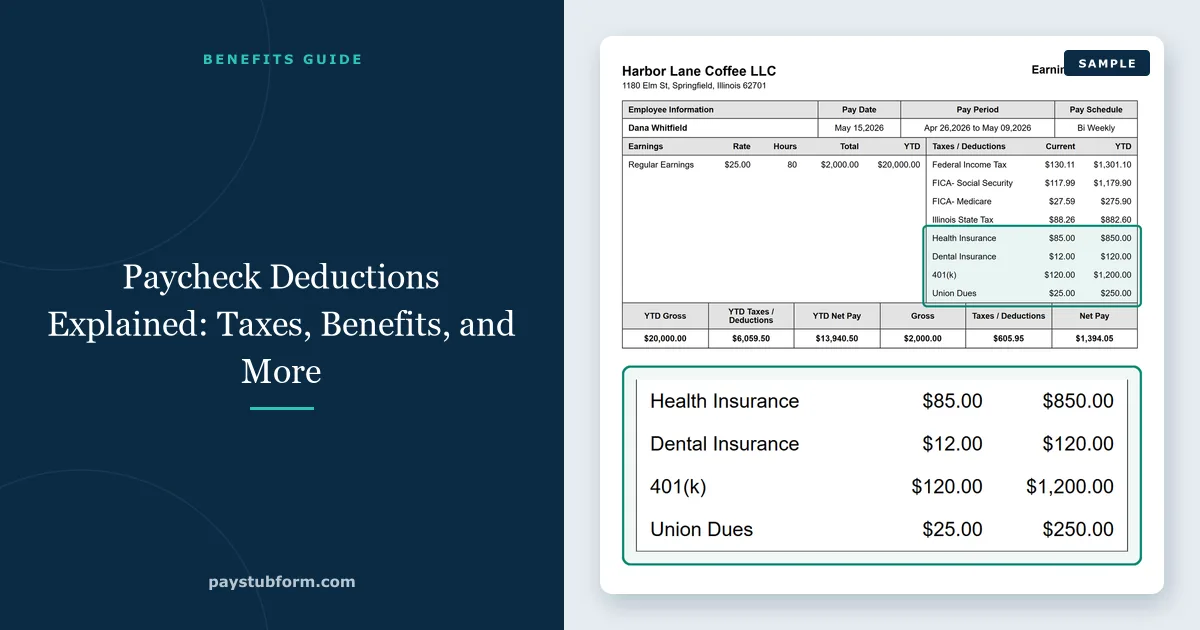
A pay stub lists anywhere from four to twenty lines under gross pay, and they do not all do the same thing. Some are tax. Some are benefits you chose. Some are court-ordered. One or two are not deductions at all — they are printed for information and never touched your money.
Sorting them into those groups is what turns a confusing stub into a readable one, and it is also how you tell a genuine error from a normal month-to-month change. Here is every category that can appear, in the order it comes out.
Quick take: Deductions come out in a fixed order — pre-tax, then taxes, then after-tax, then garnishments — and each layer changes the base the next one is calculated on. Employer contributions sit outside that stack entirely.
Layer one: pre-tax deductions
These come out first and reduce the wages that are taxed. The important thing — and the detail most people have backwards — is that they do not all reduce the same taxes.
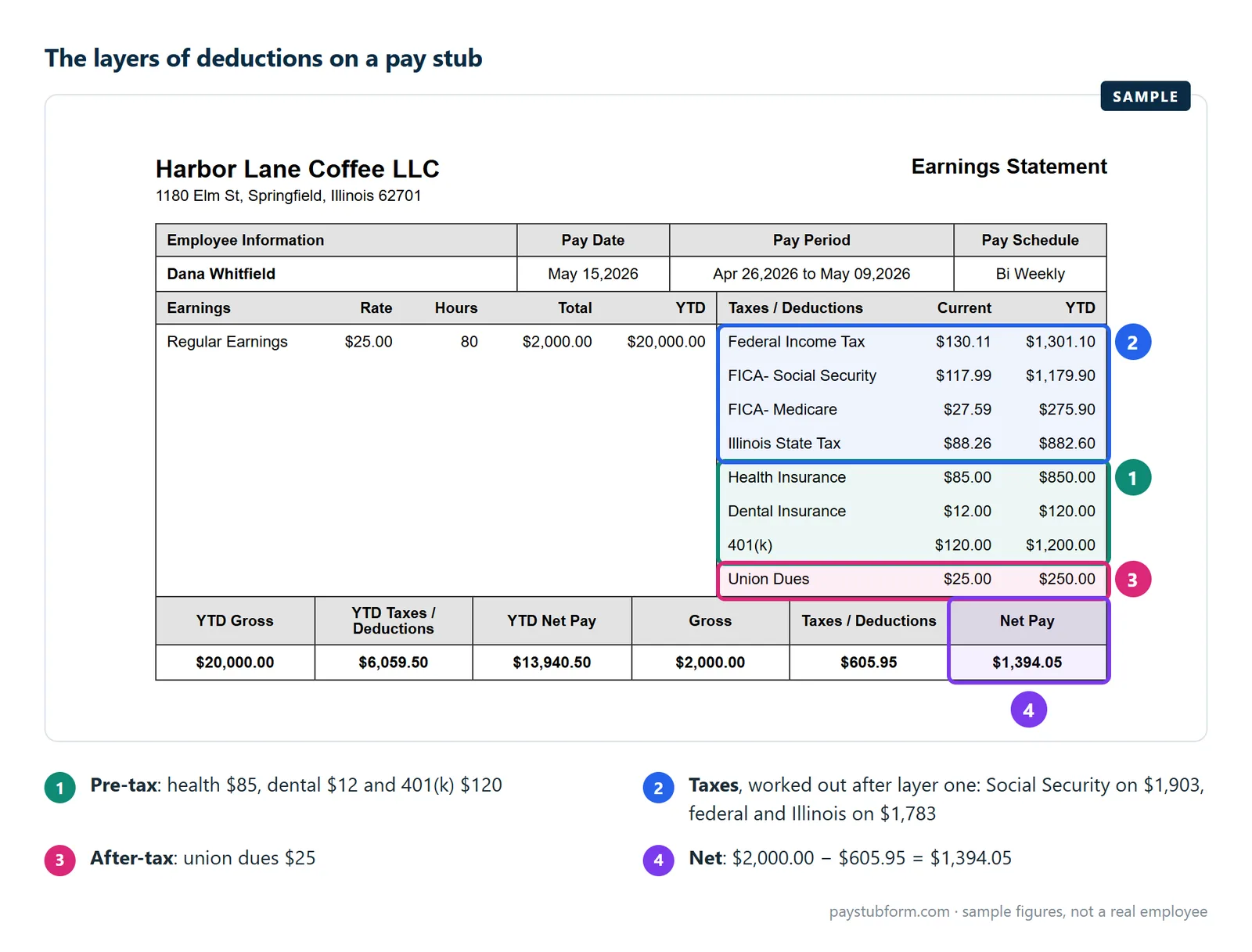
Section 125 cafeteria plan benefits are generally excluded from federal income tax, Social Security tax and Medicare tax alike. That covers medical, dental and vision premiums, health and dependent care FSA contributions, and HSA contributions made by salary reduction. For 2026 the health FSA salary reduction limit is $3,400, and HSA contributions are capped at $4,400 for self-only coverage and $8,750 for family coverage, with an extra $1,000 from age 55.
Traditional retirement deferrals behave differently. A 401(k), 403(b) or 457(b) deferral is excluded from federal income tax but not from Social Security and Medicare — the IRS states plainly that employee elective salary deferrals are subject to Social Security and Medicare tax while not being subject to federal income tax withholding. You pay 6.2% and 1.45% on money you never saw. The 2026 deferral limit is $24,500, plus $8,000 from age 50 and $11,250 between ages 60 and 63.
Commuter benefits carry a monthly exclusion of $340 for qualified parking and $340 for transit passes.
Our guide to pre-tax versus after-tax deductions works through which group each one falls into and what each is actually worth.
Layer two: taxes
Four lines are near-universal, and each has its own base.
- Federal income tax withholding, calculated from your W-4 and your taxable wages. It is an estimate of what you will owe, not the tax itself.
- Social Security, 6.2%, on wages up to $184,500 for 2026. Once year-to-date Social Security wages reach that ceiling the line stops for the rest of the year.
- Medicare, 1.45%, on every dollar with no ceiling. Above $200,000 of wages from one employer an extra 0.9% is added — see the $200,000 trigger.
- State and sometimes local income tax, which varies enormously. There is nothing at all in Texas; in Ohio a municipal and sometimes a school district tax is withheld on top of the state rate.
A bonus or commission in the period can make the federal line look wrong. Supplemental wages are often withheld at a flat 22% rather than through your usual tables, rising to a mandatory 37% once supplemental wages pass $1,000,000 in a year. That is withholding, not a tax rate.
Layer three: after-tax deductions
These come out of money that has already been taxed, so they reduce your net pay and nothing else: Roth 401(k) contributions, union dues, charitable giving through payroll, repayment of an employer loan, and life insurance above the excludable amount.
There is a related line that runs the opposite way. Imputed income increases your taxable wages without putting anything in your pocket — most commonly the cost of employer-provided group-term life insurance above $50,000 of coverage. If your taxable wages exceed your gross pay, this is almost always why.
Layer four: garnishments
Court-ordered deductions come out last and have their own federal ceilings, calculated on a figure that is not your net pay.
The Department of Labor defines disposable earnings as what is left after legally required deductions — taxes, Social Security, Medicare and state unemployment insurance. Your health premium, your 401(k) and your union dues are voluntary, so they do not reduce it. Disposable earnings are therefore almost always higher than your take-home pay.
For an ordinary debt the ceiling is the lesser of 25% of disposable earnings, or the amount by which disposable earnings exceed 30 times the federal minimum wage — $217.50 a week at the current $7.25 federal minimum. Child support and alimony can reach 50% to 60%, plus another 5% when payments are more than twelve weeks in arrears. Defaulted federal student loans can take up to 15%. The ordinary limits do not apply to federal or state tax debt at all.
This is why a garnishment can look larger than a quarter of what you take home and still be correct.
What is not a deduction
Two things on a stub look like deductions and are not. The employer's half of Social Security and Medicare, its retirement match and its share of your health premium are all paid on top of your wages — some stubs print them for information, and they never reduce your net pay. Employer matching and non-elective retirement contributions are subject to neither FICA nor federal income tax at the time they are made.
Tip: If a line has an "ER" suffix it is the employer's, not yours. "EE" is the employee's. Only the EE lines belong in the arithmetic that produces your net pay.
Telling an error from a normal change
Most month-to-month changes have ordinary explanations. Social Security stopping because you reached the wage base. A three-paycheck month on a biweekly schedule, where fixed monthly premiums are usually not taken from the third check. A benefit election changing at open enrolment. Reaching the annual 401(k) limit, which stops the deduction entirely.
What is worth questioning: a deduction you did not elect; a pre-tax election that is not reducing any taxable wage figure; the same benefit taken twice; a deduction that did not change when your coverage did; and anything that takes your pay below minimum wage for the hours worked.
Check your own stub in three minutes
- Add every deduction and tax line. Gross pay minus that total must equal net pay to the cent — if it does not, a line is missing or mislabelled.
- Sort the deductions into the four layers above, and set aside any ER lines as not yours.
- Confirm gross minus the Section 125 group equals your Social Security and Medicare wages, and that gross minus the Section 125 group and the retirement deferral equals your federal taxable wages.
- Compare this stub to the last one and circle only what changed. That is nearly always where the answer is.
- Check the year-to-date column, because a small error repeating for months only becomes visible there.
What your employer must itemise depends on your state — our state-by-state guide sets out what each one requires. You can also create an accurate pay stub here with every deduction in its proper layer.
Quick answers
Why is my net pay different when my salary didn't change?
Usually a benefit election change, reaching the Social Security wage base, hitting the annual 401(k) limit, or a month with an extra pay date. Comparing two stubs line by line finds it faster than calling payroll.
Does my 401(k) reduce all my taxes?
No. A traditional deferral is excluded from federal income tax but remains subject to Social Security and Medicare. A Section 125 health premium reduces all three.
What are the "ER" lines on my stub?
Employer contributions, shown for information. They are paid on top of your wages and are never deducted from your pay, even though they appear in the same column.
Why is my garnishment more than 25% of my take-home pay?
Because the limit is a percentage of disposable earnings, not of net pay. Disposable earnings subtract only legally required deductions, so voluntary ones like your health premium and 401(k) are still in the base.
My taxable wages are higher than my gross pay. Is that wrong?
Usually not. Imputed income — most often employer-paid group-term life insurance above $50,000 of coverage — adds taxable value without adding cash.
Can my employer deduct for a cash shortage or broken equipment?
Only within limits, and the rules are tighter than many employers assume. Federal rules restrict deductions that cut into minimum wage, and several states require written authorisation or prohibit the deduction outright. A deduction you never authorised in writing is worth questioning.
Sources
- IRS Publication 15-B — Employer's Tax Guide to Fringe Benefits (2026): Section 125 treatment, the $3,400 health FSA limit, the $4,400 and $8,750 HSA limits, the $340 monthly commuter exclusions and the $50,000 group-term life exclusion.
- IRS — Are retirement plan contributions subject to withholding for FICA, Medicare or federal income tax?: that pre-tax deferrals are subject to Social Security and Medicare but not federal income tax, and that employer contributions are subject to neither.
- IRS Topic no. 751 — Social Security and Medicare withholding rates: the 6.2%, 1.45% and 0.9% rates.
- Social Security Administration — Contribution and Benefit Base: the $184,500 wage base for 2026.
- IRS Publication 15 (Circular E), Employer's Tax Guide for 2026: the 22% optional flat rate for supplemental wages and the mandatory 37% above $1,000,000.
- U.S. Department of Labor — Fact Sheet #30, Wage Garnishment Protections of the CCPA: disposable earnings, the 25% and 30-times-minimum-wage ceilings, and the child support and student loan limits.
- IRS — 401(k) limit increases to $24,500 for 2026: the deferral and catch-up limits.
General U.S. information, current for the 2026 tax year. State rules on permissible deductions vary and are often stricter than the federal position.


Comments (0)
Loading comments...
Leave a Comment