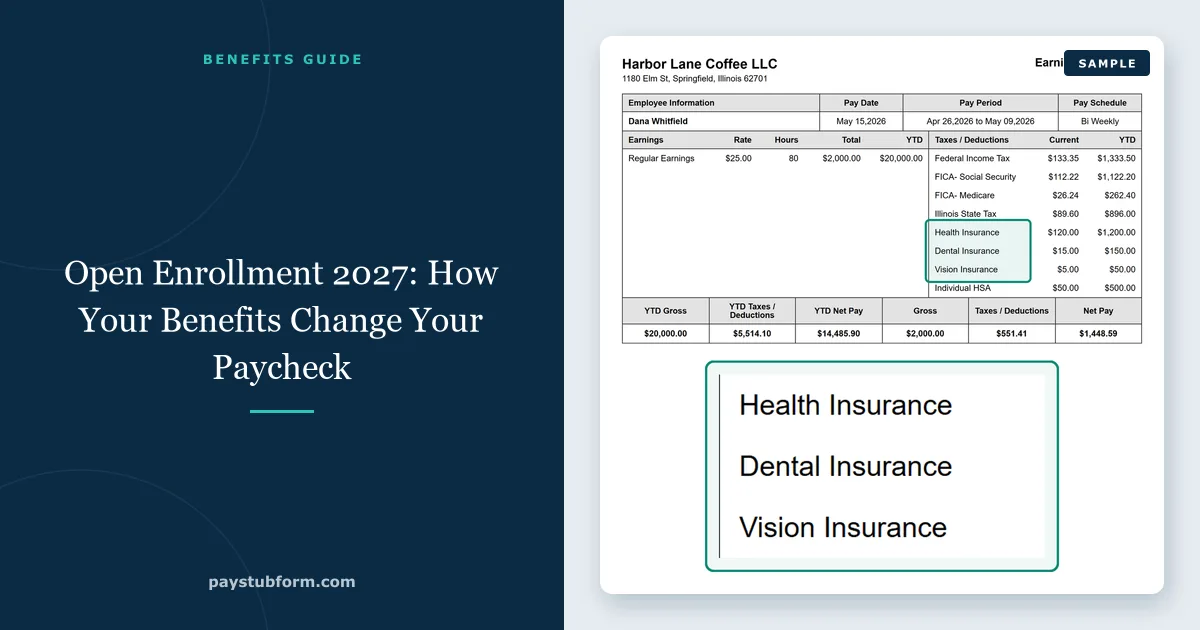
Open enrollment is the one time of year you decide how much of your paycheck goes to health insurance, an FSA or HSA, and other benefits — and the choices show up on your first pay stub in January. Most of them are locked in for twelve months. Knowing how each election is taxed tells you what your take-home pay will actually be, and what to check when the new deductions appear.
Quick take: Health premiums, FSA and HSA contributions made through payroll usually come out before federal income tax, Social Security and Medicare, so each dollar costs you less than a dollar of take-home pay. A traditional 401(k) lowers income tax but not Social Security or Medicare. For 2027 the HSA limit is $4,500 for self-only coverage and $9,000 for family coverage; the dependent care FSA limit is $7,500. Check your first January stub against what you elected.
1. Why open enrollment changes your paycheck
Every benefit you elect becomes a deduction line on your pay stub. Open enrollment — usually a few weeks in October or November for plans that start January 1 — resets those lines for the year. Under the tax rules for employer cafeteria plans, most elections then cannot be changed until the next open enrollment unless you have a qualifying life event such as marriage, a birth, or losing other coverage. Tax changes for the new year are covered separately in 2027 tax brackets and your paycheck.
Two things change on the stub: the deduction itself, and the taxes. Because most benefit deductions are taken before tax, electing more lowers your taxable wages, so the tax lines shrink a little too. Our guide to pre-tax and after-tax deductions explains how to tell them apart on a stub.
2. How each election is taxed
| Election | Federal income tax | Social Security and Medicare |
|---|---|---|
| Health, dental and vision premiums (through a Section 125 plan) | Not taxed | Not taxed |
| Health FSA | Not taxed | Not taxed |
| Dependent care FSA | Not taxed | Not taxed |
| HSA contributions through payroll | Not taxed | Not taxed |
| Traditional 401(k) | Not taxed now | Taxed |
| Roth 401(k) | Taxed | Taxed |
This is why your W-2 can show three different wage figures: pre-tax premiums come out of Boxes 1, 3 and 5, while a traditional 401(k) comes out of Box 1 only. See W-2 Boxes 1, 3 and 5. State income tax usually follows the federal treatment, with exceptions — a few states tax HSA contributions, for example.
3. The limits for 2027
- HSA: $4,500 with self-only coverage and $9,000 with family coverage under a high-deductible health plan, plus a $1,000 catch-up contribution if you are 55 or older. The limits include anything your employer puts in.
- Dependent care FSA: $7,500 per household, or $3,750 if married filing separately. The limit rose from $5,000 starting in 2026 and is set by law rather than adjusted each year.
- Health FSA: $3,400 for plan years beginning in 2026. The IRS announces the next year's figure in the fall; if your enrollment materials show a 2027 amount, use that. Your employer can set a lower limit than the IRS maximum.
- 401(k): $24,500 in 2026, with an extra $8,000 allowed from age 50. The IRS normally announces the following year's limits in November, after many enrollment windows have opened. You can usually change a 401(k) percentage at any time, so it does not have to be settled during open enrollment.
4. What it does to take-home pay: a worked example
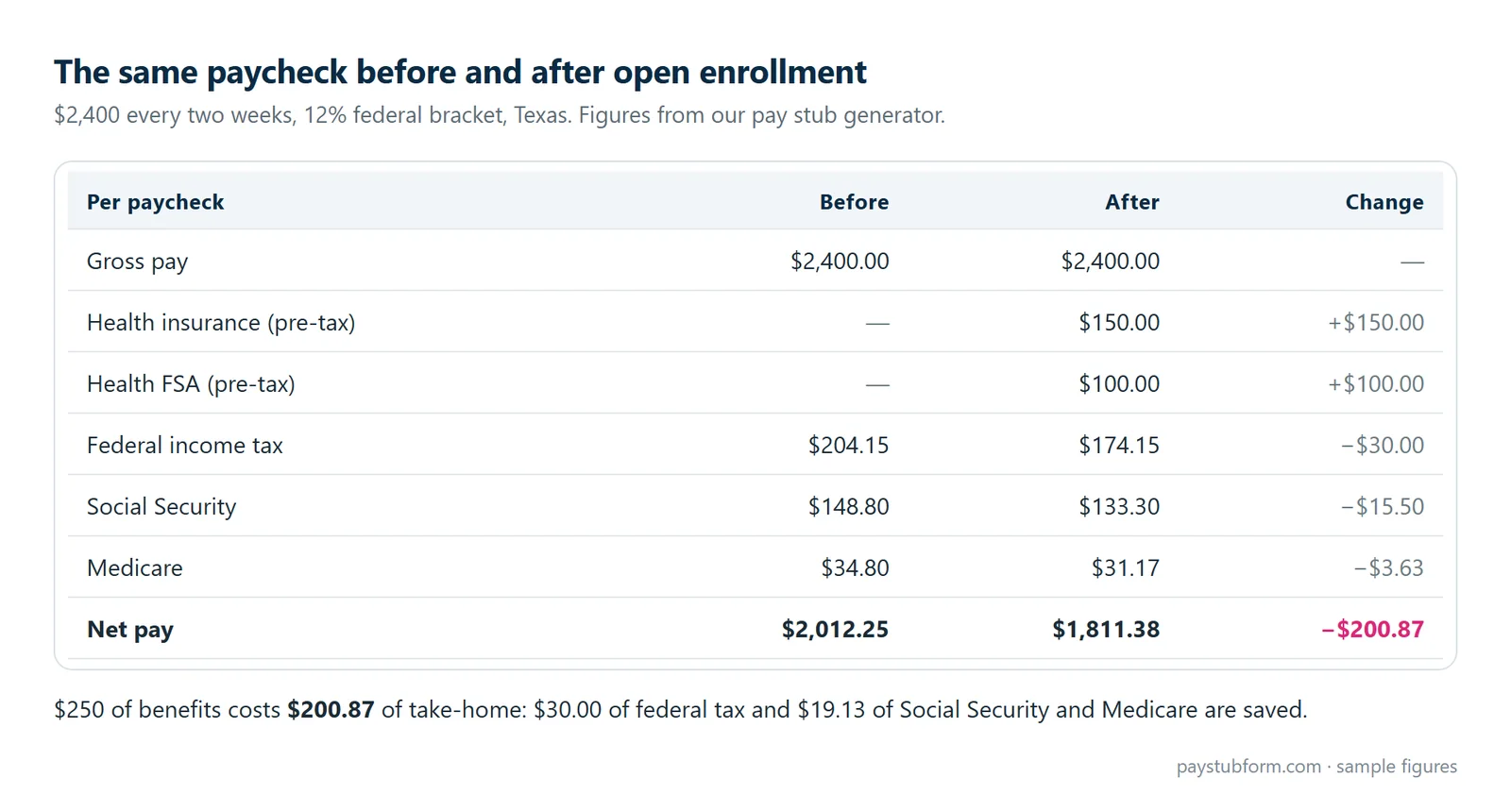
Take someone paid $2,400 every two weeks whose top federal rate is 12%. During open enrollment they elect a $150 health premium and $100 to a health FSA per paycheck — $250 of pre-tax deductions.
| Per paycheck | Amount |
|---|---|
| Pre-tax deductions elected | $250.00 |
| Federal income tax saved (12% of $250) | $30.00 |
| Social Security and Medicare saved (7.65% of $250) | $19.13 |
| Drop in take-home pay | $200.87 |
The $250 of benefits costs about $201 of take-home pay, before any state income tax saving. Put the same $250 into a traditional 401(k) instead and you save the $30 of income tax but not the $19.13, because 401(k) contributions are still subject to Social Security and Medicare.
To see the effect on your own pay, start with your current take-home in the paycheck calculator, then subtract your elections less the tax saved.
5. Elections people get wrong
- The health FSA is use-it-or-lose-it. Money left at the end of the plan year is forfeited unless your employer offers a carryover or a grace period. Elect what you are confident you will spend.
- You need a high-deductible plan to fund an HSA. And you generally cannot contribute to an HSA while covered by a general-purpose health FSA, including a spouse's.
- The HSA limit is prorated. If you are eligible for only part of the year, your limit is generally reduced.
- Doing nothing is a choice. Many plans roll your medical coverage forward, but FSA elections usually reset to zero each year unless you re-enroll.
- Dependent care FSA or the tax credit. The same expenses cannot be used for both, so compare the two before electing the maximum.
6. Check your first paycheck in January
- Each deduction matches your election. Divide the annual amount by your number of paychecks: 26 if paid every two weeks, 24 if twice a month. The 2027 payroll calendar shows how many paydays your schedule has.
- Pre-tax items are marked pre-tax. If a premium is being taken after tax by mistake, your taxes will be too high.
- Year-to-date totals restart. January begins a new year for every YTD column; see what YTD means on a pay stub.
- Social Security starts again. If you hit the wage base late last year and the 6.2% stopped, it returns with the first paycheck of the new year.
- Report errors quickly. Payroll can correct a wrong election early in the year far more easily than in December.
Not sure what a code on the deductions list means? The pay stub abbreviations guide covers the common ones, and health insurance on a pay stub shows how to find your real premium.
The five-minute version
- List what you spent on health care and dependent care this year.
- Pick the medical plan first; it decides whether you can use an HSA.
- Fund an HSA up to $4,500 (self-only) or $9,000 (family) for 2027 if you can.
- Elect a health FSA only for what you are sure to spend.
- Estimate the new take-home pay: elections minus the tax they save.
- Save your confirmation and compare it with your first January pay stub.
Quick answers
Does open enrollment change my paycheck?
Yes, if your elections or their cost change. The new deductions start with the first paycheck of the plan year, usually early January, and your tax lines change with them because most benefits are taken before tax.
Are health insurance premiums taken out before taxes?
Usually. When premiums are paid through an employer's Section 125 cafeteria plan, they are not subject to federal income tax, Social Security or Medicare.
What is the HSA contribution limit for 2027?
$4,500 for self-only coverage and $9,000 for family coverage under a high-deductible health plan, plus $1,000 if you are 55 or older. Employer contributions count toward the limit.
Can I change my benefits after open enrollment ends?
Only with a qualifying life event, such as marriage, divorce, a birth or adoption, or a change in other coverage. Otherwise elections made through a cafeteria plan stay in place for the plan year. A 401(k) contribution can usually be changed at any time.
Does a 401(k) contribution lower my Social Security and Medicare tax?
No. A traditional 401(k) contribution lowers the wages used for federal income tax, but Social Security and Medicare are still figured on it.
What happens if I miss open enrollment?
It depends on the plan. Medical coverage often continues as it was, but flexible spending account elections generally do not carry over, and you may have to wait a year to add coverage unless you have a qualifying life event.
Sources
- IRS Revenue Procedure 2026-24: the 2027 HSA contribution limits of $4,500 and $9,000.
- IRS Publication 15-B, Employer's Tax Guide to Fringe Benefits: how cafeteria plan benefits, FSAs, HSAs and dependent care assistance are treated for income tax, Social Security and Medicare.
- IRS Publication 969, Health Savings Accounts and Other Tax-Favored Health Plans: HSA eligibility, the high-deductible plan requirement and FSA rules.
- IRS — 401(k) contribution limits: the elective deferral and catch-up limits.
- IRS Topic No. 602, Child and Dependent Care Credit: why the same expenses cannot be used for both the credit and a dependent care FSA.
General U.S. information, current as of October 2026. The worked example assumes a 12% federal bracket and no state income tax; your figures depend on your pay, plan and state. Plan rules vary by employer — your enrollment materials govern.


Comments (0)
Loading comments...
Leave a Comment