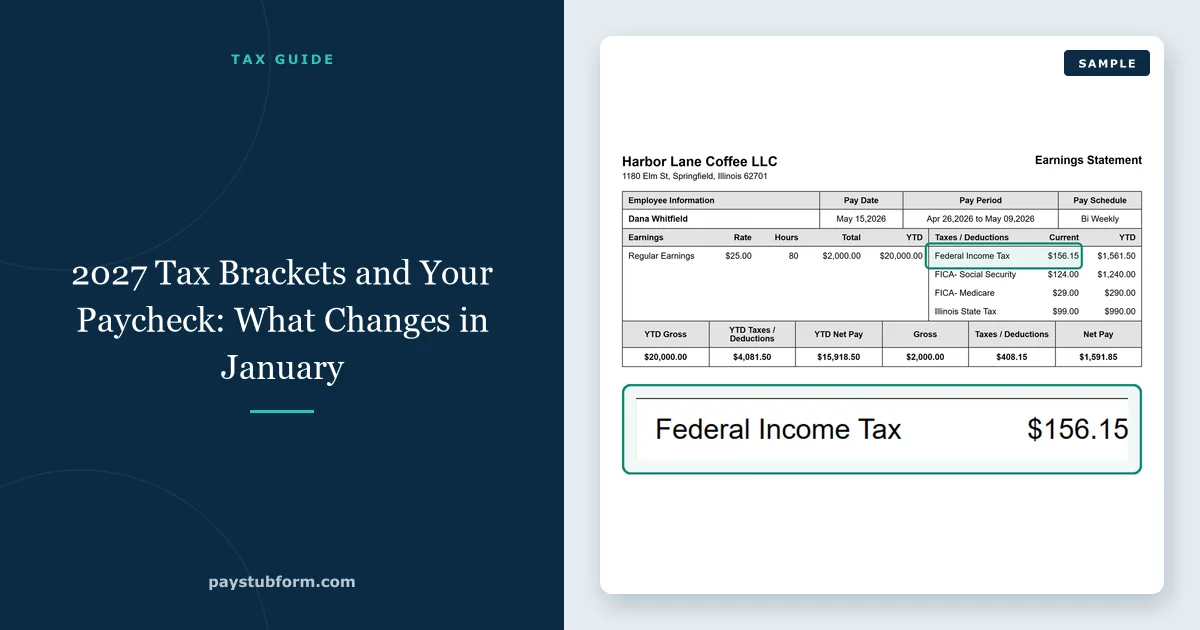
Your first paycheck of 2027 will be calculated with new numbers: inflation-adjusted tax brackets, a higher standard deduction, a new Social Security wage base and new withholding tables. For most people the combined effect is small — a few dollars more take-home per check for the same pay — but a few changes matter more, especially for higher earners, anyone changing benefits during open enrollment, and workers in states that are cutting rates.
This guide separates what is already official for 2027 from what is still a projection, shows when each official figure arrives, and explains how each one shows up on a pay stub.
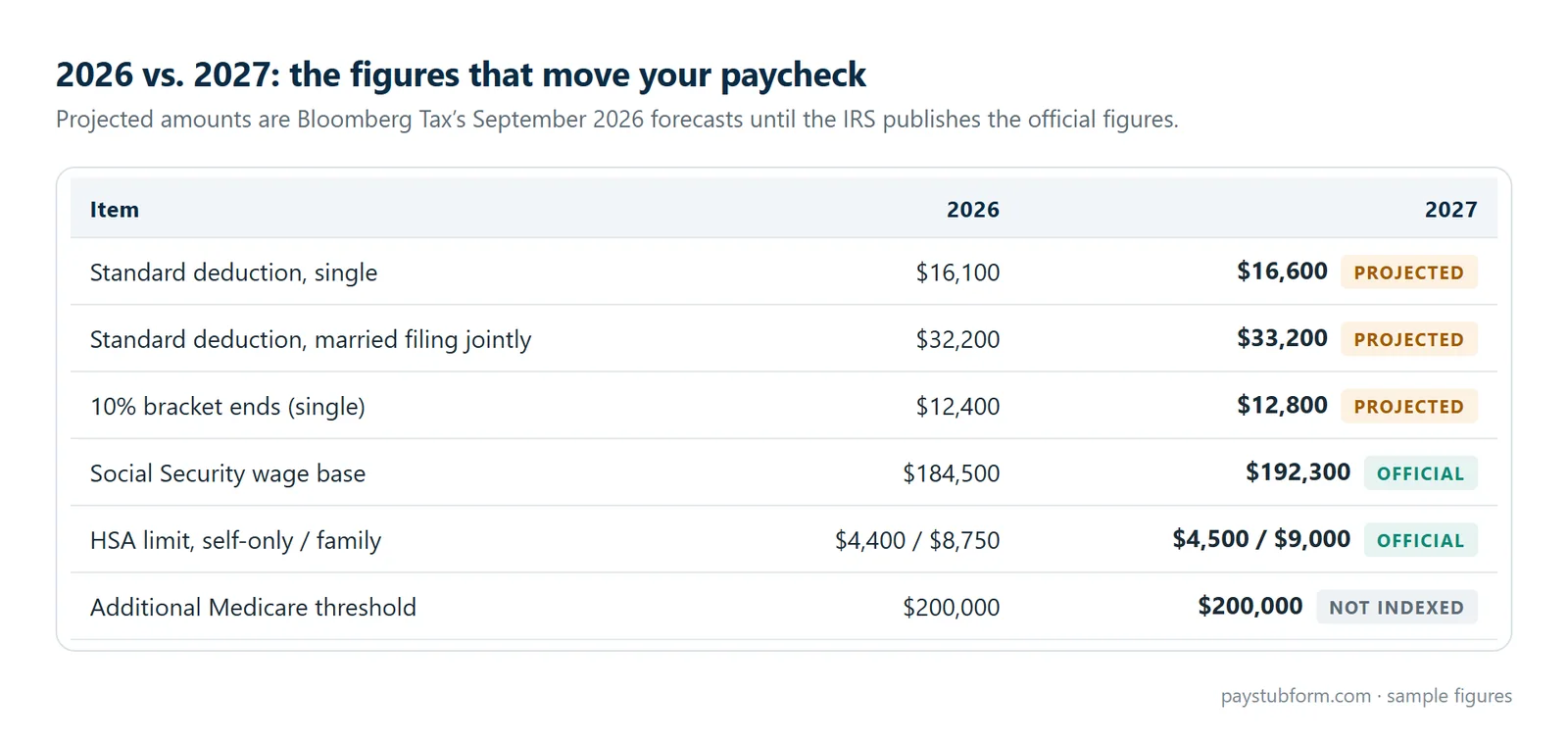
Quick take: As of October 14, 2026, two sets of 2027 figures are official: the HSA limits ($4,500 self-only, $9,000 family) and the Social Security wage base, which the SSA set at $192,300, up from $184,500, alongside a 3.6% COLA. The IRS usually publishes the new brackets and standard deduction in October or November and the 401(k) limits soon after. Projections point to brackets rising about 3.2% and the standard deduction reaching $16,600 single and $33,200 joint. The seven rates — 10% to 37% — do not change.
Status note: figures marked projected come from published forecasts, not the IRS. We will replace them with the official numbers when the IRS releases them. The Social Security figures in this guide are the SSA's official 2027 amounts.
1. 2026 versus 2027 at a glance
| Item | 2026 (official) | 2027 | Official release |
|---|---|---|---|
| Standard deduction, single | $16,100 | $16,600 projected | IRS, Oct–Nov 2026 |
| Standard deduction, married filing jointly | $32,200 | $33,200 projected | IRS, Oct–Nov 2026 |
| Standard deduction, head of household | $24,150 | about $24,950 projected | IRS, Oct–Nov 2026 |
| 10% bracket ends (single) | $12,400 | $12,800 projected | IRS, Oct–Nov 2026 |
| Social Security wage base | $184,500 | $192,300 (official) | Announced October 14, 2026 |
| Social Security / Medicare rates | 6.2% / 1.45% | Unchanged (set by law) | — |
| Additional Medicare threshold | $200,000 | $200,000 (not indexed) | — |
| 401(k) employee limit | $24,500 | Not yet announced | IRS, usually November |
| HSA limit, self-only / family | $4,400 / $8,750 | $4,500 / $9,000 (official) | Released June 2026 |
The bracket and standard deduction projections are Bloomberg Tax's, reported in September 2026. One caveat: the inflation index behind the 2027 brackets is missing a month of data from the 2025 government shutdown, so forecasters warn the official amounts could differ slightly.
2. Brackets and the standard deduction: a small raise in take-home pay
When brackets and the standard deduction rise with inflation but your pay does not, less of your income falls into each rate, and federal withholding drops slightly. The rates themselves are permanent under the 2025 tax law known as the One Big Beautiful Bill, so only the dollar thresholds move.
How much? A $500 higher standard deduction for a single filer in the 12% bracket is worth about $60 a year — roughly $2.30 per biweekly paycheck. The bracket thresholds add a little more. If you get a raise in January, most of the change on your stub will come from the raise, not the tables; our guide to gross pay versus net pay shows how the lines connect.
Payroll applies the new numbers through the IRS's 2027 withholding tables in Publication 15-T, normally released in December and used from the first payroll of the year. You do not need to file anything for this to happen.
3. Social Security wage base: why high earners pay more
Social Security tax is 6.2% of wages up to the annual wage base and stops once your year-to-date wages pass it. Medicare (1.45%) has no cap, and Additional Medicare of 0.9% applies to wages above $200,000.
The wage base rises from $184,500 to $192,300 in 2027 — more than the $190,200 the 2026 Trustees Report had projected. Anyone earning above it pays Social Security on $7,800 more of wages: about $484 more for the year at 6.2%, with the maximum employee Social Security tax rising from $11,439 to $11,922.60. Your employer pays the same amount again. Most workers never reach the base and see no change. Those who do will notice the Social Security line stopping later in 2027 than in 2026. Our guide to Social Security and Medicare on a pay stub explains the cap, and Additional Medicare tax covers the $200,000 trigger.
4. What carries over from 2026
- Overtime and tips deductions. The deductions for qualified overtime pay (up to $12,500, or $25,000 joint) and qualified tips (up to $25,000) run from 2025 through 2028, so they still apply in 2027. They are claimed on your return; to reflect them in your paychecks, use the Step 4(b) worksheet on Form W-4.
- The senior deduction. An extra deduction of up to $6,000 for people 65 and older, also through 2028, with a phase-out above $75,000 of modified AGI ($150,000 joint).
- Roth catch-up for higher earners. Since 2026, workers 50 and older whose prior-year Social Security wages from the employer exceeded the threshold ($150,000 for 2026, indexed) must make 401(k) catch-up contributions as Roth. For 2027 the test uses your 2026 wages, so check box 3 of your 2026 W-2. On the stub, catch-up contributions appear as an after-tax Roth line instead of a pre-tax one. See 401(k) contributions on a pay stub.
- The 1099 reporting threshold. Businesses file a 1099-NEC for payments of $2,000 or more made in 2026; the threshold is indexed for inflation from 2027.
5. Open enrollment changes your January stub more than taxes do
For most employees, the biggest January difference comes from benefit elections made this fall, not from the IRS. New medical, dental and vision premiums, a new HSA or FSA election, and a new 401(k) percentage all take effect with the new plan year. Pre-tax deductions also reduce taxable wages, so each one moves both the deduction and the tax lines. Our guides to health insurance on a pay stub and pre-tax versus post-tax deductions show what to check, and the 2027 HSA limits above are already final if you are choosing a contribution now. Our open enrollment guide works through the 2027 limits with an example.
6. State changes
States set their own 2027 rates and withholding tables, often late in the year, and several states have scheduled rate cuts or are phasing in paid family and medical leave contributions. Your state's line can therefore change in January even if nothing federal does. Check our state pay stub guides for your state's current rules, and state and local taxes on a pay stub for how the lines work.
7. What to do before January
- Check 2026 first. With a few paychecks left, run the IRS Tax Withholding Estimator with your latest stub. A change now has a large per-check effect because it is spread over few paychecks.
- Make open enrollment choices deliberately. Note your new premium and contribution amounts so you can check them on the first 2027 stub.
- Update your W-4 if your life changed. Marriage, a new child, a second job or a spouse's job change matter far more than the inflation adjustments. See how a W-4 change affects your paycheck.
- Compare your first 2027 stub with your last 2026 stub. Expect federal tax slightly lower for the same pay, Social Security unchanged unless you are near the cap, and benefit lines matching your elections. Our guide to why a paycheck changes works line by line.
Want to see the effect on your own numbers? Our free paycheck calculator estimates take-home pay from gross pay, filing status and state.
The five-minute version
- Rates stay at 10%–37%; only the brackets and standard deduction rise, by about 3.2% if projections hold.
- Projected standard deduction for 2027: $16,600 single, $33,200 joint.
- The 2027 Social Security wage base is official: $192,300, up from $184,500.
- 2027 HSA limits are final: $4,500 self-only, $9,000 family.
- Overtime, tips and senior deductions continue through 2028.
- Check your first January stub against your last December stub and your open enrollment elections.
Quick answers
What are the 2027 tax brackets?
The IRS has not published them yet; it usually does in October or November. Bloomberg Tax projects that thresholds will rise about 3.2%, with the 10% bracket ending at $12,800 for single filers and $25,600 for joint filers. The seven rates stay the same.
What is the 2027 standard deduction?
Projected at $16,600 for single filers and $33,200 for married couples filing jointly, up from $16,100 and $32,200 in 2026. The official figures come with the IRS's inflation adjustments.
Will my paycheck go up in 2027?
Slightly, for the same gross pay, because higher brackets and a higher standard deduction reduce federal withholding. Changes in benefit premiums, retirement contributions or state tax can outweigh that.
What is the 2027 Social Security wage base?
$192,300, up from $184,500 in 2026, as announced by the SSA on October 14, 2026. Wages above that amount are not subject to the 6.2% Social Security tax, so the maximum an employee pays in 2027 is $11,922.60. Medicare has no cap.
When do the new withholding tables start?
With the first payroll paid in 2027. Employers use the 2027 edition of IRS Publication 15-T, normally published in December.
Do I need a new W-4 for 2027?
No. Your current W-4 stays in effect. File a new one only if you want to change your withholding — or by February 15, 2027 if you claimed exemption for 2026 and want to keep it.
Sources
- IRS — Tax year 2026 inflation adjustments: 2026 brackets and standard deductions used for comparison.
- IRS — 2026 401(k) and IRA limits: the $24,500 limit and catch-up amounts.
- IRS — Rev. Proc. 2026-24: official 2027 HSA contribution limits.
- Journal of Accountancy — 2027 wage base and COLA announced: the SSA's $192,300 wage base, 3.6% COLA and $11,922.60 maximum tax.
- PayrollOrg — Trustees project 2027 wage base: the earlier $190,200 projection, for comparison.
- CBS News — 2027 tax bracket projections: Bloomberg Tax's forecast of a 3.2% adjustment.
- IRS — New and enhanced deductions for individuals: overtime, tips and senior deductions for 2025–2028.
- SSA — Contribution and benefit base: the official wage base history, including 2027.
General U.S. information, last reviewed October 14, 2026. Projected figures are forecasts and will change to official amounts when the IRS publishes them.


Comments (0)
Loading comments...
Leave a Comment