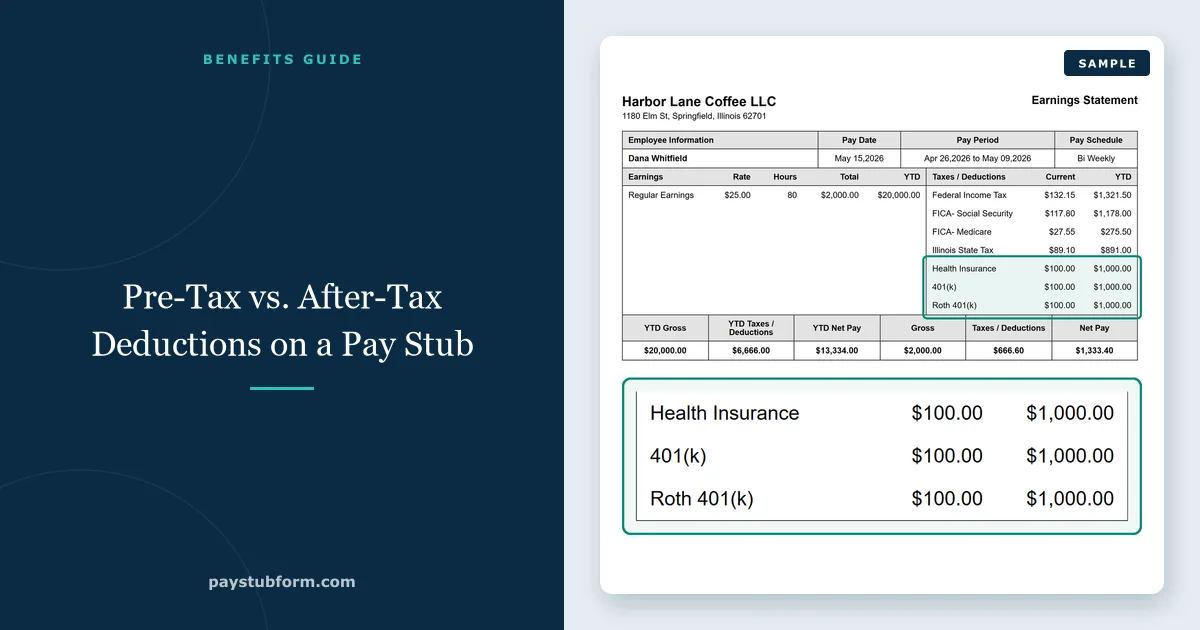
Two deductions on your pay stub can be the same size and cost you completely different amounts. One comes out before tax is calculated, so it shrinks the figure you are taxed on. The other comes out afterwards, from money that has already been taxed. A $200 pre-tax deduction might reduce your take-home by about $150; a $200 after-tax deduction reduces it by exactly $200.
That is the whole concept — but the detail that trips people up is that "pre-tax" does not mean pre-all-tax. Some pre-tax deductions escape income tax and Social Security and Medicare. Others escape only income tax. Knowing which is which explains most of the gaps on a pay stub and nearly all of the gaps on a W-2.
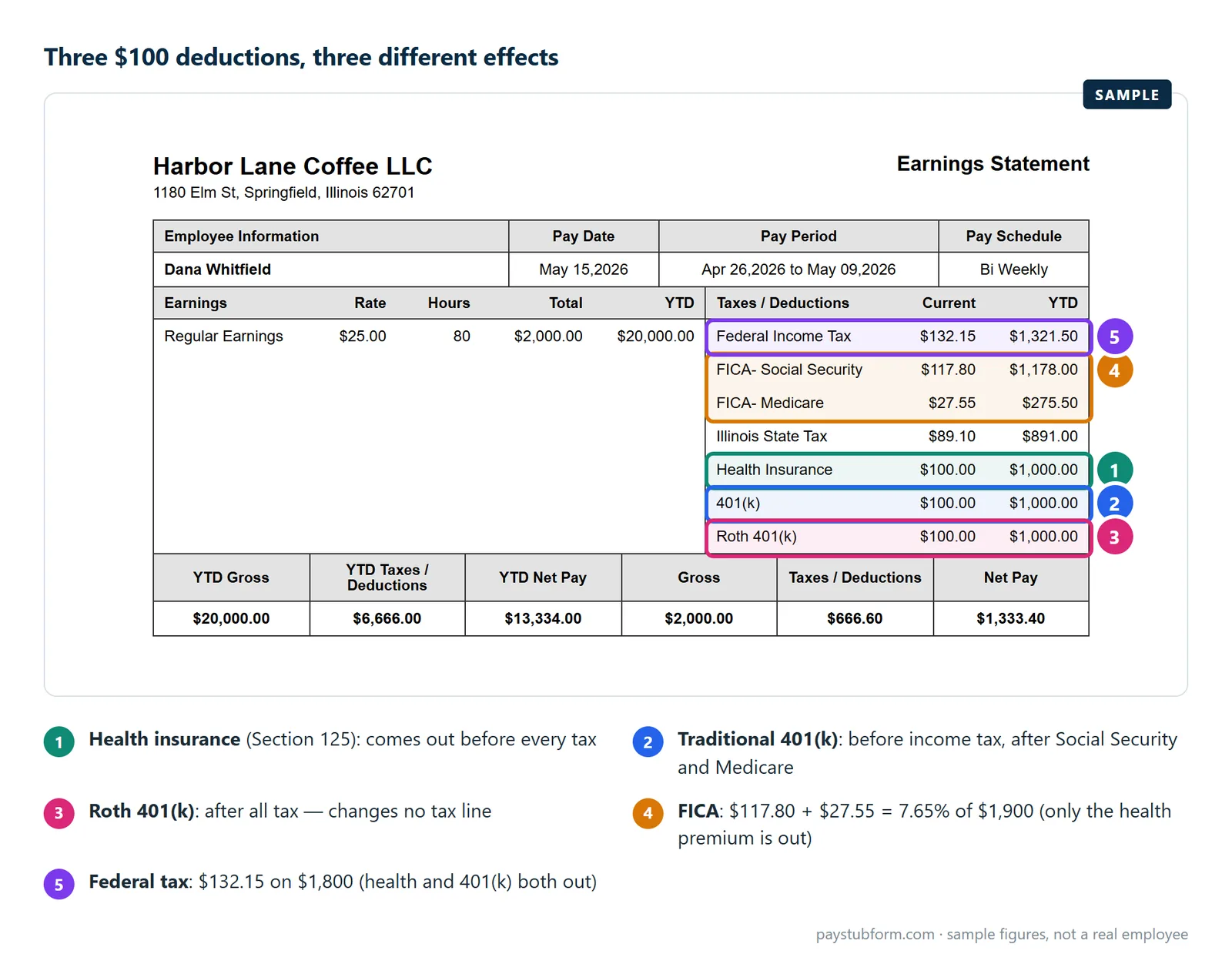
Quick take: Section 125 benefits — health premiums, FSA, HSA by salary reduction — reduce federal income tax, Social Security and Medicare wages alike. A traditional 401(k) deferral reduces only income tax wages. You pay 6.2% and 1.45% on money you put into your 401(k).
Three groups, not two
Pre-tax for everything. Benefits provided under a Section 125 cafeteria plan are generally excluded from federal income tax withholding, Social Security tax and Medicare tax. This group includes medical, dental and vision premiums, health FSA contributions, dependent care FSA, and HSA contributions made by salary reduction.
Pre-tax for income tax only. Traditional 401(k), 403(b) and 457(b) deferrals. The IRS is explicit that employee elective salary deferrals are subject to Social Security and Medicare tax while not being subject to federal income tax withholding. The money leaves before income tax and after FICA.
After-tax. Roth 401(k) contributions, union dues, garnishments, charitable giving through payroll, repayment of an employer loan, and life insurance above the excludable amount. These reduce your net pay and nothing else.
| Deduction | Federal income tax | Social Security & Medicare |
|---|---|---|
| Health, dental, vision premium (Section 125) | Reduces | Reduces |
| Health FSA / dependent care FSA | Reduces | Reduces |
| HSA by salary reduction | Reduces | Reduces |
| Commuter and parking benefits | Reduces | Reduces |
| Traditional 401(k) deferral | Reduces | Does not reduce |
| Roth 401(k) contribution | Does not reduce | Does not reduce |
| Union dues, garnishments, payroll giving | Does not reduce | Does not reduce |
The 2026 limits worth knowing
Pre-tax treatment comes with ceilings, and they change most Januaries.
- Health FSA: for plan years beginning in 2026, a cafeteria plan may not allow salary reduction contributions to a health FSA above $3,400.
- HSA: $4,400 for self-only coverage and $8,750 for family coverage in 2026, with an extra $1,000 catch-up from age 55.
- Commuter benefits: a monthly exclusion of $340 for qualified parking and $340 for transit passes and commuter highway vehicle transportation.
- Traditional 401(k): $24,500 of elective deferrals, plus $8,000 from age 50 and $11,250 between ages 60 and 63.
What a pre-tax deduction is really worth
The saving is your marginal rate, not the whole amount. In the 22% federal bracket, $200 of Section 125 premium costs you about $200 minus 22% income tax minus 7.65% FICA — roughly $141 of take-home. The same $200 as a Roth contribution costs the full $200.
A traditional 401(k) deferral sits in between: it saves the 22% income tax but not the 7.65%, so $200 deferred costs about $156 of take-home. That is still a good trade, but it is not the 29.65% saving people often assume, and it is why your Social Security and Medicare wages stay stubbornly close to your gross pay no matter how much you defer. See how the 401(k) line reads on a stub and why the FICA lines do not move with it.
The part that isn't a deduction at all
Two things on a stub look like deductions and are not.
Employer contributions. The employer's half of Social Security and Medicare, its 401(k) match and its share of your health premium are paid on top of your wages. Some stubs print them for information. They never reduce your net pay.
Imputed income. This runs the other way: it increases your taxable wages without putting anything in your pocket. The common case is employer-provided group-term life insurance — the cost of up to $50,000 of coverage is excludable, and the cost of coverage above that becomes taxable income. You will see your taxable wages exceed your gross pay and no extra money arrive.
Tip: If you cannot tell which group a deduction is in, compare the stub's taxable wage lines to gross pay. A deduction that appears in the gap between gross and federal taxable wages but not in the gap between gross and Social Security wages is a retirement deferral. One that appears in both gaps is a Section 125 benefit.
Where this shows up at year end
Every one of these rules becomes visible on your W-2, which is why the boxes disagree. Box 1 is reduced by both groups of pre-tax deductions. Boxes 3 and 5 are reduced only by the Section 125 group. Your 401(k) deferral is reported separately in Box 12 with code D, which is how the gap between Box 1 and Box 5 is explained to the IRS.
Our guide to why W-2 Boxes 1, 3 and 5 show three different figures walks through the reconciliation, and the year-to-date columns on your final stub are what you check it against.
Check your own stub in three minutes
- List every deduction and sort it into the three groups above.
- Confirm that gross pay minus the Section 125 group equals your Social Security and Medicare wages.
- Confirm that gross pay minus the Section 125 group and the retirement deferral equals your federal taxable wages.
- Anything left over that reduced net pay but no wage figure is after-tax, as it should be.
- If a deduction you elected as pre-tax is not reducing any wage figure, raise it with payroll — that is an election that was not applied, and it costs you every period until it is fixed.
State rules add their own layer on top of the federal one, and not every state follows the federal treatment of every benefit — our state-by-state guide covers what applies where. You can also create an accurate pay stub here with the deductions placed in the right groups.
Quick answers
Does a pre-tax deduction save me the full amount?
No. It saves you tax at your marginal rate on that amount, not the amount itself. $200 pre-tax typically costs around $141 to $156 of take-home depending on which group it falls in.
Does my 401(k) reduce Social Security and Medicare tax?
No. Traditional deferrals are excluded from federal income tax but remain subject to Social Security and Medicare. This is the most commonly misunderstood rule on a pay stub.
Is a Roth 401(k) contribution pre-tax?
No. Roth contributions are after-tax — they reduce your net pay without reducing any taxable wage figure. The benefit comes later, in retirement, not on this paycheck.
Why are my taxable wages higher than my gross pay?
Imputed income, most often the cost of employer-provided group-term life insurance above $50,000 of coverage. It is taxable value you received as a benefit rather than cash.
Are health premiums always pre-tax?
Only when they run through a Section 125 cafeteria plan, which is the usual arrangement but not universal. If your employer has no cafeteria plan, the premium is an after-tax deduction and reduces nothing but your net pay.
Can I change which deductions are pre-tax?
Not directly — the treatment follows the benefit and the plan, not your preference. What you can change is what you elect, and most elections are fixed until open enrolment or a qualifying life event.
Sources
- IRS Publication 15-B — Employer's Tax Guide to Fringe Benefits (2026): the $3,400 health FSA limit, the $4,400 and $8,750 HSA limits, the $340 monthly commuter exclusions, the $50,000 group-term life exclusion, and Section 125 treatment.
- IRS — Are retirement plan contributions subject to withholding for FICA, Medicare or federal income tax?: that pre-tax elective deferrals are subject to Social Security and Medicare but not federal income tax.
- IRS — 401(k) limit increases to $24,500 for 2026: the deferral and catch-up limits.
- IRS — General Instructions for Forms W-2 and W-3 (2026): how each group appears at year end, including Box 12 code D.
- IRS Topic no. 751 — Social Security and Medicare withholding rates: the 6.2% and 1.45% rates used in the worked figures.
General U.S. information, current for the 2026 tax year. Plan rules vary — your summary plan description and benefit guide govern what is offered and how it is treated.


Comments (0)
Loading comments...
Leave a Comment