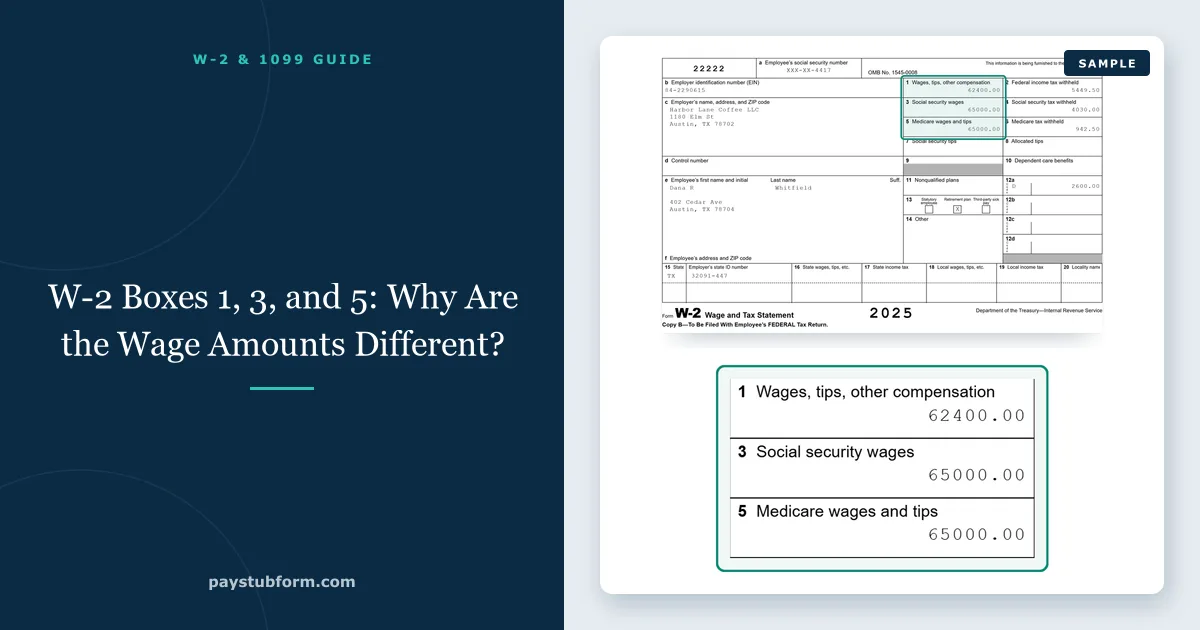
Your W-2 arrives and three boxes that should obviously all say "what I earned" say three different numbers. Box 1 is the smallest, Box 5 is usually the largest, and Box 3 sometimes matches Box 5 and sometimes stops short of it for no reason you were told about.
Nothing is wrong. Those boxes are not three attempts at the same figure — they are three different tax bases, each with its own rules about what counts. Once you know which deductions reduce which box, the gaps stop being mysterious and become something you can check in about three minutes.
Quick take: Box 1 is wages for federal income tax. Box 3 is wages for Social Security, capped at $184,500 for 2026. Box 5 is wages for Medicare, with no cap at all. A traditional 401(k) deferral lowers Box 1 but not Boxes 3 and 5; a pre-tax health premium lowers all three.
What each box actually is
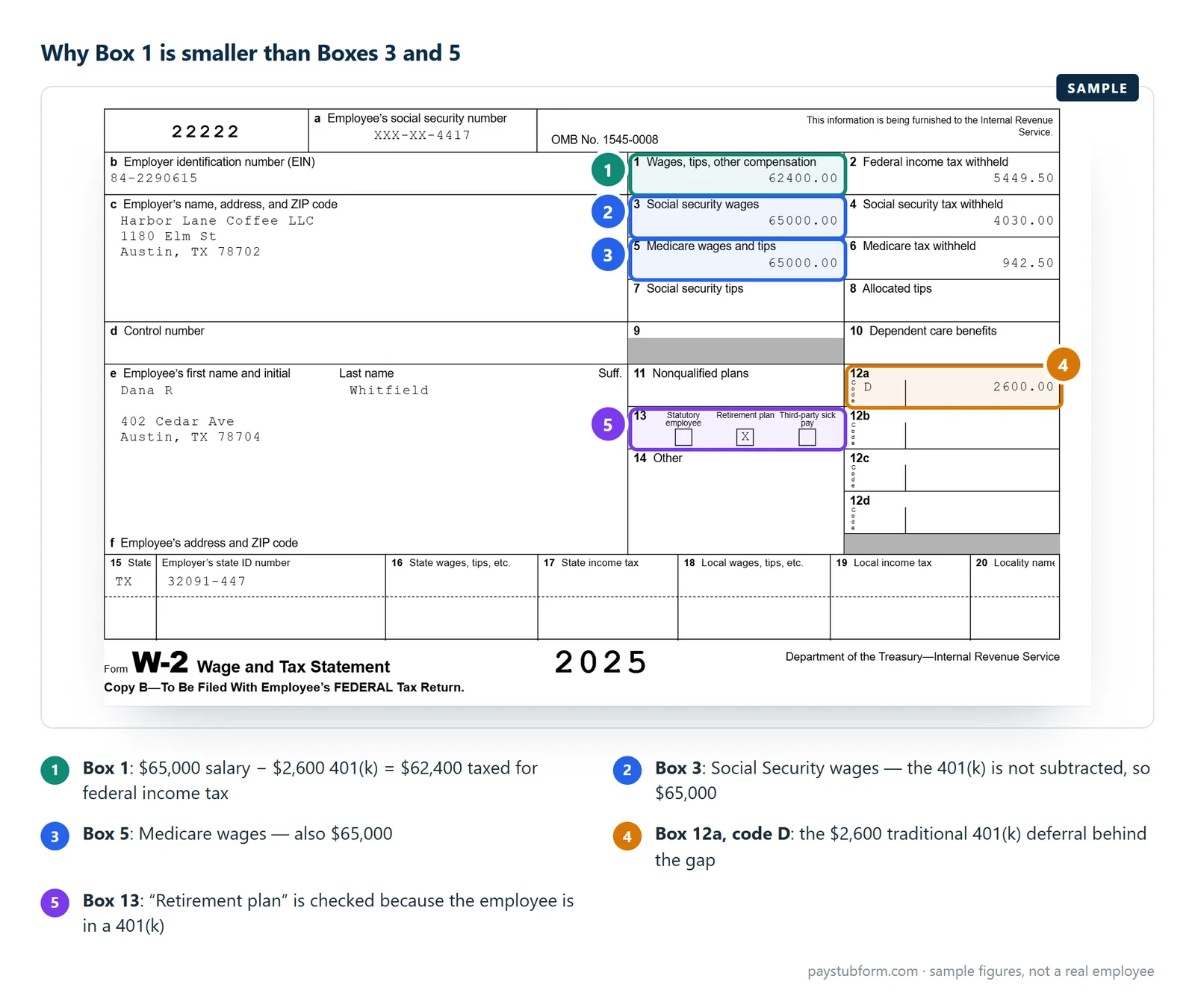
- Box 1 — Wages, tips, other compensation. The figure federal income tax was calculated on.
- Box 2 — Federal income tax withheld. What was actually taken, which is a prepayment rather than your final tax.
- Box 3 — Social Security wages. The base for the 6.2% Social Security tax, and the only one of the three with a ceiling. On a pay stub this tax is often labelled OASDI — see what OASDI tax is.
- Box 4 — Social Security tax withheld. 6.2% of Box 3.
- Box 5 — Medicare wages and tips. The base for the 1.45% Medicare tax. No ceiling.
- Box 6 — Medicare tax withheld. 1.45% of Box 5, plus any Additional Medicare Tax.
Why Box 1 is usually the smallest
Box 1 is reduced by every deduction that is excluded from federal income tax. The two most common are a traditional 401(k) deferral and anything run through a Section 125 cafeteria plan — health, dental and vision premiums, health FSA contributions, HSA contributions by salary reduction.
Defer $10,000 into a traditional 401(k) and Box 1 is $10,000 lower than your gross pay. That is the whole point of the deferral: you are not taxed on it now.
Roth 401(k) contributions do the opposite — they come out after tax, so they do not reduce Box 1 at all. Checking which one you are in is a two-minute job on the stub.
Why Boxes 3 and 5 are usually larger
Here is the rule that explains most of the confusion, and it is one people get backwards constantly.
A pre-tax 401(k) deferral is not excluded from Social Security and Medicare wages. The IRS is explicit: employee elective salary deferrals are subject to Social Security and Medicare tax, and not subject to federal income tax withholding. So that same $10,000 is missing from Box 1 and present in Boxes 3 and 5 — you paid 6.2% and 1.45% on money you never received.
Section 125 benefits behave differently: they are generally excluded from federal income tax, Social Security tax and Medicare tax alike. A pre-tax health premium lowers all three boxes.
So the arithmetic for a typical employee is roughly:
| Item | Box 1 | Boxes 3 and 5 |
|---|---|---|
| Traditional 401(k) deferral | Reduces | Does not reduce |
| Roth 401(k) contribution | Does not reduce | Does not reduce |
| Section 125 health premium | Reduces | Reduces |
| Health FSA / HSA by salary reduction | Reduces | Reduces |
| Group-term life over $50,000 | Increases | Increases |
Why Box 3 can be smaller than Box 5
Social Security tax applies only up to an annual ceiling. For 2026 that ceiling — the contribution and benefit base — is $184,500. Medicare has no ceiling whatsoever.
So for anyone earning above $184,500, Box 3 stops at exactly $184,500 while Box 5 keeps counting. Earn $300,000 and your W-2 shows Box 3 at $184,500 and Box 5 at around $300,000, and both are correct.
Box 4 follows from that: 6.2% of $184,500 is $11,439.00, which is the most any single employer will withhold in Social Security tax for 2026. If you worked for two employers and your Box 4 figures add up to more than that, the excess can be claimed back — see our guide to the two FICA lines.
Box 12 code D, and the match that appears nowhere
Your 401(k) deferral is not invisible on the W-2 — it is reported separately in Box 12 with code D. That is how the IRS reconciles the gap between Box 1 and Box 5 without you having to explain it.
Your employer's matching contribution, on the other hand, appears in none of these boxes. Matching and non-elective employer contributions are subject to neither FICA nor federal income tax at the time they are made, so they are not wages and nothing on the W-2 reports them as such. A match is real money and it is not on your W-2.
Tip: Box 1 plus Box 12 code D should land close to Box 5 for most employees. If it does not, the difference is usually a Section 125 benefit — which reduced Box 5 as well — or imputed income from group-term life insurance over $50,000.
New on 2026 W-2s: codes TT, TP and TA
The W-2 for 2026 wages adds three Box 12 codes. TT is qualified overtime: only the premium half of time and a half. TP is the cash tips you reported to your employer, with an occupation code in the new Box 14b. TA is an employer contribution to a Trump account. None of them changes the arithmetic above: overtime and reported tips are still included in Boxes 1, 3 and 5, and the overtime and tips deductions are claimed on your return rather than taken off Box 1. A TA contribution is left out of Box 1 but, under the proposed rules, still counts toward Boxes 3 and 5. Our guide to every W-2 Box 12 code explains each one and how to check it against your final stub.
Check your own W-2 in three minutes
- Take Box 5 as the starting point — it is closest to your actual gross wages for the year.
- Subtract Box 1 from Box 5. The difference should be your traditional 401(k) deferral, which is Box 12 code D, plus any other deduction that reduces income tax but not FICA.
- Check Box 3. If it equals Box 5, you earned under $184,500. If it stops at exactly $184,500, that is the 2026 wage base doing its job.
- Multiply Box 3 by 6.2% and compare to Box 4. Multiply Box 5 by 1.45% and compare to Box 6 — Box 6 will be higher if you crossed $200,000 and picked up the Additional Medicare Tax.
- Compare the whole thing against the year-to-date totals on your final pay stub of the year. They should agree, and that is exactly what those YTD columns are for.
If something does not reconcile, raise it before you file rather than after — a corrected W-2 is far easier to obtain in February than in May. Our guide to gross pay versus net pay covers the deduction stack these boxes are built from, and you can create an accurate pay stub here if you need a clean record of a period.
Quick answers
Why is Box 1 lower than my salary?
Because pre-tax deductions came out before federal taxable wages were calculated — most commonly a traditional 401(k) deferral and Section 125 health premiums. Box 1 is a tax base, not your salary.
Why are Boxes 3 and 5 higher than Box 1?
Because a traditional 401(k) deferral is excluded from federal income tax but not from Social Security and Medicare tax. The deferred amount is missing from Box 1 and present in Boxes 3 and 5.
Why does Box 3 stop at a round number?
That number is the Social Security wage base — $184,500 for 2026. Social Security tax applies only up to it, so Box 3 cannot exceed it no matter what you earned.
Should Box 3 and Box 5 ever differ for a normal earner?
Below the wage base they are usually identical, because the same deductions reduce both. They diverge mainly above $184,500, and occasionally for specific wage types treated differently by the two taxes.
Where is my employer's 401(k) match on the W-2?
Nowhere. Employer matching and non-elective contributions are not subject to FICA or federal income tax when made, so they are not reported as wages in any box. Only your own deferral appears, in Box 12 code D.
Does code TT lower my Box 1 wages?
No. Qualified overtime in code TT is still included in Box 1, Box 3 and Box 5. The overtime deduction is claimed on your return, on Schedule 1-A, and reduces your taxable income there.
My W-2 doesn't match my last pay stub. Which is right?
Usually both, measuring different things — the stub's gross pay is not any of the W-2 tax bases. Compare the stub's year-to-date taxable wage lines rather than its gross, and if those still disagree, ask payroll for a reconciliation before filing.
Sources
- IRS — General Instructions for Forms W-2 and W-3 (2026): what belongs in each box, the Box 3 wage base limit, and Box 12 code D for elective deferrals.
- IRS — Are retirement plan contributions subject to withholding for FICA, Medicare or federal income tax?: that pre-tax elective deferrals are subject to Social Security and Medicare but not federal income tax, and that employer contributions are subject to neither.
- Social Security Administration — Contribution and Benefit Base: the $184,500 figure for 2026.
- IRS Topic no. 751 — Social Security and Medicare withholding rates: the 6.2% and 1.45% rates behind Boxes 4 and 6.
- IRS Publication 15-B — Employer's Tax Guide to Fringe Benefits (2026): Section 125 treatment and the $50,000 group-term life exclusion.
General U.S. information, current for the 2026 tax year. Your own figures depend on your benefit elections and your employer's plan; for advice on your return, speak to a tax professional.


Comments (0)
Loading comments...
Leave a Comment