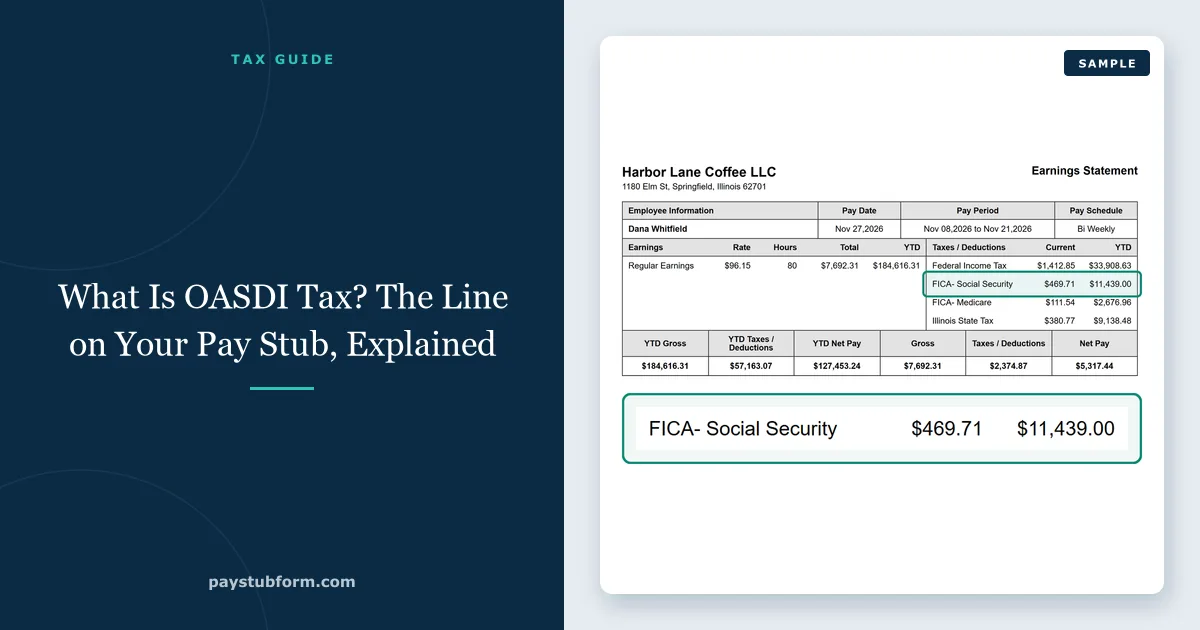
OASDI tax is Social Security tax. The letters stand for Old-Age, Survivors, and Disability Insurance, the official name of the Social Security program, and the line on your pay stub is your 6.2% contribution to it — charged on wages up to $184,500 in 2026 and $192,300 in 2027.
It is not a separate tax on top of Social Security, it is not federal income tax, and it is not something you get back at tax time. What it buys you is work credits toward retirement, disability and survivor benefits. Here is how to read the line, how to check the amount yourself, and the handful of situations where it should not be on your stub at all.
Quick take: OASDI = Social Security. You pay 6.2% of your Social Security wages, your employer pays another 6.2% that never comes out of your check, and the line stops for the year once your wages with that employer reach the wage base. Medicare (1.45%) is the separate line next to it, and it never stops.
1. The names OASDI goes by on a pay stub
Payroll software rarely prints "Social Security" in full. Depending on who runs your payroll, the same 6.2% deduction can appear as:
- OASDI or Fed OASDI/EE — the usual label on ADP stubs. "EE" means employee: your share.
- OASDI/ER — the employer's matching share. If it is printed, it is for information only and is not subtracted from your pay.
- SS, SOC SEC, SS Tax or FICA-SS — the same tax under a shorter label.
- FICA — some employers combine Social Security and Medicare into one 7.65% line. In that case there is no separate OASDI line to find.
The line right next to it is almost always Medicare, shown as MED, Fed MED/EE, HI (Hospital Insurance) or FICA-Med. Our pay stub abbreviations glossary decodes the rest of the codes you are likely to see.
2. The rates and limits for 2026 and 2027
The employee rate has been 6.2% since 1990, apart from a temporary cut to 4.2% in 2011 and 2012. What changes every year is the wage base — the most wages the tax applies to in a calendar year. The Social Security Administration announces the next year's figure each October.
| 2026 | 2027 | |
|---|---|---|
| Employee OASDI rate | 6.2% | 6.2% |
| Employer OASDI rate | 6.2% | 6.2% |
| Wage base (taxable maximum) | $184,500 | $192,300 |
| Most an employee pays in the year | $11,439.00 | $11,922.60 |
| Earnings for one work credit | $1,890 | $1,970 |
If you earn more than $192,300, expect about $483.60 more OASDI tax in 2027 than in 2026. The rate is not going up. The ceiling is. That is one of the reasons the first paycheck of a new year can come out smaller than the last one of the old year — our 2027 paycheck guide covers the other reasons.
3. How to calculate OASDI on your own paycheck
The formula is short: Social Security wages × 6.2%. The part people get wrong is the first number. Social Security wages are not the same as gross pay.
- Pre-tax health, dental and vision premiums (a Section 125 cafeteria plan) reduce Social Security wages.
- Traditional 401(k) and 403(b) deferrals do not. They lower your federal income tax but you still pay OASDI on that money. See how 401(k) contributions appear on a pay stub.
- Taxable fringe benefits such as group-term life insurance over $50,000 add to Social Security wages without adding cash to your check.
Worked example — biweekly paycheck:
| Line | Amount |
|---|---|
| Gross pay | $2,000.00 |
| Pre-tax medical premium (Section 125) | −$120.00 |
| Traditional 401(k), 5% | $100.00 (does not reduce OASDI wages) |
| Social Security wages | $1,880.00 |
| OASDI (6.2%) | $116.56 |
| Medicare (1.45%) | $27.26 |
Multiply gross pay by 6.2% instead and you get $124.00 — a $7.44 gap that looks like a payroll error and is not one. The stub is right; the base was wrong. If you want to see the whole check worked out, our paycheck calculator applies the same rules by state.
4. Why OASDI disappears from some stubs in the fall
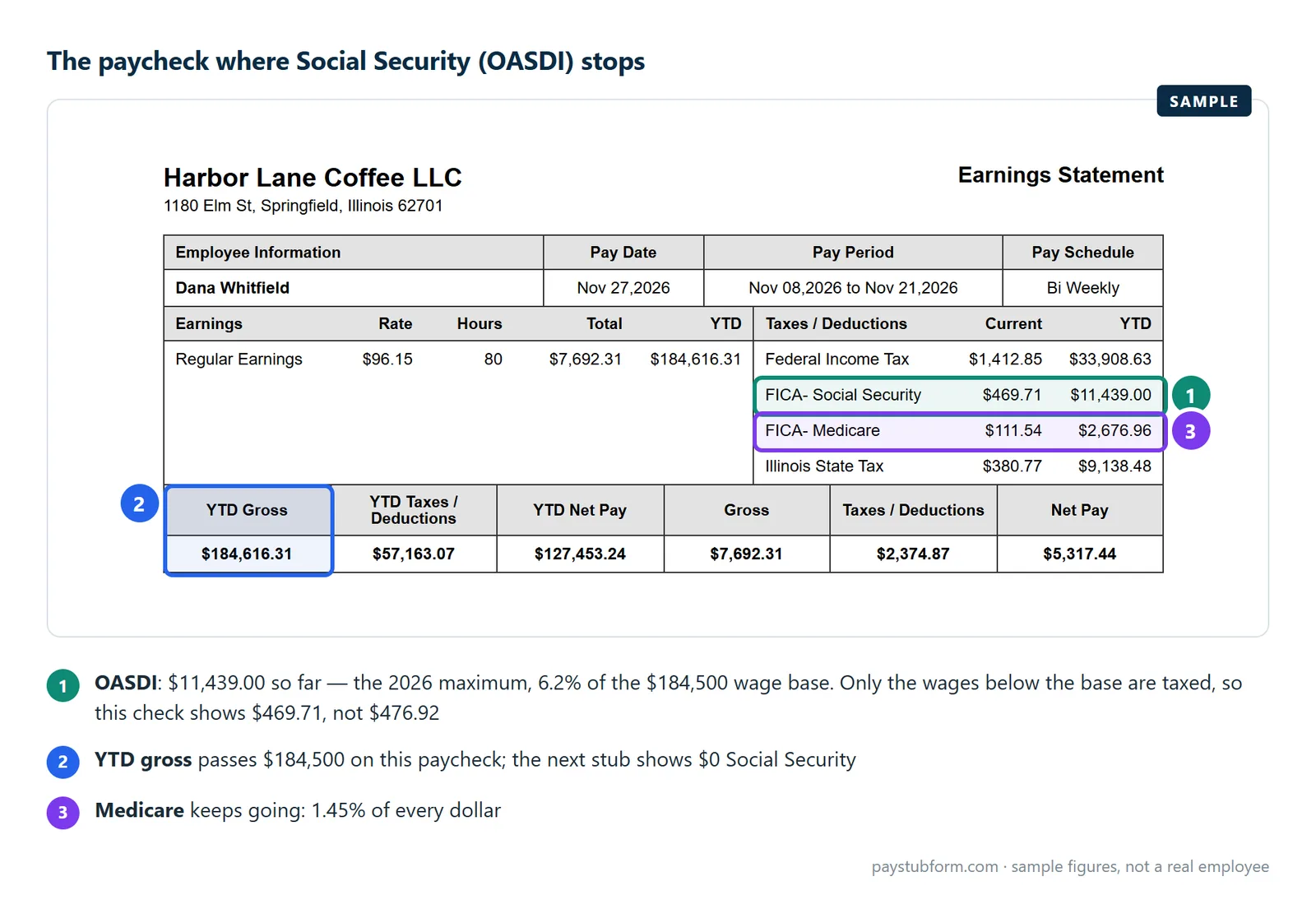
Once your year-to-date Social Security wages with one employer reach the wage base, OASDI withholding stops for the rest of the calendar year. Your net pay rises by 6.2% of gross overnight, and the line returns with your first paycheck in January.
Example — $250,000 salary, paid semi-monthly: each check is $10,416.67 and carries $645.83 of OASDI. After 17 checks, year-to-date wages are $177,083.33. The 18th check (around September 15) only has $7,416.67 left under the 2026 base, so OASDI on it is $459.83. From the 19th check on, there is no OASDI line at all. In 2027 the higher $192,300 base pushes the cut-off back by roughly one pay period.
Medicare does not do this. It has no wage base, and above $200,000 an extra 0.9% starts instead — see the Additional Medicare Tax. If OASDI has stopped and your year-to-date Social Security wages are still well below the base, that is worth a question to payroll.
5. What your OASDI money actually buys
OASDI is not a savings account and there is no balance to withdraw. It funds monthly benefits paid by Social Security, and paying it is how you qualify for them:
- Old-age: retirement benefits. You generally need 40 work credits — about ten years of work.
- Survivors: benefits paid to your spouse, children or dependent parents if you die.
- Disability: monthly benefits if you cannot work because of a long-term disability, with a lower credit requirement for younger workers.
You earn one credit for each $1,890 of covered earnings in 2026 ($1,970 in 2027), up to four a year. Earn $7,560 or more in 2026 and you have your four. The size of your eventual benefit is based on your highest 35 years of earnings — which is one more reason wages that never show up on a W-2 cost you later. If you are paid in cash, that money only counts if someone reports it.
6. Who does not pay OASDI on their wages
Most employees pay it. A few groups are exempt, and if you are in one of them, an OASDI line on your stub may be a mistake:
- Students working for their own school. Students enrolled at least half-time who work for the college or university they attend are generally exempt from both Social Security and Medicare on those wages. Off-campus jobs do not qualify.
- F-1, J-1 and M-1 students who are nonresident aliens. Generally exempt during their first five calendar years in the U.S. on work their visa allows. F-2, J-2 and M-2 family members are not.
- Children under 18 working for a parent's business. Exempt when the business is a sole proprietorship or a partnership of both parents. A corporation does not qualify.
- Some state and local government employees covered by a public retirement system instead of Social Security. Most still pay Medicare.
- Railroad employees, who pay Railroad Retirement (RRTA) tax instead.
- Ministers, whose church wages are not subject to FICA withholding — they pay self-employment tax on their own.
If OASDI was withheld when it should not have been, ask the employer to refund it first. If the employer will not, file IRS Form 843 — international students attach Form 8316.
7. OASDI if you work for yourself
There is no employer to pay the other half, so you pay both: 12.4% for Social Security as part of the 15.3% self-employment tax. It is charged on 92.35% of your net self-employment earnings, up to the same wage base, and calculated on Schedule SE when you file.
If you have both a W-2 job and side income, your W-2 wages fill the wage base first. Earn $150,000 at the job in 2026 and only the next $34,500 of self-employment earnings is subject to the 12.4%. Our guide to pay stubs for the self-employed shows how to set aside money for it each month.
8. Where OASDI shows up on your W-2
At year-end your total lands on your W-2 in two boxes:
- Box 3 — Social Security wages: your OASDI wages for the year, capped at the wage base.
- Box 4 — Social Security tax withheld: should equal Box 3 × 6.2%, give or take a few cents of rounding.
Box 3 is often higher than Box 1 because 401(k) deferrals are taken out of Box 1 but not Box 3. Our explainer on W-2 Boxes 1, 3 and 5 walks through the differences. If you worked two jobs and Box 4 across all your W-2s adds up to more than $11,439.00 for 2026, the excess comes back as a credit when you file.
The five-minute version
- Find the OASDI, SS or Fed OASDI/EE line on your stub — that is Social Security tax.
- Find Social Security wages for the period (not gross pay) and multiply by 6.2%.
- Check the year-to-date line: it should never pass $11,439.00 in 2026 or $11,922.60 in 2027 with one employer.
- If the line stopped, confirm year-to-date Social Security wages have reached the wage base.
- If you are a student working on campus, an F-1/J-1/M-1 student, or under 18 working for a parent, check whether you should be exempt.
Our full guide to Social Security and Medicare on your pay stub covers Medicare and the Additional Medicare Tax in more depth. If you need stubs that show these lines correctly, you can create a pay stub with the current rates already applied.
Quick answers
What does OASDI mean on my paycheck?
OASDI is Social Security tax — Old-Age, Survivors, and Disability Insurance. It is a 6.2% deduction from your Social Security wages, and your employer pays a matching 6.2% on top.
Is OASDI the same as federal income tax?
No. Federal income tax depends on your W-4 and appears as a separate line, often "Fed Inc Tax", "FIT" or "Federal Withholding". OASDI is a flat 6.2% that your W-4 does not change.
Do I get OASDI back in my tax refund?
Normally no. It is not a prepayment of income tax. The exceptions are over-withholding when two or more employers together took OASDI on more than the wage base, and tax withheld from someone who was exempt.
Is OASDI the same as FICA?
OASDI is one part of FICA. FICA is the Social Security tax (6.2%) plus the Medicare tax (1.45%), 7.65% in total for an employee.
Why did my OASDI stop?
Your year-to-date Social Security wages with that employer reached the wage base — $184,500 in 2026. It restarts with your first paycheck in January.
Can I opt out of OASDI?
Not as an ordinary employee. Only the specific groups covered above — certain students, nonresident visa holders, young children of business owners, some government and railroad workers, and ministers — are outside it.
Sources
- Social Security Administration — Contribution and Benefit Base: the 6.2% rate and the $184,500 wage base for 2026.
- Journal of Accountancy — Social Security wage base and COLA announced for 2027: the $192,300 wage base for 2027.
- Social Security Administration — Quarter of Coverage: earnings needed for one work credit ($1,890 for 2026).
- IRS Topic no. 751 — Social Security and Medicare withholding rates: employee and employer rates.
- IRS — Foreign student liability for Social Security and Medicare taxes: the F-1/J-1/M-1 and student exemptions, and Forms 843 and 8316.
- IRS Publication 15 — Employer's Tax Guide: family employees, ministers and other special classes of employment.
- IRS Topic no. 554 — Self-employment tax: the 12.4% Social Security portion and the 92.35% rule.
General U.S. information, current for the 2026 tax year with 2027 figures as announced in October 2026. Individual results depend on your pay, your benefit elections and applicable state or local rules; for advice on your own situation, speak to a tax professional.


Comments (0)
Loading comments...
Leave a Comment