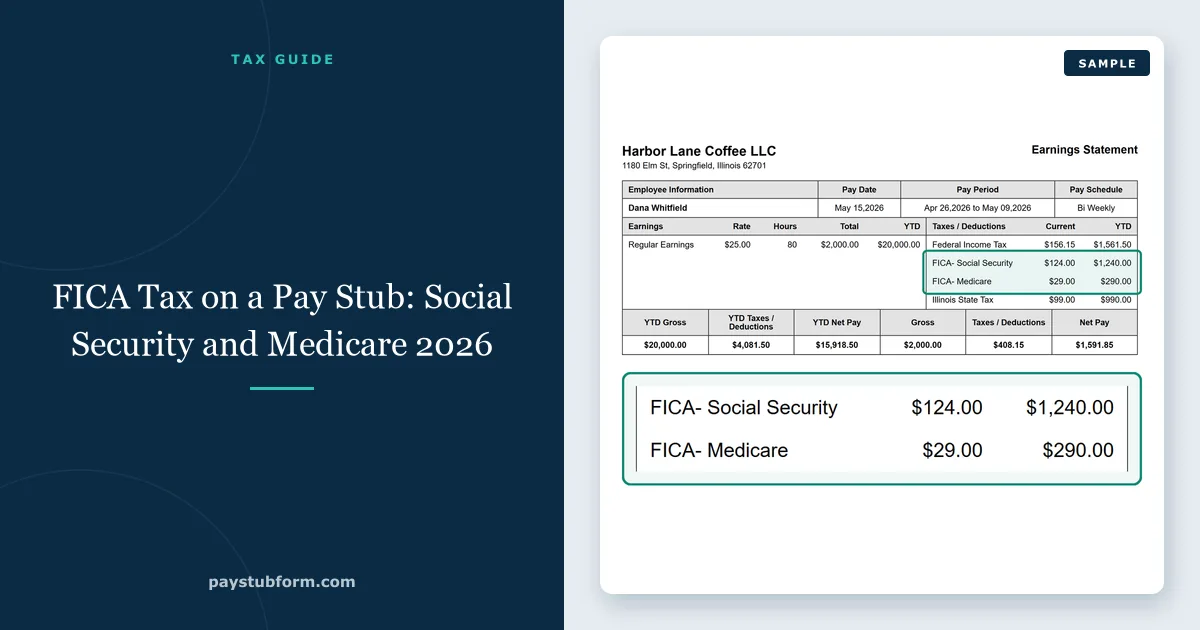
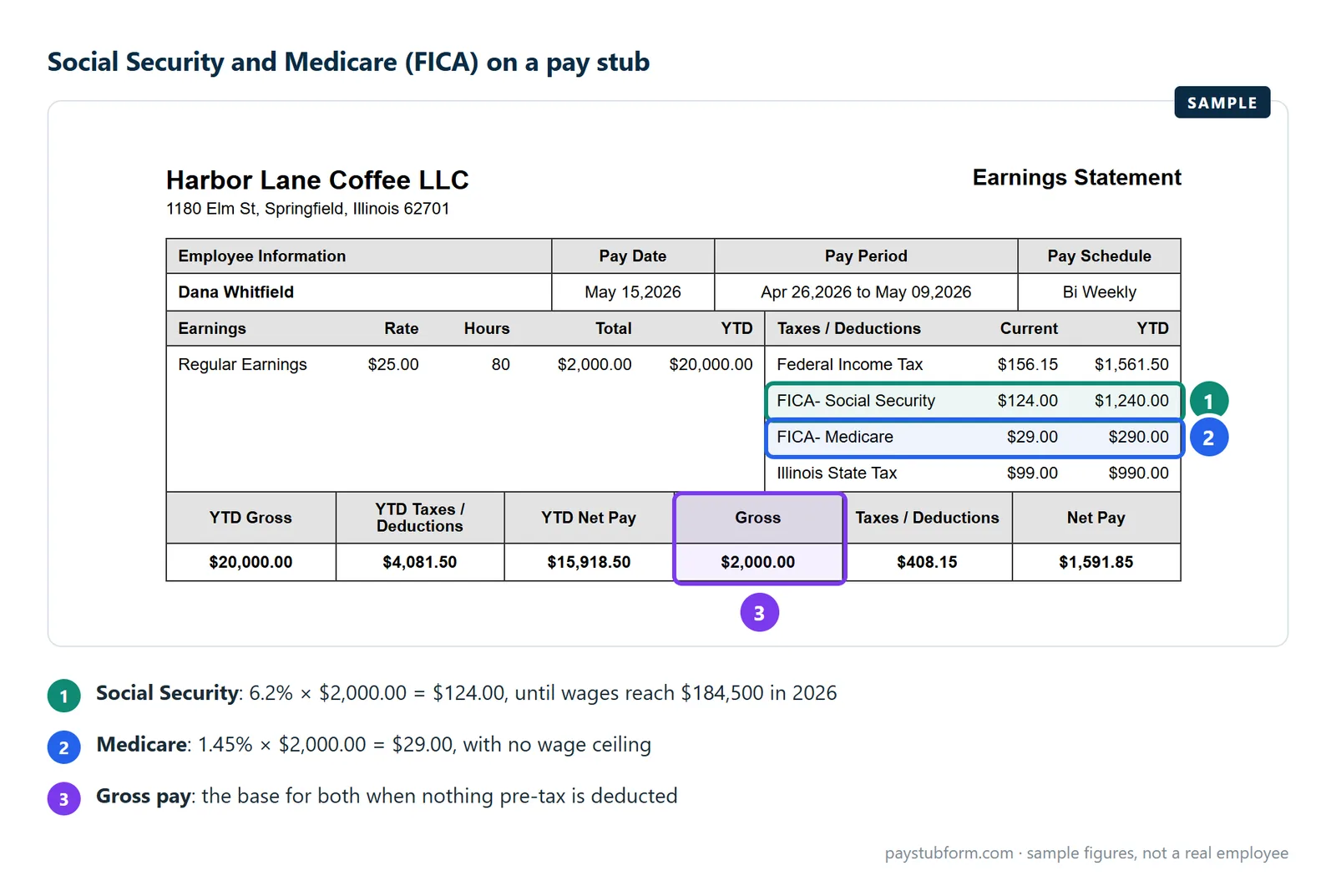
Two lines on your pay stub fund programs you will not touch for decades, and they are deducted under names that explain nothing. Social Security and Medicare on a pay stub might appear as FICA, as OASDI and HI, as Fed OASDI/EE and Fed MED/EE, or simply as SS and MED. They are not federal income tax, they are not withheld the same way, and only one of the two ever stops.
That difference is the source of most of the confusion. One of these lines disappears from some people's stubs in October and never comes back until January, which looks like a payroll error and is not one. The other quietly grows by 0.9% partway through the year for a smaller group of people. Here is what each line is, what the 2026 figures are, and how to check your own stub against them.
Quick take: In 2026 the employee rates are 6.2% for Social Security on the first $184,500 of wages, and 1.45% for Medicare on every dollar with no ceiling at all.
What these lines are called on your stub
Payroll systems do not agree on names, which is why the same deduction looks different when you change jobs. The labels you are most likely to see:
- Social Security: OASDI, Fed OASDI/EE, SS, SOC SEC, FICA-SS, or FICA Social Security. OASDI stands for Old-Age, Survivors, and Disability Insurance.
- Medicare: HI, Fed MED/EE, MED, FICA-Med, or Medicare. HI stands for Hospital Insurance.
- Both together: some employers print a single "FICA" line that combines the two at 7.65%. FICA is the Federal Insurance Contributions Act, the law that authorises both.
The "/EE" suffix means employee — your half. If you also see "/ER" lines, that is the employer's half, shown for information. It is not taken out of your pay. The same goes for employer-only taxes such as FUTA — see what FUTA tax is.
Social Security: 6.2% until your wages reach $184,500
The employee rate is 6.2% of covered wages, and the employer pays a matching 6.2%, for 12.4% in total. But the employee portion only applies up to an annual ceiling the Social Security Administration calls the contribution and benefit base — most people call it the wage base or the taxable maximum. On many stubs this line is labelled OASDI — what OASDI tax is covers it in full.
For 2026 that base is $184,500, up from $176,100 in 2025. It moves every year with the national average wage index, which is why the figure is worth re-checking each January rather than remembering. Our 2027 paycheck guide tracks next year's base as the SSA announces it.
Multiply it out and the ceiling becomes concrete. The most any one employee pays in Social Security tax in 2026 is 6.2% of $184,500, or $11,439.00. In 2025 the maximum was $10,918.20. If you earn above both ceilings, your Social Security tax went up by $520.80 this year — not because the rate changed, but because the base did. That is one of the more common reasons a January paycheck comes out different from December's.
Once your year-to-date Social Security wages with that employer reach $184,500, the line stops. Your net pay jumps by 6.2% of your gross for the rest of the year, and in January it starts again from zero.
Medicare: 1.45%, and it never stops
The employee Medicare rate is 1.45%, matched by the employer for 2.9% total. There is no wage base. Someone earning $40,000 and someone earning $4 million both pay 1.45% on every dollar of Medicare wages.
This is the single most useful thing to know about the two lines, because it explains the stub that confuses people most: Social Security has vanished, Medicare has not, and nothing is broken.
| Line | Employee rate | Employer rate | 2026 wage ceiling |
|---|---|---|---|
| Social Security (OASDI) | 6.2% | 6.2% | $184,500 |
| Medicare (HI) | 1.45% | 1.45% | None |
| Additional Medicare | 0.9% | None | Starts above $200,000 |
The extra 0.9% above $200,000
Above a certain point a third line can appear, often labelled Addl Medicare or Additional Medicare Tax. It is 0.9% on wages above the threshold, and unlike the other two, the employer does not match it.
The rule your employer follows is mechanical: withhold the extra 0.9% once it has paid you more than $200,000 in a calendar year, without regard to your filing status. Your employer does not know whether you are married, and does not take it into account.
The rule the IRS applies when you file is different. The thresholds there are $250,000 for married filing jointly, $125,000 for married filing separately, and $200,000 for everyone else. Because the two rules do not match, two things can happen:
- You had too much withheld. A married couple where one spouse earns $230,000 and the other earns nothing had 0.9% withheld on $30,000, but their joint threshold is $250,000. The over-withholding comes back when they file.
- You had too little withheld. Two spouses earning $150,000 each are $50,000 over the joint threshold, but neither employer paid over $200,000, so neither withheld anything. The balance is due at filing.
Either way it is reconciled on Form 8959, filed with your return. There is more detail in our guide to the Additional Medicare Tax and the $200,000 trigger.
Why the taxed wages do not match your gross pay
If you multiply 6.2% by your gross pay and the answer does not match the stub, the rate is not wrong — the base is. Social Security and Medicare are charged on Social Security wages and Medicare wages, which are their own figures, usually printed in the year-to-date block and almost never equal to gross pay.
What moves them apart:
- Traditional 401(k) contributions reduce your federal income tax wages but not your FICA wages. Defer $500 and you still pay Social Security and Medicare on that $500. This catches people out constantly — see how 401(k) contributions appear on a pay stub.
- Pre-tax health, dental and vision premiums under a Section 125 plan generally reduce all three. Income tax wages, Social Security wages and Medicare wages all fall.
- Group-term life insurance over $50,000 adds imputed income that raises FICA wages without adding anything to your net pay.
This is also why Boxes 1, 3 and 5 on your W-2 rarely carry the same number. Box 1 is federal taxable wages, Box 3 is Social Security wages (capped at $184,500 for 2026) and Box 5 is Medicare wages (uncapped). Three different bases, three different figures, all correct. Our guide on the difference between gross pay and net pay covers how the rest of the deductions stack up.
Two jobs in one year? Check this before you file
The wage base applies per employer, not per person. Each employer withholds Social Security tax until it has paid you $184,500 — no employer knows what the others paid you.
So if you earned $120,000 at one job and $90,000 at another, both withheld the full 6.2% on everything, and between them you paid Social Security tax on $210,000 of wages against a $184,500 ceiling. The excess is real money, and the IRS lets you claim it as a credit against your income tax when you file.
The important exception: this only works when the over-withholding came from more than one employer. If a single employer withheld too much on its own, you cannot claim it as a credit. The employer has to correct it, and if it will not, you file Form 843 with copies of your W-2s to claim the refund directly.
Tip: Add up Box 4 (Social Security tax withheld) across every W-2 you receive. If the total is more than $11,439.00 for 2026 and it came from different employers, that difference is yours to claim.
The employer's half, and what changes if you work for yourself
Your employer pays 6.2% and 1.45% alongside you. That money never appears in your gross pay and is not deducted from it — if your stub shows employer contributions, they are there for information.
Working for yourself removes that split. Self-employment tax is 12.4% for Social Security plus 2.9% for Medicare, 15.3% in all, and you pay both halves. The Social Security portion still stops at the annual maximum; the Medicare portion still does not stop at all, and the same 0.9% thresholds apply. This is one of the real differences between being paid on a W-2 and being paid as a contractor on a 1099-NEC.
How to check your own stub in three minutes
- Find the year-to-date block and locate Social Security wages and Medicare wages — not gross pay.
- Multiply YTD Social Security wages by 6.2% and YTD Medicare wages by 1.45%. Each should match the matching YTD tax line within a few cents of rounding.
- If Social Security tax has stopped, check that YTD Social Security wages have reached $184,500. If they have not, that is worth a question to payroll.
- If the numbers are off, note the exact pay date and the two YTD figures before you call. "My Social Security tax looks wrong" gets a slower answer than "YTD Social Security wages are $62,400 and the tax shows $3,744 — should that be $3,868.80?"
Federal payroll taxes are only part of the picture, and the state layer varies more than the federal one. California adds State Disability Insurance as its own employee deduction. New York adds two: a Paid Family Leave contribution of 0.432% of wages for 2026, capped at $411.91 for the year, and a Disability Benefits deduction of 0.5% capped at sixty cents a week. Texas adds nothing at all — no state income tax, no disability insurance, no paid leave contribution — so a Texas stub shows the federal lines and stops. Our state-by-state pay stub requirements guide covers what applies where. If you need a correctly calculated stub of your own, you can build one here with the 2026 rates already applied.
Quick answers
Why did Social Security stop coming out of my paycheck?
In almost every case, your year-to-date Social Security wages with that employer reached $184,500, the 2026 wage base. Withholding stops for the rest of the calendar year and restarts in January. Check the YTD Social Security wages figure on the stub to confirm.
Does Medicare tax stop at the same limit?
No. Medicare has no wage base. The 1.45% applies to every dollar of Medicare wages for the whole year, and above $200,000 an extra 0.9% is added rather than taken away.
Why is my Social Security tax higher in 2026 than in 2025?
The rate did not change — it is still 6.2%. The wage base rose from $176,100 to $184,500, so anyone earning above both ceilings pays tax on $8,400 more of wages, which works out to $520.80 more over the year.
Why doesn't 6.2% of my gross pay match the deduction?
Because the tax is charged on Social Security wages, not gross pay. Pre-tax health premiums reduce that figure; traditional 401(k) deferrals do not. Use the Social Security wages line from the stub, not gross earnings.
I had two jobs. Can I get back the extra Social Security tax?
Yes. When more than one employer withholds and the combined wages exceed the annual base, the excess can be claimed as a credit against your income tax on your return. If one employer alone withheld too much, the employer has to correct it instead.
Does my employer's matching contribution reduce my pay?
No. The employer's 6.2% and 1.45% are paid on top of your wages. They are a cost to the employer, not a deduction from your net pay, even when the stub lists them.
Sources
- Social Security Administration — Contribution and Benefit Base: the $184,500 figure for 2026 and $176,100 for 2025.
- IRS Topic no. 751 — Social Security and Medicare withholding rates: the 6.2%, 1.45% and 0.9% rates and the $200,000 employer withholding rule.
- IRS Topic no. 560 — Additional Medicare Tax: the $250,000 / $125,000 / $200,000 filing-status thresholds and Form 8959.
- IRS Topic no. 608 — Excess Social Security and RRTA tax withheld: claiming excess withholding from multiple employers, and Form 843 for a single employer.
- IRS Topic no. 554 — Self-employment tax: the 12.4% and 2.9% self-employment components.
General U.S. information, current for the 2026 tax year. Individual results depend on your pay, your benefit elections and applicable state or local rules; for advice on your own return, speak to a tax professional.


Comments (0)
Loading comments...
Leave a Comment