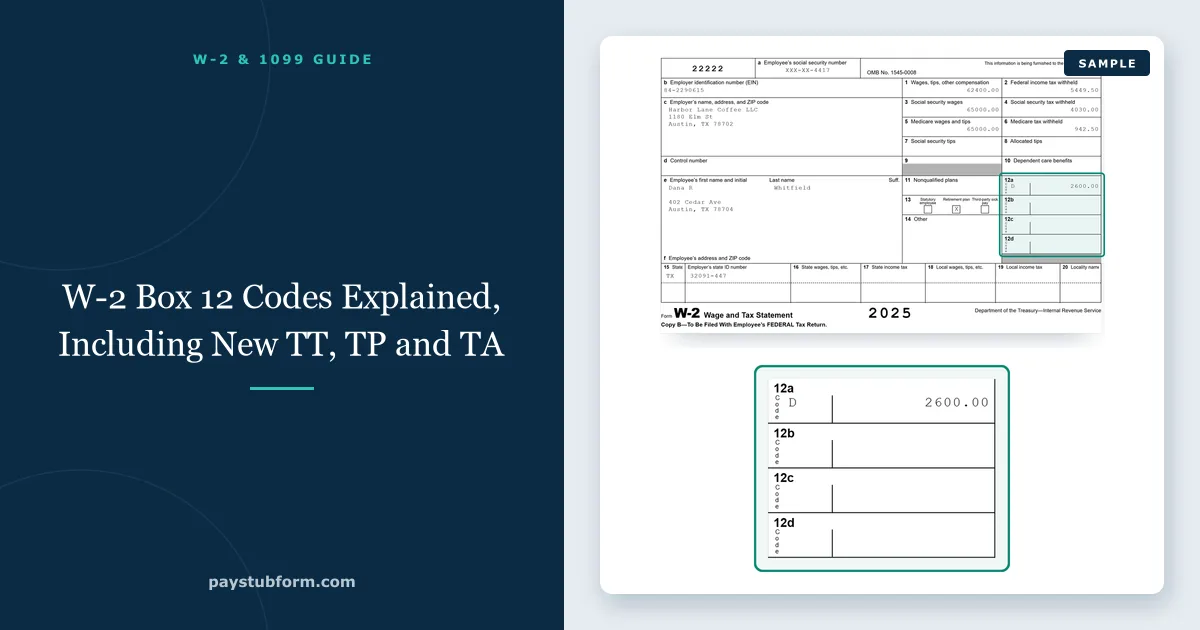
Box 12 is the part of a W-2 that looks like a code sheet: up to four short entries, each a letter code and an amount. For 2026 wages it gets three new codes, TT for qualified overtime, TP for cash tips and TA for employer Trump account contributions. These are the figures behind the "no tax on overtime" and "no tax on tips" deductions, so the W-2s that arrive in January 2027 are the first ones many people will read Box 12 closely on.
Quick take: Box 12 reports amounts that are taxed differently from ordinary wages, each under a letter code. The common ones are D (traditional 401(k) deferral), AA (Roth 401(k)), W (HSA contributions) and DD (the cost of your health coverage, which is not taxable). New for 2026: TT is the overtime premium you may deduct, up to $12,500; TP is the cash tips you reported to your employer; and TA is your employer's Trump account contribution. Overtime and tips are still included in Box 1. The deduction is taken on your tax return. It is not a reduction of your wages.
1. The new 2026 codes: TT, TP and TA
The IRS's 2026 W-2 instructions add three codes and split Box 14 into 14a and 14b. Employers did not have to report overtime or tips separately on 2025 W-2s, so for most people a 2026 W-2 is the first one that shows these amounts.
| Code | What it reports | Is it in Box 1? | What you do with it |
|---|---|---|---|
| TT | Qualified overtime compensation: only the premium above your regular rate that federal law requires | Yes, all overtime pay is still wages | Use it for the qualified overtime deduction on Schedule 1-A |
| TP | Total cash tips you reported to your employer | Yes, along with Boxes 5 and 7 | Use it with the occupation code in Box 14b for the qualified tips deduction |
| TA | Employer contributions to a Trump account for you or your dependent, starting July 4, 2026 | No, it is excluded from income up to $2,500 | Nothing on your return; it is for your records |
2. Code TT: why it is smaller than your overtime pay
Code TT is the line people will misread most often. It is not your overtime pay. It is only the part of it that is above your regular rate and that the Fair Labor Standards Act requires: the "half" in time and a half. The IRS's own example says exactly that, and the employer reports the full amount even when it is more than the deduction cap.
A worked example. You earn $24.00 an hour and work 6 hours of overtime a week for 48 weeks:
| Item | Figure |
|---|---|
| Overtime hours for the year: 6 × 48 | 288 |
| Overtime pay on your stubs: 288 × $36.00 | $10,368.00 |
| Of which straight time: 288 × $24.00 | $6,912.00 |
| Box 12, code TT: 288 × $12.00 premium | $3,456.00 |
So when overtime is paid at exactly 1.5 times the regular rate, TT is one third of the year-to-date overtime earnings on your final pay stub. That is the quickest check you can do. If your regular rate includes a shift differential or a nondiscretionary bonus, the premium is figured on that higher rate. Our guide to overtime on a pay stub shows the calculation, and the overtime calculator splits a week's overtime into straight time and premium.
What does not go in TT:
- Overtime that only state law requires. California's daily overtime after 8 hours, for example, is not FLSA overtime unless the hours also take the week past 40.
- Overtime that only a contract or company policy requires. Premium pay for weekends, holidays or a union rule counts only where the FLSA would have required it anyway.
- Overtime for exempt employees. A salaried exempt employee paid extra for long weeks is not being paid FLSA overtime.
- The straight-time part. The "one" in time and a half is ordinary pay.
3. Code TP and Box 14b: tips and your occupation code
Code TP is the total cash tips you reported to your employer. That includes tips paid on a card, which count as "cash tips" for this purpose. It is not limited to qualified tips. Whether they qualify depends on the code in the new Box 14b, the Treasury Tipped Occupation Code.
- Box 14b holds up to two occupation codes, for the tipped jobs you did for that employer.
- A code of 000 means some tips came from a job that is not on the Treasury's list. If 000 is the only code in Box 14b, the IRS says the tips in TP are not qualified tips.
- Reported tips stay in Box 1 and in Boxes 5 and 7. They are taxed through payroll, so the deduction is again claimed on your return.
Tips only reach the W-2 if you reported them. Cash tips of $20 or more in a month must be reported to your employer by the 10th of the next month. Our guide to proving cash income covers why reporting them pays off twice.
4. Code TA: Trump account contributions
From July 4, 2026, an employer can contribute up to $2,500 a year to a Trump account for an employee or the employee's dependent. Under a Section 128 contribution program the amount is excluded from your income, so it is left out of Box 1 and reported under code TA. The $2,500 limit is per employee, however many children you have. Under the proposed regulations issued in August 2026, the contribution is still subject to Social Security and Medicare tax. Most employers do not offer one yet. If yours does, check how payroll shows it on your stub. Many list it as an employer contribution line, and the year-to-date total should match code TA.
5. The other Box 12 codes you are likely to see
| Code | What it means | Taxable? |
|---|---|---|
| C | Taxable cost of group-term life insurance over $50,000 | Already included in Boxes 1, 3 and 5 |
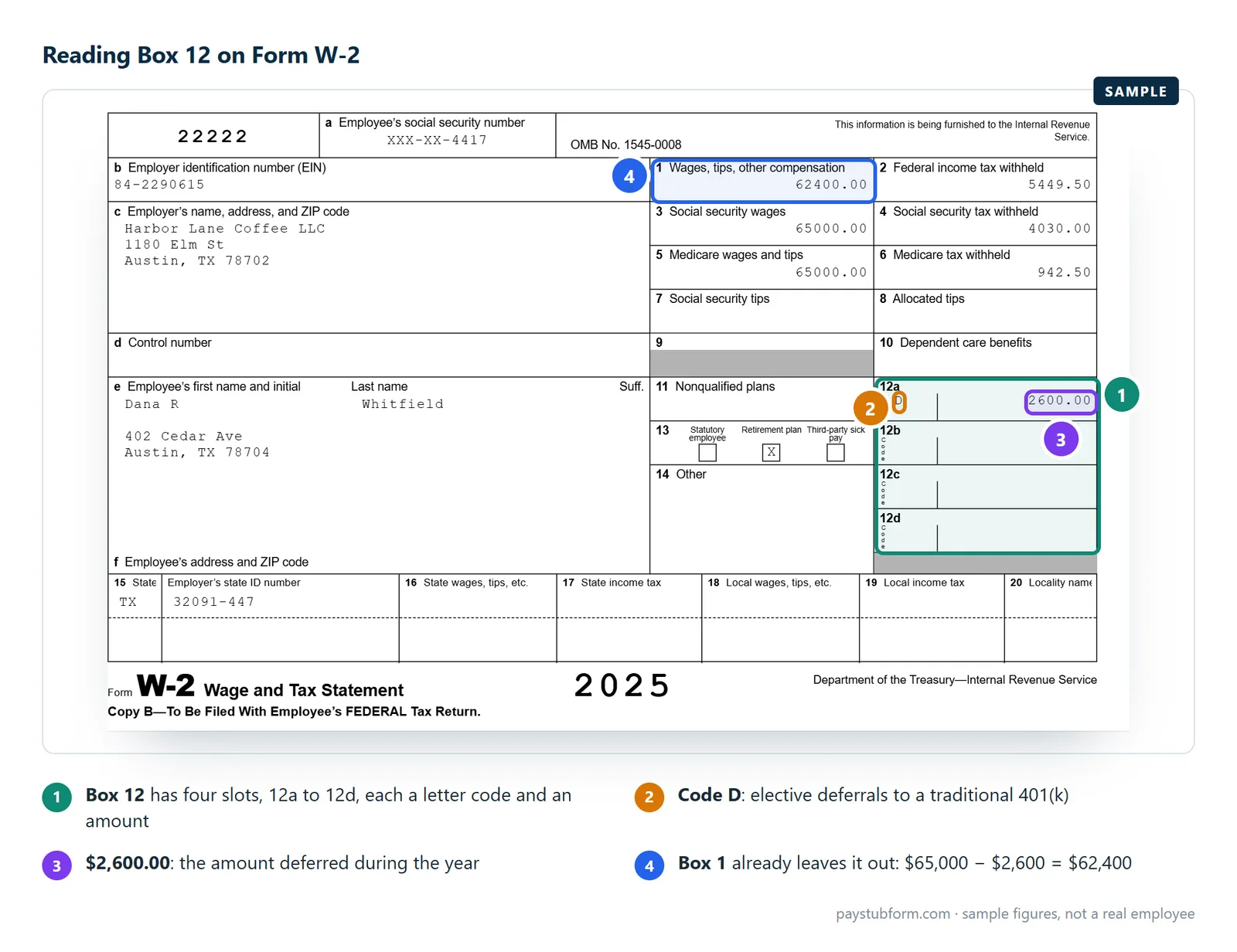
| D | Traditional 401(k) deferral | Not in Box 1; still in Boxes 3 and 5 |
| E | Traditional 403(b) deferral | Same as D |
| G | 457(b) deferral | Same as D |
| S | SIMPLE IRA salary reduction | Same as D |
| AA / BB / EE | Roth 401(k) / Roth 403(b) / Roth 457(b) contributions | Taxed now; included in Box 1 |
| W | Employer and pre-tax employee contributions to an HSA | Excluded, up to the annual limit |
| DD | Total cost of employer-sponsored health coverage | Not taxable; information only |
| FF | Benefits under a QSEHRA (small-employer health reimbursement) | Information for the premium tax credit |
| J | Nontaxable sick pay | Not in Box 1 |
| P | Excludable moving expense reimbursement (armed forces only) | Not in Box 1 |
| Q | Nontaxable combat pay | Not in Box 1 |
| V | Income from exercising nonstatutory stock options | Already included in Boxes 1, 3 and 5 |
| Y / Z | Section 409A deferrals / 409A income that failed the rules | Z is taxable and carries an extra tax |
Box 12 has room for four entries. On a paper W-2, an employee with more than four codes receives a second W-2 for the rest. That is not a duplicate. Our guide to W-2 Boxes 1, 3 and 5 shows how codes D and W explain the gap between Box 1 and Box 5.
6. How the deductions work
Both deductions apply to tax years 2025 through 2028. You can claim them whether you itemize or take the standard deduction.
- Qualified overtime: up to $12,500 a year, or $25,000 on a joint return.
- Qualified tips: up to $25,000 a year.
- Both shrink once modified adjusted gross income is over $150,000, or $300,000 on a joint return.
- You need a valid Social Security number, and married people must file jointly.
- They reduce federal income tax only. Social Security and Medicare are still owed on all of the pay, and state income tax depends on whether your state follows the federal rule.
Your paycheck does not change on its own. Payroll still withholds federal income tax on every overtime hour and every reported tip. If you expect a large deduction and would rather have the money during the year, you can estimate it on the Step 4(b) deductions worksheet of a new Form W-4. Our guide to changing your W-4 walks through it.
7. Check Box 12 against your final pay stub
- TT: Find the year-to-date overtime earnings on your last stub of 2026. If overtime was always paid at 1.5 times your regular rate, TT should be about one third of it.
- TP: Compare it with the year-to-date reported tips line. Then check Box 14b: a 000 alone means the tips will not qualify.
- D, E, AA: These should match the YTD retirement deduction lines, split into pre-tax and Roth.
- W: Your own pre-tax HSA deduction plus any employer HSA contribution.
- DD: Usually larger than your health deduction, because it includes the employer's share. Nothing to reconcile.
If TT or TP is missing or wrong, ask payroll for a corrected W-2, a Form W-2c. The IRS's instructions say an employer that finds an error in code TT must issue one. Our guide to using pay stubs to request a W-2 correction covers what to send, and W-2 versus your final pay stub walks through the rest of the form. Employers preparing their own forms can use the W-2 form generator. If you are the employer and your stubs do not split overtime into hours and rate, start now: the figures for TT come from them. You can create a pay stub that shows overtime hours and rate for each period worked. Fill it with the hours actually worked: a stub records real pay, and invented figures on a tax document are fraud.
The five-minute version
- Box 12 lists amounts taxed differently from ordinary wages, each with a letter code.
- New for 2026: TT (qualified overtime premium), TP (cash tips), TA (Trump account contributions).
- TT is only the half in time and a half: about one third of your YTD overtime pay.
- Overtime and tips stay in Box 1. The deductions are claimed on Schedule 1-A.
- Caps: $12,500 overtime ($25,000 joint), $25,000 tips; reduced above $150,000 of income ($300,000 joint).
- A 000 alone in Box 14b means your tips do not qualify.
- Wrong TT or TP? Ask for a W-2c before you file.
Quick answers
What does code TT mean on my W-2?
Qualified overtime compensation: the premium above your regular rate that the Fair Labor Standards Act requires, usually the "half" in time and a half. It is the amount you use for the federal overtime deduction, up to $12,500, or $25,000 on a joint return.
Why is code TT so much lower than my overtime pay?
Because only the premium counts. Paid at time and a half, $3,000 of overtime contains $2,000 of straight-time pay and $1,000 of premium, and only the $1,000 goes in TT.
My 2025 W-2 had no code TT. Can I still claim the overtime deduction?
Yes. Employers were not required to report it separately for 2025, and the IRS's Schedule 1-A instructions explain how to work out the qualified amount yourself, from pay stubs or other records of your overtime.
Does code TP mean my tips are tax-free?
Not by itself. TP is all the cash tips you reported. They count for the deduction only if Box 14b shows a qualifying occupation code, and the deduction is capped at $25,000 and reduced at higher incomes. Social Security and Medicare are still owed on the tips.
What is code TA on a W-2?
Your employer's contribution to a Trump account for you or your dependent, under a Section 128 program. Up to $2,500 a year is excluded from income tax, so it is not in Box 1, though Social Security and Medicare still apply to it.
Why is the amount in code DD not taxable?
DD is the total cost of your employer-sponsored health coverage, reported for information only. It does not change your tax, and it is usually larger than your own health deduction because it includes the employer's share.
Sources
- IRS — General Instructions for Forms W-2 and W-3 (2026): the new codes TA, TP and TT, the split of Box 14 into 14a and 14b, the Treasury Tipped Occupation Codes and code 000, the four-entry Box 12 limit, and the full list of Box 12 codes.
- IRS — What to know about the No Tax on Overtime deduction: who qualifies, the income thresholds, and that 2025 W-2s did not have to show overtime separately.
- IRS — What the No Tax on Tips deduction means for you: the $25,000 cap, qualified tips and the joint-filing rule.
- IRS — Schedule 1-A for the new deductions: the form used to claim the overtime and tips deductions.
- IRS — Internal Revenue Bulletin 2026-37: the proposed regulations on employer contributions to Trump accounts, including the $2,500 limit and their treatment as Social Security and Medicare wages.
- U.S. Department of Labor — Fact Sheet #23, Overtime Pay Requirements of the FLSA: the 40-hour workweek rule that defines FLSA-required overtime.
General U.S. information for the 2026 tax year. Your own figures depend on your job, your pay records and your filing status; for advice on your return, speak to a tax professional.


Comments (0)
Loading comments...
Leave a Comment