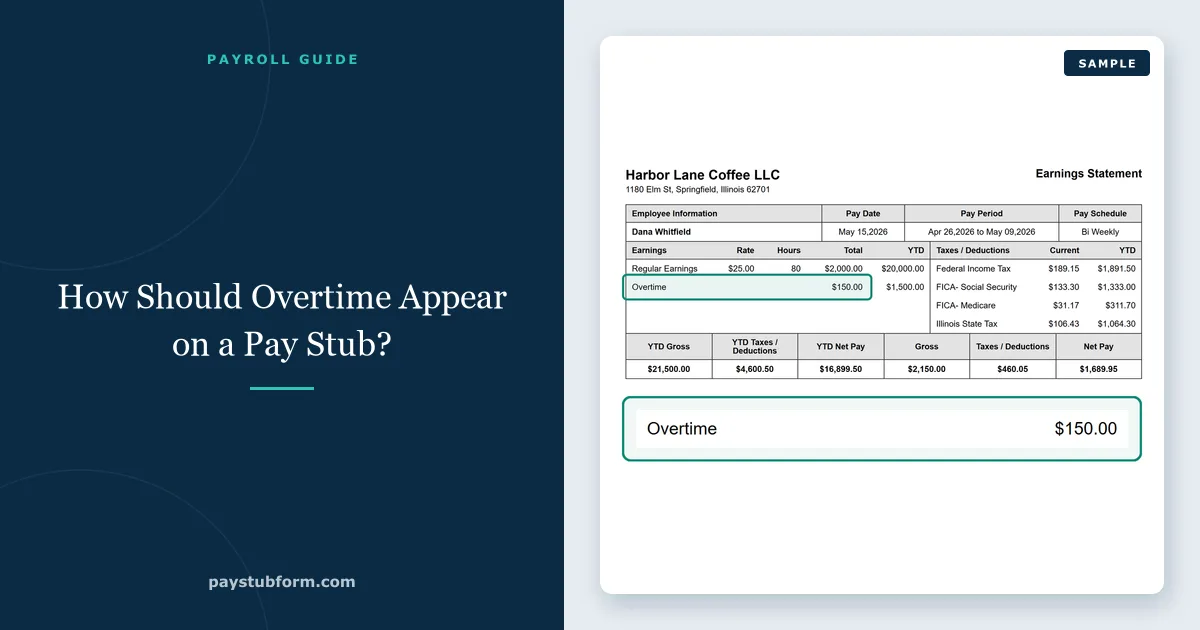
Overtime looks like the simplest line on a pay stub: hours over forty, paid at one and a half times. It is the line most often wrong, and the reason is almost never the hours. It is the rate — because the rate overtime is paid at is usually not the rate printed beside your name.
The Fair Labor Standards Act does not say "one and a half times your hourly wage". It says one and a half times your regular rate, and the regular rate is a calculated figure that sweeps in a good deal more than your base wage. If you earn a shift differential, a production bonus or a commission, your overtime should be worth more than a simple time-and-a-half on base pay — and often it is not.
Quick take: Overtime is 1.5× the regular rate for hours over 40 in a workweek. The regular rate is total compensation for the week divided by hours worked, and it has to include nondiscretionary bonuses, commissions and shift differentials — not just your base hourly wage.
How the regular rate is actually calculated
The formula the Department of Labor uses is blunt:
Total compensation in the workweek (except statutory exclusions) ÷ total hours worked in the workweek = regular rate.
So it is an average, recalculated every week, not a fixed number. A week with a differential shift in it produces a higher regular rate than a week without one, and the overtime in that week should be higher to match.
Two things must be included that employers commonly leave out:
- Nondiscretionary bonuses — anything promised or expected, tied to production, attendance, safety, quality or hitting a target. If people can predict they will get it by doing the work, it belongs in the rate.
- Shift differentials and commissions — extra pay for nights, weekends or difficult conditions, and commission earnings, are compensation for hours of employment and go into the average.
What may be excluded: genuinely discretionary bonuses, where both the fact of the payment and its amount are at the employer's sole discretion and were not promised in advance; gifts for special occasions not measured by hours, production or efficiency; paid vacation, holiday and sick leave; reimbursement of actual business expenses; perks like discounts, gym memberships or tuition assistance that are not connected to performance; and premium overtime already paid at 1.5× or more.
And one rule that settles most disputes: the regular rate is based on actual facts and cannot be circumvented by an agreement. An employee cannot validly agree to be paid overtime on base wage only.
A worked example
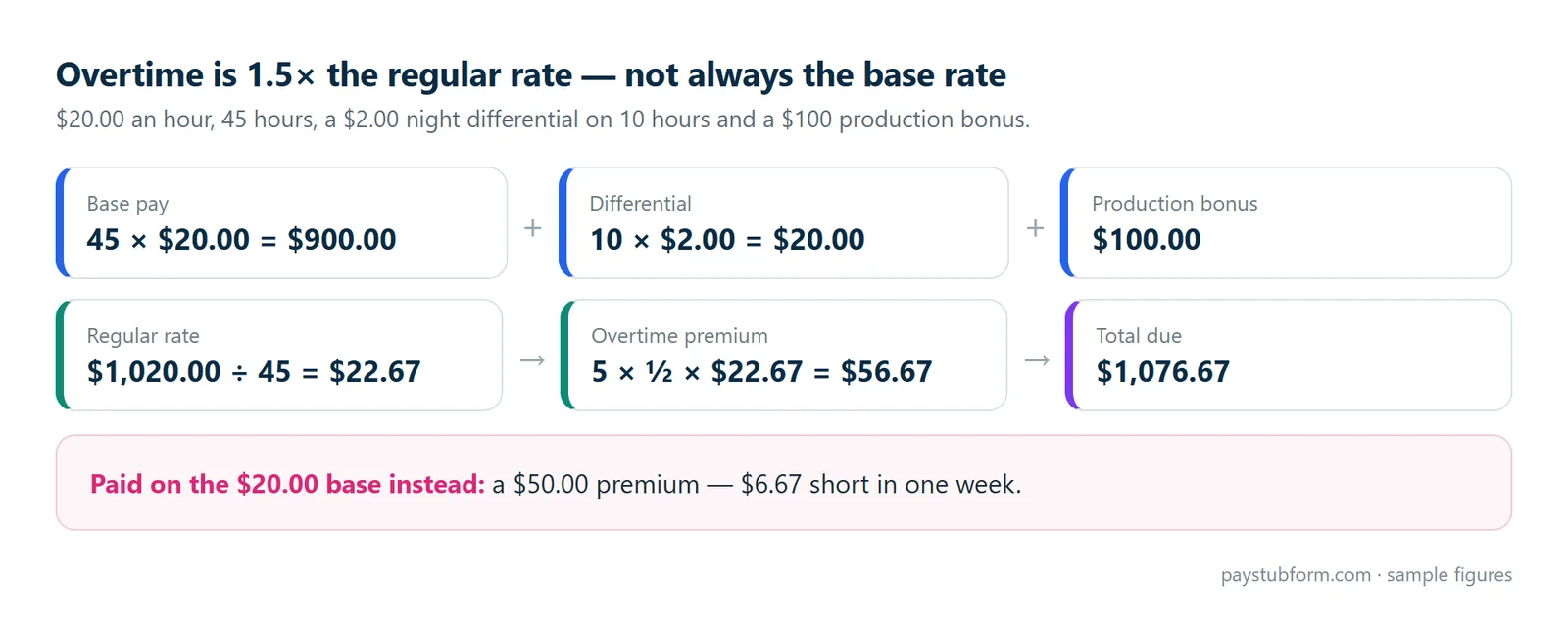
You earn $20.00 an hour, work 45 hours, and pick up a $2.00 night differential on 10 of those hours plus a $100 nondiscretionary production bonus.
| Step | Figure |
|---|---|
| Base pay: 45 × $20.00 | $900.00 |
| Shift differential: 10 × $2.00 | $20.00 |
| Production bonus | $100.00 |
| Total straight-time compensation | $1,020.00 |
| Regular rate: $1,020.00 ÷ 45 hours | $22.67 |
| Overtime premium owed: 5 hours × ½ × $22.67 | $56.67 |
| Total due | $1,076.67 |
Pay overtime on the $20.00 base rate instead and the premium is $50.00 — short by $6.67 in a single week. Over a year of similar weeks that is a few hundred dollars, and it is invisible unless you check. The year-to-date columns are where a shortfall this size becomes large enough to see.
The workweek is the unit, and it is fixed
A workweek is a fixed and regularly recurring period of 168 hours — seven consecutive 24-hour periods. It does not have to match the calendar week, and it does not have to match your pay period.
That last point matters, because averaging hours over two or more weeks is not permitted. On a biweekly pay cycle, 50 hours in week one and 30 in week two is not "80 hours, no overtime" — it is 10 hours of overtime in week one and a short week two. An employer who nets them off is underpaying, and this is one of the most common errors on biweekly stubs.
Two related points people assume wrongly. The FLSA requires no overtime premium for working a weekend, a holiday or a regular day of rest merely because of when the work falls — a holiday is only special if your employer's policy or a state law makes it so. And there is no federal cap on how many hours an employee aged 16 or over may work in a week; the law requires the premium, not a limit.
Tip: Find out which day your employer's workweek starts. Without it you cannot check an overtime figure at all, because you cannot tell which hours fall in which week.
Salaried does not mean exempt
Being paid a salary does not remove the right to overtime. Exemption from the executive, administrative and professional rules requires the job duties to qualify and the salary to clear a threshold. The salaried pay stub checklist shows what else to verify on a salary stub.
That threshold is a live issue worth getting right, because the figures changed and then changed back. A 2024 rule raised the salary level, was judicially vacated, and on May 14, 2026 the Department of Labor published a technical amendment removing the vacated language from the Code of Federal Regulations and republishing the operative 2019 regulations. The figures now in force are:
- Standard salary level: $684 per week, equivalent to $35,568 a year.
- Highly compensated employees: $107,432 a year, including at least $684 per week paid on a salary or fee basis.
Much of the guidance written in 2024 and 2025 still quotes the higher figures from the vacated rule. If you are checking your own status against a number you read somewhere, check the date on it.
Clearing the salary threshold is necessary but not sufficient — the duties test still has to be met. A salaried employee whose work does not meet it is non-exempt and is owed overtime regardless of how the pay is labelled.
What your stub should show
How much detail is required depends on where you work, not on federal law. New York requires a non-exempt employee's statement to show the regular hourly rate, the overtime rate, the number of regular hours and the number of overtime hours, separately. California requires all applicable hourly rates in effect during the period with the hours worked at each. Ohio, since April 2025, requires hours worked in excess of forty in a workweek to be shown. North Carolina requires none of it.
Where the breakdown is required and missing, that is its own violation. Our state-by-state guide sets out what each state obliges an employer to show.
Working long peak-season weeks in a holiday job? Our guide to seasonal job taxes covers overtime, holiday pay and the new federal overtime deduction on a short-term paycheck.
The overtime deduction and code TT on your W-2
For 2025 through 2028, eligible workers can deduct qualified overtime pay on their federal return: up to $12,500 a year, or $25,000 on a joint return, reduced once income is over $150,000 ($300,000 joint). Only the premium the FLSA requires counts, which is the half in time and a half, calculated on the regular rate described above. Overtime that only state law or a contract requires, such as California's daily overtime in a week under 40 hours, does not.
Your paycheck does not change because of it. Payroll still withholds federal income tax, Social Security and Medicare on every overtime hour, and the deduction comes when you file. From the 2026 W-2 that arrives in January 2027, the qualified amount is reported in Box 12 with code TT. If your overtime was always paid at exactly 1.5 times the regular rate, TT should be about one third of the year-to-date overtime earnings on your final stub. Our guide to W-2 Box 12 codes walks through the check.
Check your own overtime in three minutes
- Establish the workweek start day, then add the hours in each week separately — never across the pay period.
- Add all compensation for that week: base pay, differentials, commissions and any nondiscretionary bonus.
- Divide by hours worked. That is your regular rate for that week.
- Multiply the overtime hours by half that rate. Added to straight time for all hours, that is what you are owed.
- If the stub shows overtime at exactly 1.5× your base wage in a week where you also earned a differential or a bonus, the rate is too low — and that is a question for payroll, with the week and the figures in hand.
If an overtime error has been repeating, the gap between gross and net will not reveal it — only the hours and rate lines will. You can create an accurate pay stub here with overtime calculated properly.
Quick answers
Is overtime 1.5 times my hourly wage?
Not necessarily. It is 1.5 times your regular rate, which is total weekly compensation divided by hours worked. If you earn only a flat hourly wage with nothing else, the two are the same. Add a differential, commission or nondiscretionary bonus and the regular rate is higher.
Does a bonus change my overtime rate?
A nondiscretionary one does — it must be included in the regular rate for the period it covers, which can mean recalculating overtime retroactively. A genuinely discretionary bonus, not promised in advance, may be excluded.
I worked 50 hours one week and 30 the next. Do I get overtime?
Yes — 10 hours of it, in the first week. Averaging hours over two or more weeks is not permitted, even when both weeks fall in the same pay period.
Do I get overtime for working a Saturday or a holiday?
Not under federal law, simply because of the day. Overtime is owed for hours beyond 40 in the workweek. Premium pay for weekends or holidays comes from your employer's policy, a contract, or state law.
I'm on a salary. Can I still be owed overtime?
Yes. Exemption needs both qualifying duties and a salary of at least $684 a week ($35,568 a year). Salary alone does not make you exempt, and job titles carry no weight.
Is my overtime tax-free now?
Not on the paycheck. Overtime is still withheld like other wages. The federal deduction for qualified overtime, up to $12,500 ($25,000 joint) for 2025 through 2028, covers only the premium part and is claimed on your return. Social Security, Medicare and, in most cases, state tax still apply.
Is there a limit on how many hours I can be made to work?
Not under the FLSA for anyone aged 16 or over. The law requires the overtime premium rather than a ceiling on hours; any limit would come from state law or your contract.
Sources
- U.S. Department of Labor — Fact Sheet #56A, Overview of the Regular Rate of Pay: the calculation, what must be included, the statutory exclusions, and that the rate cannot be circumvented by agreement.
- U.S. Department of Labor — Fact Sheet #23, Overtime Pay Requirements of the FLSA: the 168-hour workweek, the prohibition on averaging across weeks, weekend and holiday work, and the absence of an hours cap for workers 16 and over.
- U.S. Department of Labor — Earnings thresholds for the EAP exemption: the $684 weekly and $107,432 annual figures currently in force.
- U.S. Department of Labor — Technical amendment restoring the EAP exemption regulations (May 14, 2026): removal of the judicially vacated 2024 rule and republication of the 2019 regulations.
- IRS — What to know about the No Tax on Overtime deduction: who qualifies, the $12,500 and $25,000 limits and the income thresholds.
- IRS — General Instructions for Forms W-2 and W-3 (2026): Box 12 code TT and the rule that only the premium portion of overtime is reported.
General U.S. information, current for 2026. State overtime rules can be stricter than the federal standard — several states add a daily threshold the FLSA does not have.


Comments (0)
Loading comments...
Leave a Comment