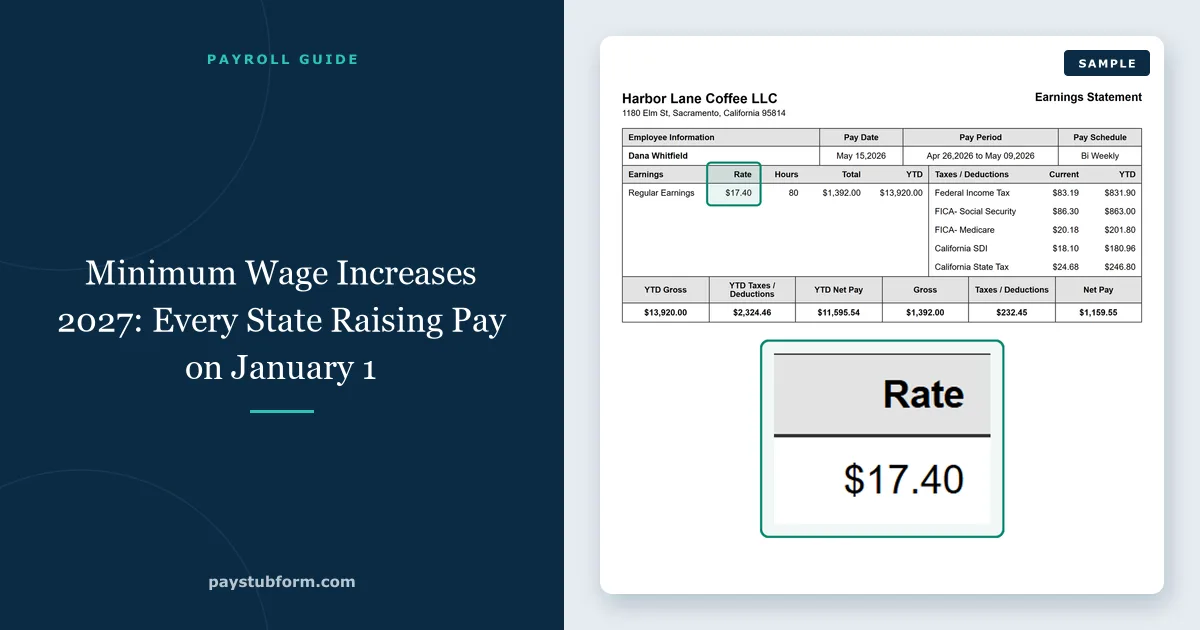
On January 1, 2027, the minimum wage goes up in 15 states, and a 16th, Vermont, is still waiting on its official figure. Most of the new rates are already final. They are either written into state law or were published by the state labor department this fall. New York, where the rate was expected to rise with inflation, is holding at $17.00 and $16.00 instead. The federal minimum is still $7.25, where it has been since 2009. Below is every state change, what it adds to a full-time paycheck, and what employers need to update before the first payroll of 2027.
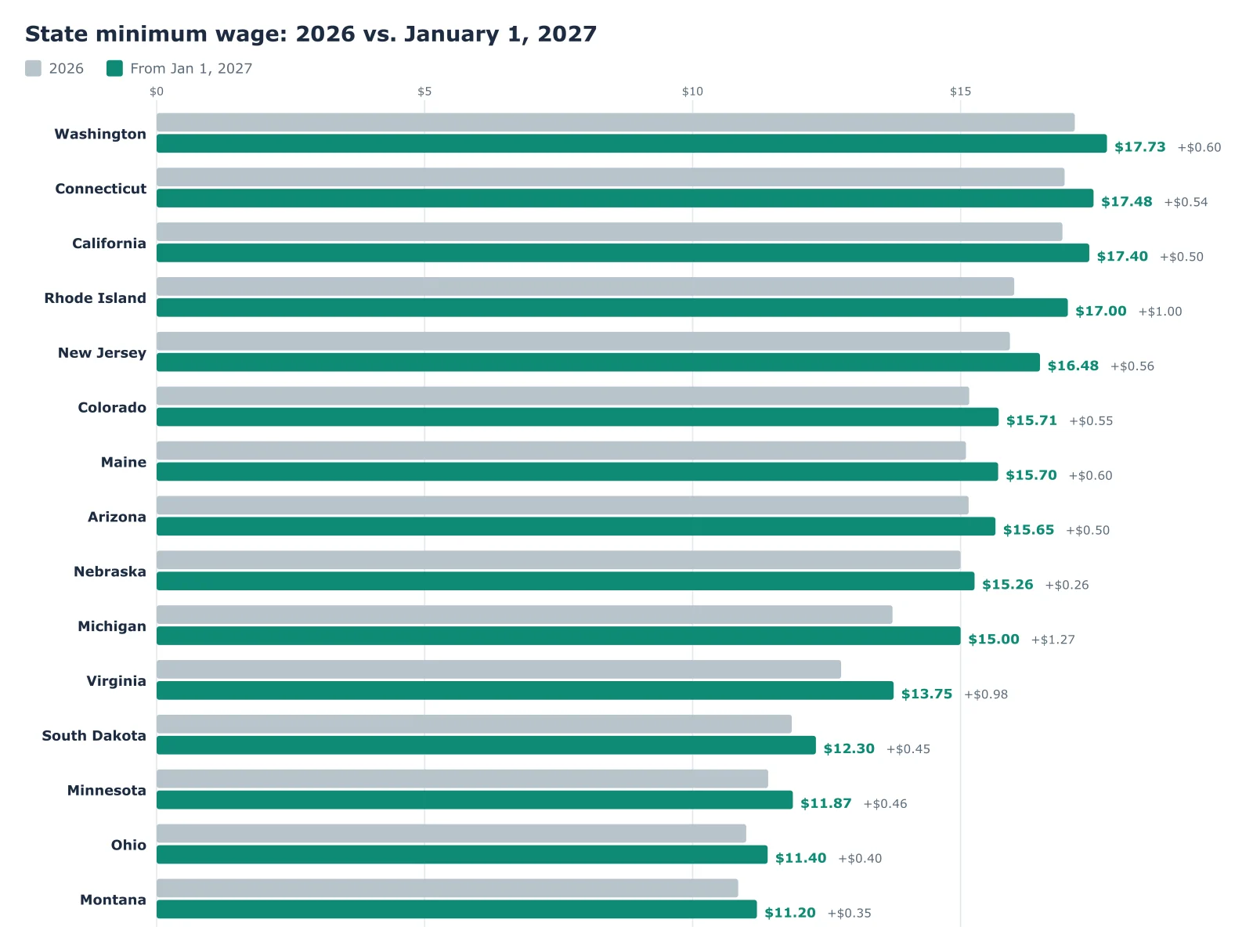
Quick take: From January 1, 2027 the highest state minimums are Washington $17.73, Connecticut $17.48, California $17.40 and Rhode Island $17.00. The biggest raises are Michigan (+$1.27, to $15.00), Rhode Island (+$1.00) and Virginia (+$0.98, to $13.75). New York, Missouri, Illinois, Massachusetts and Maryland do not change on January 1. Hours worked from January 1 must be paid at the new rate, even in a pay period that started in December.
1. Every state raising its minimum wage on January 1, 2027
The last column is the gross raise for a full-time employee paid exactly the minimum (2,080 hours a year).
| State | 2026 | Jan 1, 2027 | Raise per hour | Per year, full time |
|---|---|---|---|---|
| Washington | $17.13 | $17.73 | +$0.60 | +$1,248.00 |
| Connecticut | $16.94 | $17.48 | +$0.54 | +$1,123.20 |
| California | $16.90 | $17.40 | +$0.50 | +$1,040.00 |
| Rhode Island | $16.00 | $17.00 | +$1.00 | +$2,080.00 |
| New Jersey | $15.92 | $16.48 | +$0.56 | +$1,164.80 |
| Colorado | $15.16 | $15.71 | +$0.55 | +$1,144.00 |
| Maine | $15.10 | $15.70 | +$0.60 | +$1,248.00 |
| Arizona | $15.15 | $15.65 | +$0.50 | +$1,040.00 |
| Nebraska | $15.00 | $15.26 | +$0.26 | +$540.80 |
| Michigan | $13.73 | $15.00 | +$1.27 | +$2,641.60 |
| Virginia | $12.77 | $13.75 | +$0.98 | +$2,038.40 |
| South Dakota | $11.85 | $12.30 | +$0.45 | +$936.00 |
| Minnesota | $11.41 | $11.87 | +$0.46 | +$956.80 |
| Ohio | $11.00 | $11.40 | +$0.40 | +$832.00 |
| Montana | $10.85 | $11.20 | +$0.35 | +$728.00 |
| Vermont | $14.42 | Not yet published | Indexed to inflation; projected at about $14.91 |
How the rates are set. Rhode Island, Michigan and Virginia raise theirs on a schedule written into state law. Virginia's next step is $15.00 on January 1, 2028. The rest adjust for inflation every year and publish the figure in the fall. Nebraska now rises 1.75% a year, and its 2028 rate is set at $15.53. Ohio's $11.40 applies to larger employers. Businesses below the state's gross-receipts threshold, and workers under 16, stay at $7.25. New Jersey has lower rates for seasonal workers, small employers with fewer than six employees, and farm work.
2. States that do not change on January 1
- New York stays at $17.00 in New York City, Long Island and Westchester and $16.00 in the rest of the state. Inflation indexing was due to start in 2027, but one of the law's "off-ramp" conditions was met, so there is no increase. Home care aides still rise to $20.00 and $19.00. The governor has proposed legislation to adjust the rate starting in March 2027.
- Missouri stays at $15.00. A 2025 law repealed the yearly inflation increases that voters had approved.
- Illinois, Massachusetts and Maryland stay at $15.00. Hawaii stays at $16.00 until it rises to $18.00 in 2028.
- Mid-year states: Florida reached $15.00 on September 30, 2026. Alaska moves to $15.00 on July 1, 2027. Oregon and Washington, D.C. adjust each July 1.
- The federal minimum wage stays $7.25. It is the rate that applies in the 20 states that have no higher minimum of their own.
Cities and counties can set their own higher minimums, and many adjust on January 1 too. Seattle, for example, goes to $22.14 and Denver to $19.84. Pay whichever is highest: the federal, state or local rate for the place the work is done.
3. Tipped workers
States that let employers count tips toward the minimum (a "tip credit") raise the tipped cash wage along with the main rate:
| State | Tipped cash wage from Jan 1, 2027 |
|---|---|
| Colorado | $12.69 |
| Arizona | $12.65 (minimum wage less the $3.00 tip credit) |
| Maine | $7.85 |
| Michigan | $6.30 |
| Ohio | $5.70 |
| California, Washington, Minnesota, Montana | No tip credit: tipped employees get the full minimum wage |
Where there is a tip credit, the employer still has to make up the difference whenever tips plus the cash wage come to less than the full minimum for the workweek. For 2026 wages, the tips an employee reports also go on the W-2 under the new code TP. Our W-2 Box 12 codes guide explains it.
4. What changes on the paycheck
Take a part-time worker in Michigan who works 30 hours a week and is paid every two weeks:
| Item | December 2026 | January 2027 |
|---|---|---|
| Hourly rate | $13.73 | $15.00 |
| Hours per pay period | 60 | 60 |
| Gross pay per check | $823.80 | $900.00 |
| Overtime rate (1.5×) | $20.595 | $22.50 |
That is $76.20 more gross pay per check before taxes, and a new rate line on the stub. Social Security and Medicare take 7.65% of the raise. How much federal and state income tax rises depends on the W-4, and our hourly paycheck calculator shows the take-home figure. The raise also lifts the overtime rate, any pay figured as a multiple of the minimum, and in some states the salary an exempt employee must earn. In California the exempt minimum is twice the state minimum wage for full-time work, which comes to $72,384 a year from January 1, 2027 ($17.40 × 2 × 2,080). New York, Washington, Colorado and Maine also have state salary thresholds of their own.
5. The pay period that crosses January 1
Many pay periods start in December and end in January. For example, a biweekly period from December 26, 2026 to January 8, 2027. The new rate applies to hours worked on and after January 1, not to the whole period. Hours worked December 26 to 31 can be paid at the 2026 rate. Hours from January 1 must be paid at the 2027 rate. The clearest stub shows them as two earnings lines with their own rates. Our guide to pay period vs pay date explains why it is the work date that counts, not the payday. The 2027 payroll calendar shows where each period falls.
6. Your five-minute checklist for January 1
- Find your rate: check the state table above, then your city or county, and pay the highest that applies.
- Update everyone below the new rate from January 1, including part-time, seasonal and tipped staff. Recheck tipped cash wages and tip-credit make-up.
- Split the pay period that crosses January 1 into December and January hours if the rates differ.
- Recheck exempt salaries in states whose threshold is tied to the minimum wage, such as California's $72,384.
- Replace the workplace posters with the 2027 versions from your state labor department.
- Check the first 2027 stubs. The rate, hours and year-to-date totals should restart cleanly for the new year. If you run payroll yourself, our pay stub generator makes a stub with the new rate, and our hourly pay stub checklist lists what each stub must show. Keep the records by pay period, as our payroll records guide explains.
Quick answers
Which states raise the minimum wage on January 1, 2027?
Arizona, California, Colorado, Connecticut, Maine, Michigan, Minnesota, Montana, Nebraska, New Jersey, Ohio, Rhode Island, South Dakota, Virginia and Washington. Vermont also adjusts on January 1, but its 2027 rate had not been published in early November 2026.
What is the highest state minimum wage in 2027?
Washington's, at $17.73 an hour from January 1, 2027, followed by Connecticut at $17.48 and California at $17.40. Some cities are higher still, such as Seattle at $22.14.
Is New York's minimum wage going up in 2027?
Not on January 1. It stays at $17.00 in New York City, Long Island and Westchester and $16.00 elsewhere, because an off-ramp condition in the indexing law was met. Home care aides rise to $20.00 and $19.00.
Is the federal minimum wage changing in 2027?
No. It remains $7.25 an hour, unchanged since July 24, 2009. It applies only where the state and local minimums are lower or do not exist.
Does the new rate apply to a pay period that started in December?
Only to the hours worked from January 1. Hours worked in December 2026 can be paid at the 2026 rate, even when the paycheck comes in January.
Does a minimum wage raise change my taxes?
Your rates stay the same, but the extra pay is taxed like any other wages: 7.65% for Social Security and Medicare, plus federal and state income tax. Since the 2027 federal brackets are also adjusted for inflation, your withholding on a small raise should not jump. See 2027 tax brackets and your paycheck.
Sources
- U.S. Department of Labor — State minimum wage laws: the $7.25 federal minimum and each state's minimum wage law and agency.
- New York State — Minimum wage rate schedule: rates stay at $17.00 and $16.00 on January 1, 2027 because an off-ramp condition was met; home care aides rise to $20.00 and $19.00.
- Washington State Department of Labor & Industries — Minimum wage: the 2027 rate of $17.73.
- California Department of Industrial Relations — Minimum wage: the statewide rate and the exempt-salary rule of twice the minimum wage.
- Michigan Department of Labor and Economic Opportunity — Wage and Hour: the scheduled $15.00 minimum and tipped rate for 2027.
- Experian Employer Services — 2027 state and local minimum wage changes (October 9, 2026): the 2027 state rates and the tipped rates for Colorado, Maine, Michigan and Ohio, checked against the state notices above.
- Bloomberg Tax — Vermont minimum wage expected to rise to $14.91 for 2027: the projected Vermont rate before the state's announcement.
General information on state minimum wages as of November 2026. Local rates, small-employer rates and industry rules vary; check your state labor department's 2027 notice before running payroll.


Comments (0)
Loading comments...
Leave a Comment