Payroll records are what you reach for when an employee questions a paycheck, when a state agency asks for wage data, or when the IRS asks you to support a quarterly return. In every one of those moments the question is the same: can you show how each payment was calculated, from the hours to the deposit? A small business that can answer that in ten minutes has good records. One that has to rebuild the answer from bank statements does not.
This checklist covers what federal law requires you to keep, how long to keep it, and the habits that keep a small payroll defensible without a full-time payroll department.
Quick take: Keep three things together for every pay period — the source data (hours and rates), the calculation (gross to net), and the proof of payment. Keep payroll records for at least three years under federal wage law and employment tax records for at least four, and check whether your state asks for longer.
1. What the FLSA requires you to record
If you have employees covered by the Fair Labor Standards Act, the Department of Labor expects you to keep specific information for each non-exempt employee. There is no required form or format — a spreadsheet, payroll software or paper ledger all work — but the content is fixed:
- Full name and Social Security number, home address with ZIP code, and birth date if the employee is under 19.
- Sex and occupation.
- The time and day the workweek begins.
- Hours worked each day and total hours worked each workweek.
- The basis on which wages are paid (hourly, weekly, piece rate) and the regular hourly rate.
- Total daily or weekly straight-time earnings and total overtime earnings for the workweek.
- All additions to and deductions from wages.
- Total wages paid each pay period, the date of payment and the pay period covered.
The workweek start is the item most small employers forget. Without it, nobody — including you — can check whether overtime was calculated correctly, because overtime is owed per workweek, not per pay period.
2. How long to keep payroll records
Different rules set different minimums, and the safe approach is to keep everything for the longest period that applies to you. For employers that includes the records behind the annual FUTA tax return, Form 940.
| Record | Federal minimum | Rule |
|---|---|---|
| Payroll records (the list above) | 3 years | FLSA, DOL |
| Time cards, wage rate tables, work schedules, records of additions and deductions | 2 years | FLSA, DOL |
| Employment tax records, including W-4s and copies of returns | 4 years after the tax is due or paid, whichever is later | IRS |
| Form I-9 | 3 years after hire or 1 year after employment ends, whichever is later | USCIS |
States often go further. New York requires payroll records to be kept for six years. California requires employers to keep copies of itemised wage statements for at least three years. Check your own state before you shred anything.
Tip: Set one retention period for the whole payroll file — six years covers most combinations of federal and state rules — rather than tracking a different date for each document type.
3. Reconcile before you pay, not after
Most payroll errors are cheaper to catch before the money moves. A short pre-payroll review catches the common ones:
- Hours. Approved timecards match the hours entered into payroll, including any edits a manager made.
- Rates. Any raise, new role or shift differential took effect on the right date. A midperiod rate change should produce two earnings lines.
- Overtime. Calculated per workweek, at 1.5× the regular rate — which includes nondiscretionary bonuses and differentials, not just base pay.
- Changes. New W-4s, state withholding forms, benefit elections and garnishment orders were entered before this run. A new W-4 must be in effect no later than the start of the first payroll period ending on or after the 30th day after you receive it.
- Totals. Gross minus taxes and deductions equals net for each employee, and total net pay equals the amount leaving the bank account.
The last check is the one that catches the expensive mistakes: a duplicate payment, a missing employee or an extra zero.
4. Pay stubs: what the employee sees
Federal law does not require you to give employees a pay stub, but most states do, and many specify what it must show. California requires nine items on every wage statement, including all hourly rates and the hours worked at each. New York requires the regular and overtime rates and hours for non-exempt employees. Some states require only a statement of deductions. Our state-by-state guide sets out what each state requires.
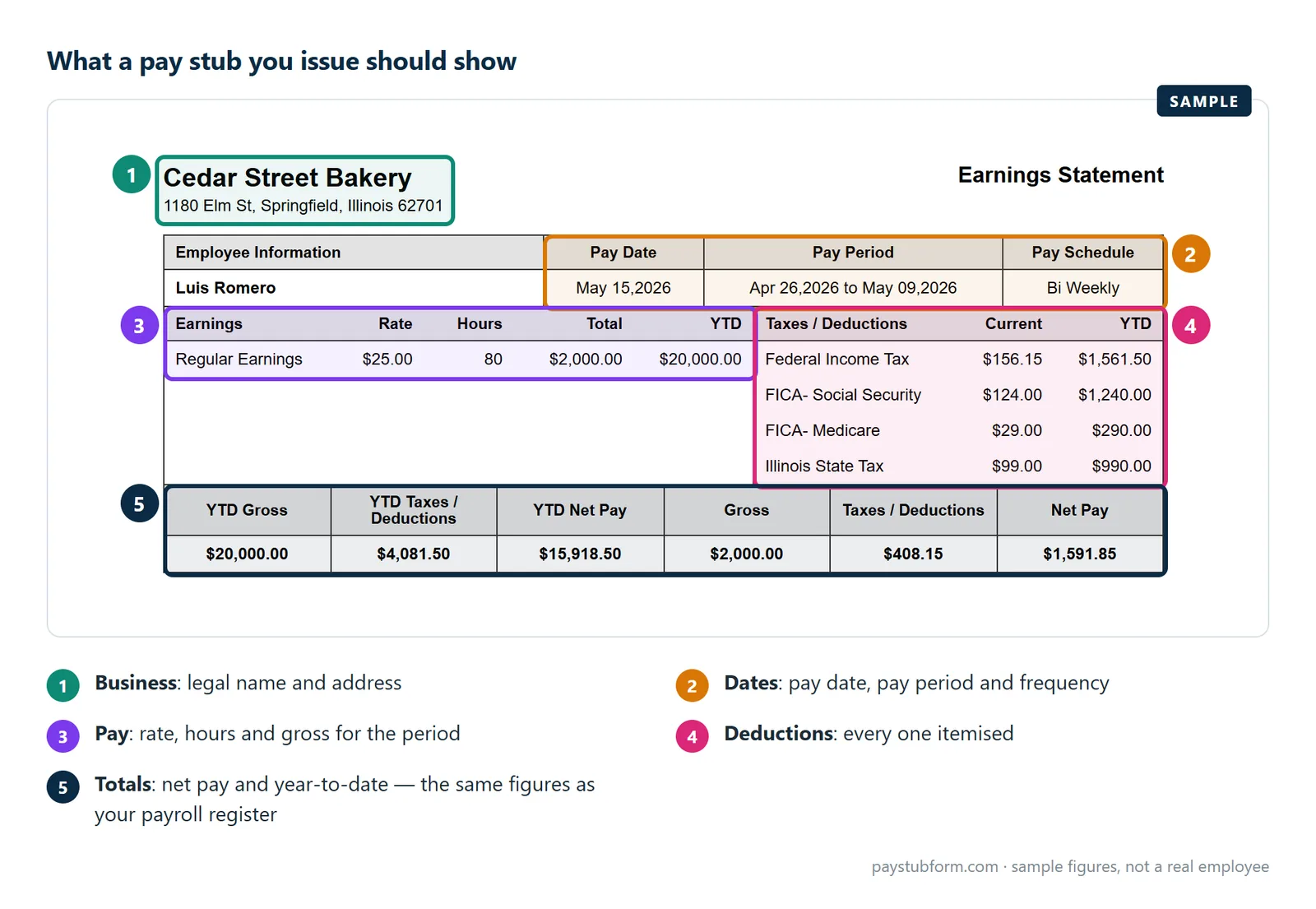
Whatever your state requires, a stub that reconciles cleanly is your first line of defence: when the employee can see hours, rate, each deduction and year-to-date totals, most questions answer themselves. A polished stub cannot fix wrong underlying data, though — the stub is only ever as accurate as the hours and rates behind it.
5. Keep corrections traceable
When a check is voided, reissued or adjusted, do not overwrite the original. Keep a record of:
- The original payment and why it was wrong.
- The correction — a replacement check, an off-cycle payment or an adjustment on the next run.
- The effect on year-to-date wages and taxes.
- Who approved it and when.
Corrections made in the same calendar year usually flow through to the W-2 automatically. Corrections discovered after the W-2 has been issued may need a Form W-2c, and the paper trail is what lets you prepare one accurately. Our guide to correcting a W-2 using pay stub records explains the employee side of that process.
6. Protect the data
A payroll file holds Social Security numbers, bank account details and salary information — exactly what identity thieves want. Limit access to the people who run payroll, store files encrypted or in a locked cabinet, and never send full Social Security numbers or bank details in ordinary email. When the retention period ends, destroy records securely rather than throwing them away.
The minimum record set, per pay period
- Approved hours for each non-exempt employee, by day and by workweek.
- The rate or rates in effect and the basis of pay.
- The gross-to-net calculation: earnings lines, taxes, deductions and net pay.
- Proof of payment: pay date, amount and method.
- Any change documents that took effect: W-4s, state forms, benefit elections, garnishment orders.
- A note of every correction, with its year-to-date effect.
If you run payroll by hand or in a spreadsheet, you can create accurate pay stubs here from the records you already keep, with taxes calculated for your state.
Quick answers
How long does a small business need to keep payroll records?
At least three years for FLSA payroll records and two years for supporting time cards and rate tables. Employment tax records must be kept at least four years after the tax was due or paid. Several states require longer — New York requires six years.
Does federal law require a particular time clock or format?
No. Any timekeeping method is acceptable as long as the records are complete and accurate. Paper, spreadsheets and payroll software all meet the requirement.
Do I need to keep records for exempt salaried employees?
Yes, though fewer items. You do not need to track their daily hours for overtime purposes, but you still need identifying information, pay basis, total wages, deductions and pay dates.
Am I required to give employees pay stubs?
Not under federal law, but most states require some form of wage statement, and many specify the items it must contain. Check your state's rule before deciding what to provide.
Should a payroll correction replace the original record?
No. Keep the original and add the correction alongside it, with the reason, the replacement payment and the year-to-date effect. An audit trail is far easier to defend than an overwritten record.
Can I keep payroll records electronically?
Yes. Electronic records are acceptable for both DOL and IRS purposes, as long as they are accurate, complete and can be produced in readable form when requested.
Sources
- U.S. Department of Labor — Fact Sheet #21, Recordkeeping Requirements under the FLSA: the required payroll items and the three- and two-year retention periods.
- IRS — Employment Tax Recordkeeping: the four-year retention rule for employment tax records.
- IRS Publication 15 (2026), Employer's Tax Guide: when a new Form W-4 must take effect and federal employment tax deposit and filing rules.
- USCIS — Handbook for Employers (M-274): Form I-9 retention.
General U.S. information, current for 2026. State payroll and recordkeeping rules are frequently stricter than the federal standard — check yours alongside this.


Comments (0)
Loading comments...
Leave a Comment