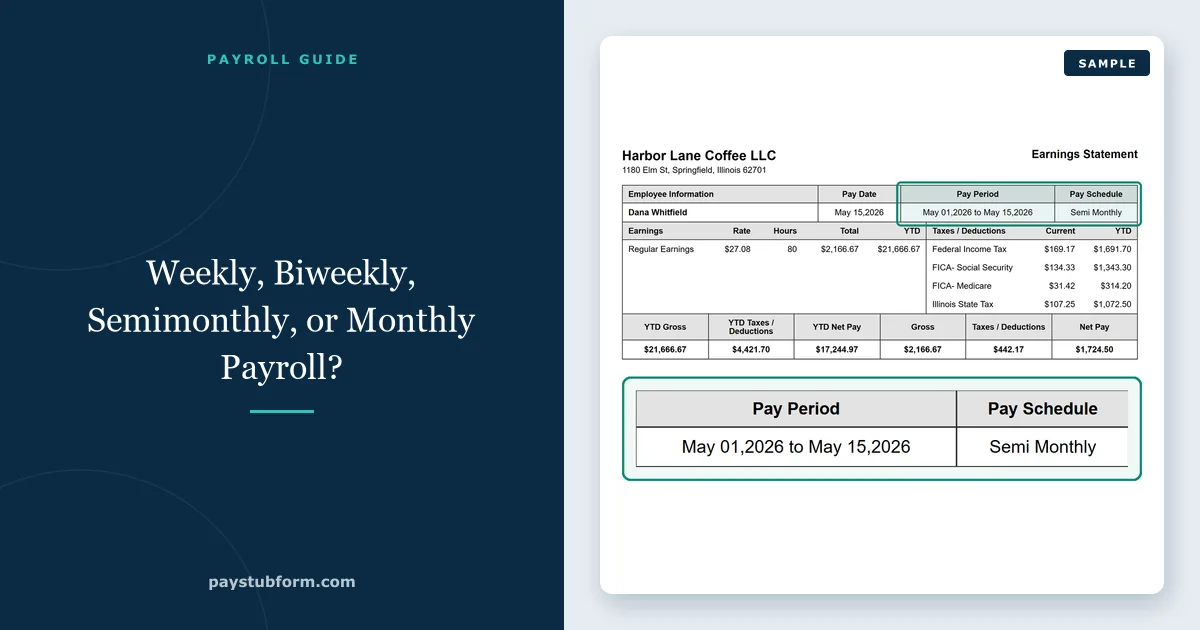
Biweekly and semimonthly sound like the same thing and are not. One pays you 26 times a year, the other 24. Over a year the total is identical; month to month it is not, and that difference is the reason a household budget that balanced on paper runs short in ten months of the year.
Which schedule you are on also determines when your employer is legally required to pay you, because several states regulate frequency directly. Here is what each schedule produces, and how to build a bill calendar that survives it.
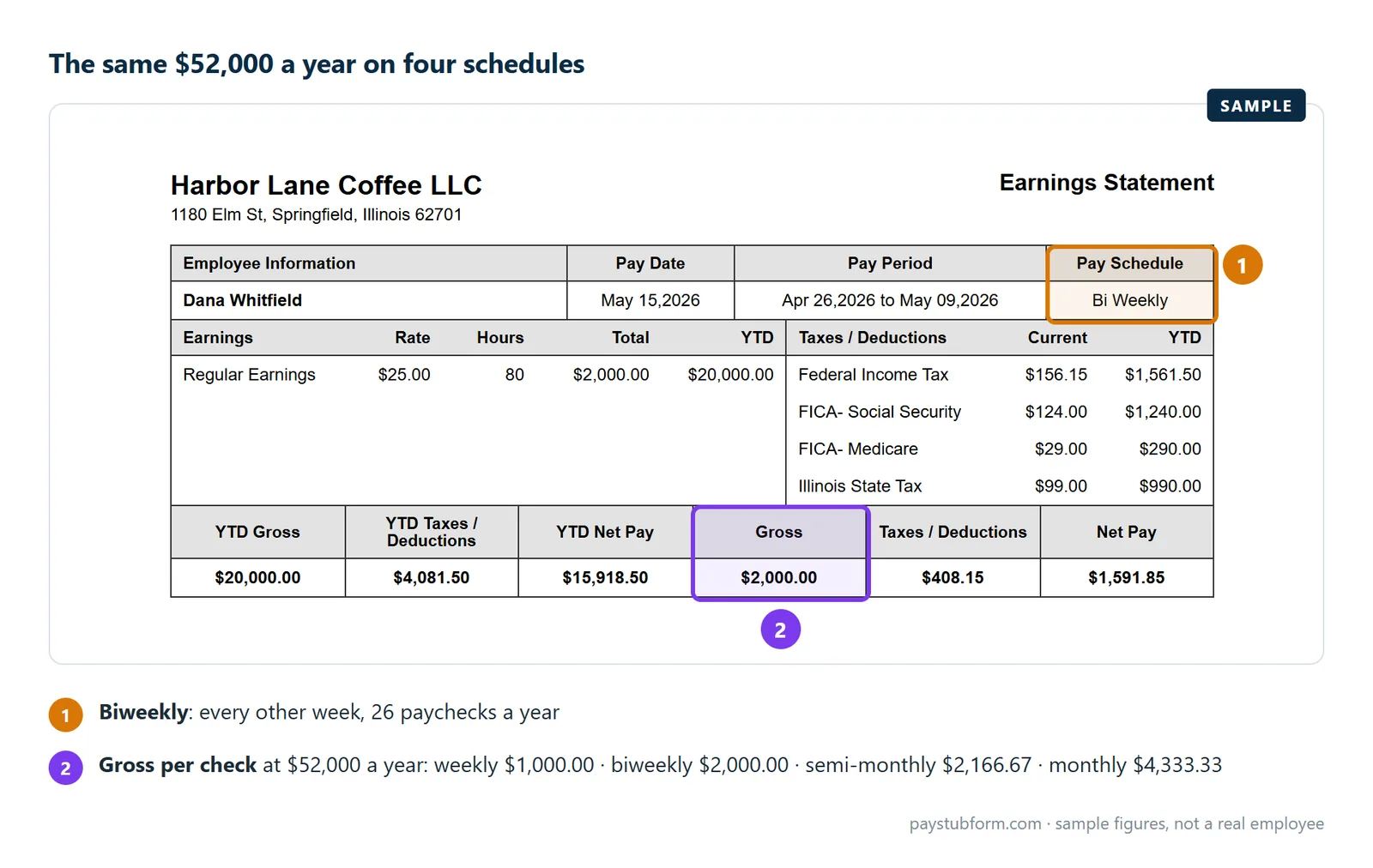
Quick take: Biweekly means every two weeks — 26 paychecks, and two months a year with three pay dates. Semimonthly means twice a month — 24 paychecks, always two per month, with the gap between them swinging between 13 and 18 days.
The four schedules
| Schedule | Paychecks a year | Pattern |
|---|---|---|
| Weekly | 52 | Same day every week |
| Biweekly | 26 | Every second week, same weekday |
| Semimonthly | 24 | Twice a month on fixed dates, e.g. the 15th and the last day |
| Monthly | 12 | Once a month on a fixed date |
Biweekly pay dates drift through the month because 26 fortnights do not divide evenly into 12 months. Semimonthly dates do not drift, but the interval between them does — from the 15th to the last day of February is 13 days; from the 15th to the 31st of March is 16.
The two months that break budgets
On a biweekly schedule, two months each year contain three pay dates. Budget as though every month has two and you are short in ten months and flush in two — and the two will not feel like a surplus, because the ten already spent them.
The arithmetic is worth doing once. Twenty-six paychecks of $1,800 is $46,800 a year, which averages $3,900 a month. But ten months bring $3,600 and two bring $5,400. Your planning figure is $3,600, and the third cheque in those two months is a decision you get to make rather than money that disappears. Our guide on building a budget from take-home pay works through the method.
Semimonthly has the opposite property: every month is identical, which makes budgeting simpler, but the uneven gap between pay dates can leave a long stretch before a large bill. Our guide to what semi-monthly pay means lists every 2027 semi-monthly pay date and the per-check amount at common salaries.
Tip: Find next year's three-paycheck months now, from a calendar, and assign both extra cheques in advance — an emergency fund, a debt payment, an annual insurance bill. Unassigned, they are absorbed without trace.
Overtime is unaffected by your schedule
A point worth being firm about, because it is where real money is lost. Overtime is calculated on the workweek — a fixed and regularly recurring period of 168 hours — not on your pay period.
So on a biweekly schedule, 50 hours in week one and 30 in week two is not "80 hours, no overtime". It is 10 hours of overtime in week one. Averaging hours over two or more weeks is not permitted, even when both weeks sit inside the same pay period. See how overtime is actually calculated and why the pay period and the workweek are different units.
Deductions do not divide evenly either
Most benefit premiums are quoted monthly, so they split cleanly over 24 semimonthly cheques and awkwardly over 26 biweekly ones. Employers handle this in one of two ways, and it is worth knowing which yours uses:
- Take the premium from only the first two cheques of each month, skipping the third in a three-paycheck month. This is the common approach, and it is why that third cheque is larger than the other two by more than one period's pay.
- Spread the annual premium across all 26, making every deduction slightly smaller and every cheque consistent.
Retirement deferrals behave differently again: a percentage election follows your gross pay every period, so a third cheque carries a third deduction. If you are close to the annual limit, that can bring the cap forward — and if your plan matches per pay period without a true-up, stopping early can cost you match. Our guide on reading the 401(k) line covers it.
What your state allows
Frequency is not entirely up to the employer. Several states set a floor, and the rules differ in shape as well as in strictness.
- New York ties it to the kind of work: manual workers must be paid weekly, not later than seven calendar days after the week in which the wages were earned. Clerical and other workers must be paid at least semi-monthly. Commission salespersons must be paid at least monthly.
- Texas requires employees exempt from FLSA overtime to be paid at least once a month and everyone else at least twice a month, with each pay period as nearly as possible an equal number of days.
- Ohio sets a calendar rather than a frequency: wages for the first half of a month are due on or before the 1st of the next month, and wages for the second half on or before the 15th.
- California requires most employees to be paid at least twice a month on paydays announced in advance.
- North Carolina sets no minimum frequency, binding the employer instead to the payday it told you about in writing at hiring.
A monthly schedule is therefore unlawful for most non-exempt employees in several states. Our state-by-state guide covers the rest.
Build a calendar that survives it
- Write down your actual pay dates for the next three months from a calendar, rather than assuming two a month.
- Mark the three-paycheck months if you are biweekly, and decide now what the extra cheque does.
- List fixed bills with their due dates and assign each to the pay date that comes before it.
- Find the longest gap between two pay dates in the quarter and check that nothing large falls inside it.
- Confirm how your employer handles benefit deductions in a three-paycheck month, so a larger cheque does not get spent as a windfall.
If you need a pay stub showing the period and schedule correctly, you can create one here.
Quick answers
Is biweekly the same as semimonthly?
No. Biweekly is every two weeks — 26 cheques a year, with two months containing three pay dates. Semimonthly is twice a month — 24 cheques, always two per month.
How many paychecks are in a year?
52 weekly, 26 biweekly, 24 semimonthly, 12 monthly. The annual total is the same; the distribution is not.
Why was one paycheck bigger than usual?
Most often a three-paycheck month on a biweekly schedule, where the monthly benefit premium was taken from the first two cheques only. Reaching the Social Security wage base can do it too.
Does a biweekly schedule change my overtime?
No. Overtime is calculated per workweek, over 40 hours in each seven-day week separately. Hours cannot be averaged across the two weeks of a biweekly period.
Can my employer pay me monthly?
Only if your state allows it for your role. Several states require at least semi-monthly payment for non-exempt employees, and New York requires weekly payment for manual workers.
Can my employer change my pay frequency?
Generally yes, with advance notice and provided the new schedule still meets your state's minimum. It cannot be used to push wages already earned past the deadline that applied to them.
Sources
- U.S. Department of Labor — Fact Sheet #23, Overtime Pay Requirements of the FLSA: the 168-hour workweek and the prohibition on averaging hours across weeks.
- New York Labor Law § 191: weekly payment for manual workers, semi-monthly for clerical and other workers, monthly for commission salespersons.
- Texas Labor Code § 61.011: monthly for FLSA-exempt employees, twice monthly for everyone else.
- Ohio Revised Code § 4113.15: the semi-monthly payment calendar.
- IRS — 401(k) limit increases to $24,500 for 2026: the annual deferral limit a third pay date can bring forward.
General U.S. information, current for 2026. Pay frequency requirements are set by state law and vary by the kind of work performed.


Comments (0)
Loading comments...
Leave a Comment