Most budgets fail for an arithmetic reason rather than a willpower one. They are built on a salary figure that never arrives in full, divided by twelve months that do not match the dates money actually lands. The money looks like it should be there, the calendar disagrees, and the overdraft fills the gap.
A budget built from net pay and real pay dates behaves differently, because it is describing the money you actually have on the days you actually have it. The arithmetic takes about twenty minutes and your pay stub supplies almost all of it.
Quick take: Budget from the net pay figure on your stub, not your salary. Then work in weeks rather than months — the CFPB's own cash flow method carries each week's closing balance into the next, which is what exposes the week where the rent and the car payment collide.
Start with the number that actually arrives
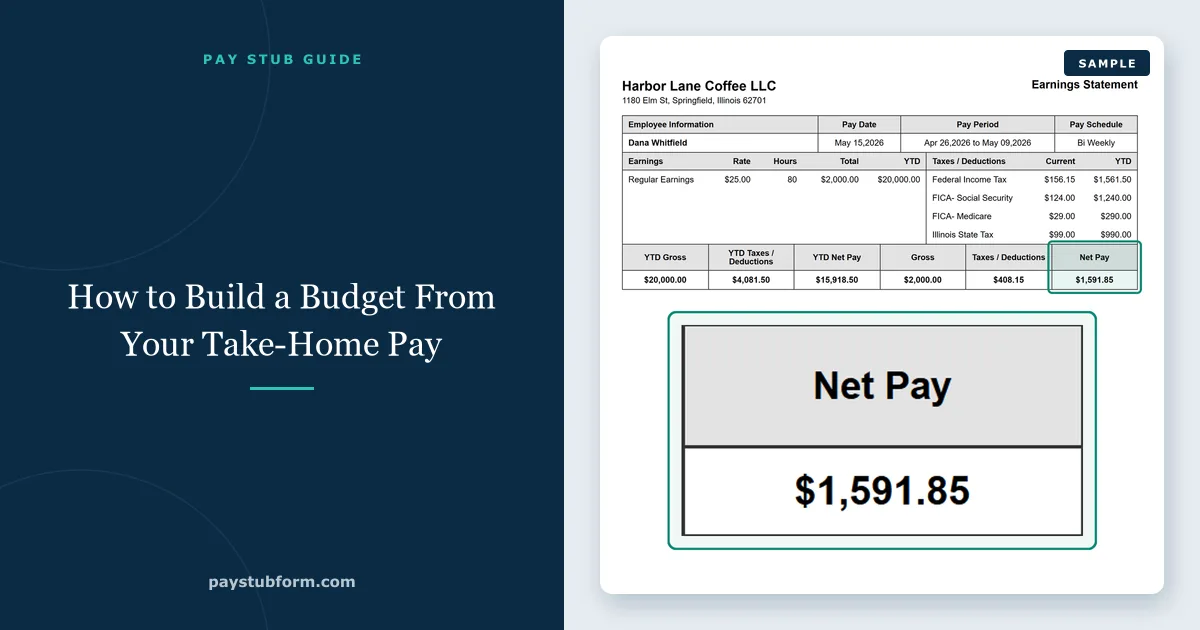
Find net pay on your most recent stub. That is gross earnings after every tax and deduction — the figure that matches your bank deposit. It is typically 25% to 35% below gross once federal and state tax, Social Security at 6.2%, Medicare at 1.45% and your benefit deductions have come out. Our guide to gross pay versus net pay breaks down each layer.
Take net pay from two or three recent stubs rather than one, and use the lowest. Paychecks vary — overtime, a commission, a month with an extra benefit deduction — and a budget built on your best month is a budget that fails in your worst one.
One thing not to do: do not budget from a bonus. Bonuses are withheld at a flat rate and arrive irregularly, so they belong in your plan as something that funds a goal, not as something that pays a bill.
Get your pay dates right, because months lie
This is where most household budgets quietly break.
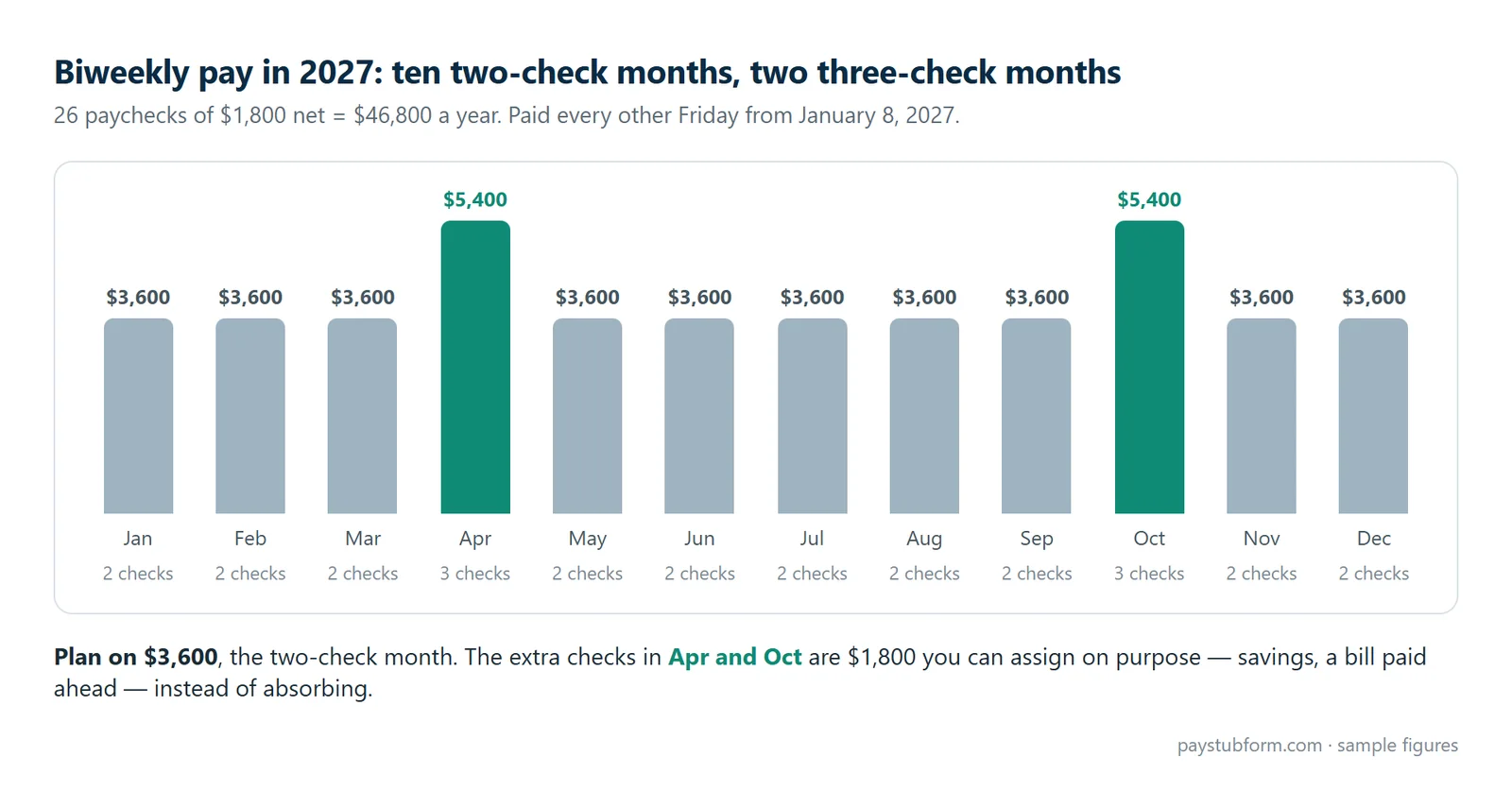
Biweekly means every two weeks — 26 paychecks a year, not 24. Two months each year contain three pay dates. If you budget as though every month has two, you are short in ten months and flush in two, and the two will not feel like a surplus because the ten already spent it.
Semimonthly means twice a month, usually the 15th and the last day — 24 paychecks, always two per month, but the gap between them swings between 13 and 18 days.
Multiply out the one you are on: 26 biweekly paychecks of $1,800 is $46,800 a year, or $3,900 a month on average — but $3,600 in most months and $5,400 twice. The $3,600 is your planning figure. The two extra checks are a decision you get to make rather than money that disappears.
Build the plan in weeks, not months
The CFPB's cash flow method is built around tracking the timing of income and expenses to make sure you have enough from week to week. Each week's ending balance becomes the next week's starting balance, which is what makes a cash shortage visible before it happens rather than after.
In practice:
- Write down what is actually in your accounts today.
- List each week's income — your pay dates, not a monthly average, plus any benefits or other income.
- List each week's expenses on the dates they are actually due: rent, loan payments, insurance, utilities, subscriptions, groceries, fuel.
- Subtract expenses from income for that week and carry the balance forward.
- Repeat across eight to twelve weeks.
A negative week is not a judgement. It is a scheduling problem, and the usual fixes are moving a due date, splitting a bill across two pay dates, or holding part of one paycheck for the following week.
Three categories, in priority order
Once the timing works, the split is straightforward.
- Fixed obligations. Rent or mortgage, loan payments, insurance, childcare, utilities. These have due dates and consequences, so they get allocated first, against specific pay dates.
- Variable essentials. Food, transport, medicine, household basics. Give each a weekly number rather than a monthly one — weekly numbers are easier to feel.
- Everything else. Saving, debt beyond the minimum, and spending you choose. Treat the first two as bills with due dates, otherwise they become whatever is left, which is usually nothing.
Ratio rules are a starting point, not an answer. A rule that leaves 50% of income for essentials is useless where rent alone takes 45%; what the ratio is really asking is which of the three groups has room to move.
What your pay stub is already doing for you
Several things people try to budget for are already handled upstream, and double-counting them is a common error.
- Taxes are already out. Net pay is after them. Do not set money aside for income tax on wages unless you are deliberately under-withheld.
- Health premiums taken pre-tax are already out, so they are not a monthly bill to plan for.
- Retirement contributions are already out, which means your savings rate is higher than your budget shows. Count the 401(k) line as saving when you judge how you are doing — see how to read that line.
- HSA and FSA contributions are already out, so medical costs up to those balances are pre-funded.
Tip: Set the fixed transfers — savings, extra debt payment — for the day after each pay date, not the end of the month. Money that leaves immediately is saved; money that leaves at month end is whatever survived.
Plan for net pay changing, because it will
Net pay is not a constant, and the swings are predictable enough to plan for.
In January it usually falls: new tax tables, the Social Security wage base resetting, new benefit premiums. Late in the year it can rise sharply for higher earners, when Social Security withholding stops once wages pass $184,500 for 2026. Open enrolment changes it. A raise changes it by less than the raise. The January 2026 changes are set out here.
Re-check your planning figure against an actual stub twice a year, and after any change of job, benefit election or pay rate.
Build it in twenty minutes
- Take net pay from your three most recent stubs and use the lowest.
- Write down your actual pay dates for the next three months from a calendar.
- List fixed obligations with their due dates and assign each to the pay date that precedes it.
- Give variable essentials a weekly figure.
- Run the weekly balance forward and find the weeks that go negative.
- Fix those weeks by moving dates or splitting bills, then set your savings transfer for the day after payday.
If you need a clear copy of a pay record to work from or to provide, you can create an accurate one here. And if the deposit in your account does not match the net pay on the stub, that gap has its own explanations.
Quick answers
Should I budget on gross or net pay?
Net, always. Gross income never reaches you. Gross is what lenders and landlords ask for; net is what pays the bills.
How do I handle the two extra paychecks on a biweekly schedule?
Plan every month as a two-paycheck month, then decide in advance what the third does — an emergency fund, a debt payment, an annual bill. Unassigned, it is absorbed without trace.
My pay varies every period. What do I use?
Budget fixed obligations against the lowest recent net pay, and treat anything above that as variable income allocated when it arrives. The weekly cash flow method handles this better than a monthly average does.
Does the 50/30/20 rule work?
Only as a sanity check. It assumes housing and essentials fit in half your income, which is not true in much of the country. Use it to see which group is out of proportion, not as a target.
Should I count my 401(k) as saving?
Yes. It left your pay before you saw it, so it is invisible in a net-pay budget while still being money you saved. Add it back when you judge your savings rate.
Why is my net pay different every month?
Overtime, benefit changes, the number of pay dates in that month, reaching the Social Security wage base, or a new tax year's withholding tables. Comparing two stubs line by line finds it quickly.
Sources
- Consumer Financial Protection Bureau — Creating a cash flow budget: the week-by-week method and carrying each week's ending balance forward.
- IRS Topic no. 751 — Social Security and Medicare withholding rates: the 6.2% and 1.45% deductions that separate gross from net.
- Social Security Administration — Contribution and Benefit Base: the $184,500 wage base for 2026, after which net pay rises.
General U.S. information, current for 2026. This is budgeting guidance, not financial advice; your own numbers depend on your pay, deductions and obligations.


Comments (0)
Loading comments...
Leave a Comment