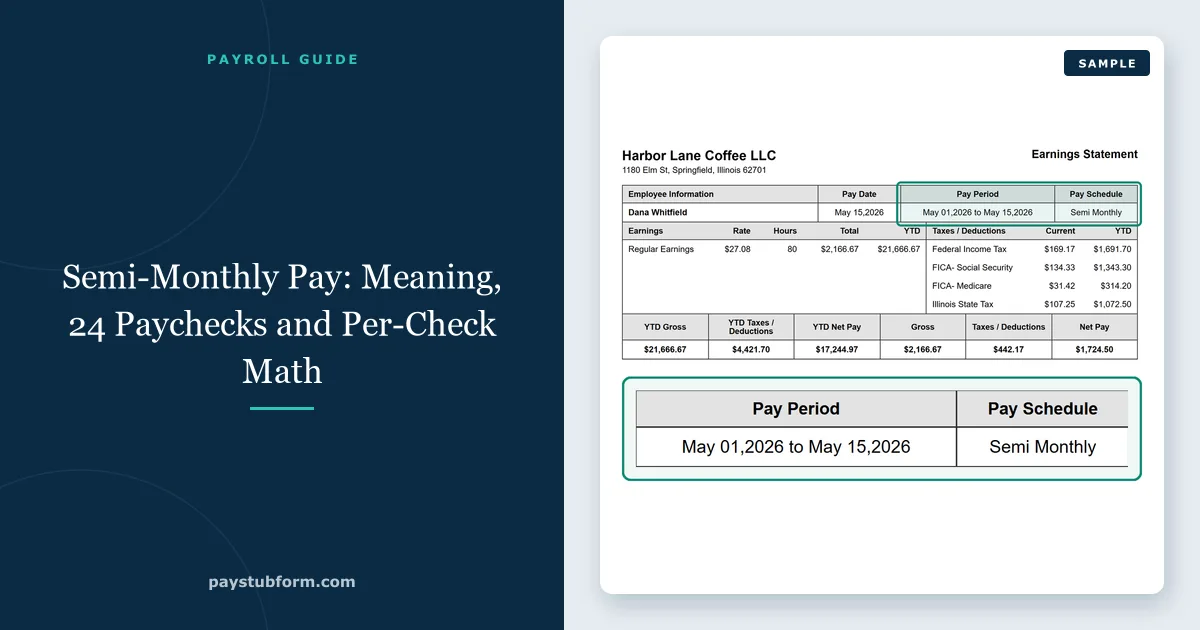
Semi-monthly pay means you are paid twice a month on two fixed dates — most often the 15th and the last day of the month — for 24 paychecks a year. Each paycheck covers half a month, so a salaried employee's gross pay is the annual salary divided by 24, and it is the same on every check.
It is easy to confuse with biweekly pay, which is every two weeks and gives 26 paychecks. Below is what semi-monthly means on a pay stub, how much each check is at common salaries and hourly rates, and every 2027 semi-monthly pay date with the weekend and holiday adjustments already made.
Quick take: Semi-monthly = twice a month, 24 paychecks, always two per month, fixed calendar dates. Per check: salary ÷ 24 (a $60,000 salary is $2,500.00 gross). When the 15th or the last day falls on a weekend or bank holiday, most employers pay on the business day before — in 2027 that happens 10 times.
1. What semi-monthly means
"Semi" means half, so semi-monthly is "every half month". The schedule is tied to the calendar, not to the day of the week:
- Pay dates: two fixed dates each month. The 15th and the last day is the most common pair; the 1st and 15th, or the 10th and 25th, are also used.
- Pay periods: usually the 1st–15th and the 16th–end of the month. The first period always has 15 days; the second has 13 to 16, depending on the month.
- Paychecks a year: exactly 24, every year. There are no "three-paycheck months".
- Weekday: changes every time. One payday might be a Tuesday and the next a Friday.
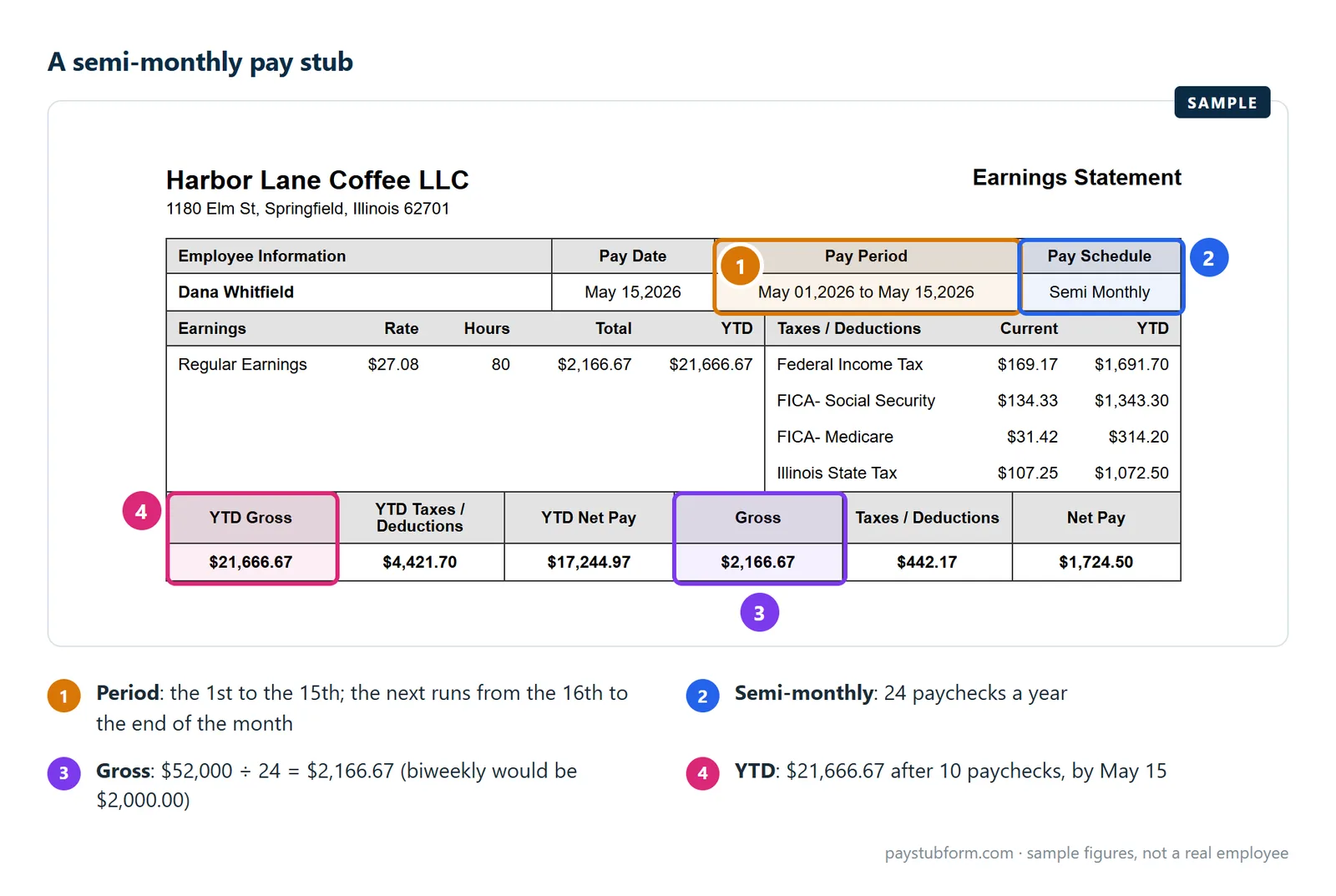
On a pay stub you will usually see it as "Pay frequency: Semi-Monthly" or the abbreviation SM, next to the period start and end dates. If the period on your stub ends on the 15th or the last day of a month, you are almost certainly paid semi-monthly. Our guide to pay period vs pay date explains why those two dates differ.
2. Semi-monthly vs biweekly at a glance
| Semi-monthly | Biweekly | |
|---|---|---|
| How often | Twice a month, fixed dates | Every two weeks, same weekday |
| Paychecks a year | 24 | 26 (sometimes 27) |
| Paychecks a month | Always 2 | 2, except two months with 3 |
| Salary per check | Annual ÷ 24 | Annual ÷ 26 |
| Hours per period (full time) | About 86.67 on average, varies | Always 80 |
| Common with | Salaried office staff | Hourly workers |
Both schedules pay the same amount over a year. The difference is how the money is spread out. Our pay frequency guide covers weekly and monthly schedules too, and how to budget around biweekly three-paycheck months.
3. How much is each semi-monthly paycheck?
For a salary, divide the annual amount by 24. The table shows gross pay per check before taxes and deductions, next to the biweekly amount for the same salary.
| Annual salary | Semi-monthly check (÷24) | Biweekly check (÷26) | Difference per check | Monthly |
|---|---|---|---|---|
| $40,000 | $1,666.67 | $1,538.46 | $128.21 | $3,333.33 |
| $50,000 | $2,083.33 | $1,923.08 | $160.26 | $4,166.67 |
| $60,000 | $2,500.00 | $2,307.69 | $192.31 | $5,000.00 |
| $75,000 | $3,125.00 | $2,884.62 | $240.38 | $6,250.00 |
| $100,000 | $4,166.67 | $3,846.15 | $320.51 | $8,333.33 |
A semi-monthly check is larger than a biweekly one, but there are two fewer of them, so the annual total is identical. To see what is left after federal, state and FICA taxes, enter the salary and choose "Twice a month" in our free paycheck calculator.
Hourly pay on a semi-monthly schedule. A full-time year is 2,080 hours, which averages 86.67 hours per semi-monthly period. That average is only a planning figure: an hourly employee is paid for the hours actually worked in each period, so the check changes with the number of workdays between the 1st and the 15th, or between the 16th and the end of the month.
| Hourly rate | Average semi-monthly gross (86.67 h) | Biweekly gross (80 h) |
|---|---|---|
| $15 | $1,300.00 | $1,200.00 |
| $20 | $1,733.33 | $1,600.00 |
| $25 | $2,166.67 | $2,000.00 |
| $30 | $2,600.00 | $2,400.00 |
Need the yearly figure for an hourly rate? Our hourly to salary calculator converts in both directions.
4. 2027 semi-monthly pay dates
The table uses the most common pattern — the 15th and the last day of the month — and moves any date that falls on a weekend or Federal Reserve bank holiday to the business day before, which is what most payroll providers do. Ten of the 24 dates move in 2027.
| Month | Mid-month payday | End-of-month payday |
|---|---|---|
| January | Fri, Jan 15 | Fri, Jan 29 (31st is a Sunday) |
| February | Fri, Feb 12 (15th is Presidents' Day) | Fri, Feb 26 (28th is a Sunday) |
| March | Mon, Mar 15 | Wed, Mar 31 |
| April | Thu, Apr 15 | Fri, Apr 30 |
| May | Fri, May 14 (15th is a Saturday) | Fri, May 28 (31st is Memorial Day) |
| June | Tue, Jun 15 | Wed, Jun 30 |
| July | Thu, Jul 15 | Fri, Jul 30 (31st is a Saturday) |
| August | Fri, Aug 13 (15th is a Sunday) | Tue, Aug 31 |
| September | Wed, Sep 15 | Thu, Sep 30 |
| October | Fri, Oct 15 | Fri, Oct 29 (31st is a Sunday) |
| November | Mon, Nov 15 | Tue, Nov 30 |
| December | Wed, Dec 15 | Fri, Dec 31 |
Some employers pay on the business day after a weekend or holiday instead, and a few use the 1st and 15th. Your offer letter or employee handbook states which rule yours follows. Our 2027 payroll calendar lists weekly, biweekly and monthly dates as well.
5. Is 2027 a 27-paycheck year for biweekly workers?
It depends on which Friday cycle you are on. 2027 begins on a Friday and has 53 Fridays, so one of the two every-other-Friday cycles has 27 scheduled paydays: January 1, 15, 29 … through December 31.
- If your employer pays early for holidays, the January 1 payday (New Year's Day) is paid on Thursday, December 31, 2026. That check counts toward your 2026 W-2, and 2027 has the usual 26.
- If your employer pays late for holidays, it is paid on Monday, January 4, 2027, and that cycle gets 27 paychecks in 2027.
- The other cycle (January 8, 22 …) has 26 paydays, with three-paycheck months in April and October.
Semi-monthly workers never face this: it is 24 paychecks every year. A 27th biweekly paycheck matters for salaried employees, because some employers divide the salary by 27 that year, making each check smaller, while others keep dividing by 26 and pay one extra check. Ask payroll before January if your paydays fall on that cycle.
6. What changes on a semi-monthly pay stub
- Benefit deductions are even. Monthly premiums split cleanly in half, so every check shows the same health, dental and vision deduction — no skipped deductions in a third-paycheck month.
- Federal withholding uses the semi-monthly table. Payroll uses the 24-period column of the IRS withholding tables, so each check withholds 1/24 of the annual estimate. Over the year it ends up the same as on a biweekly schedule.
- Overtime is still weekly. Overtime is calculated per seven-day workweek, and a week that straddles the 15th belongs to two pay periods. Federal rules let the employer pay that overtime on the next regular payday if it cannot be calculated in time, so an hourly stub can show overtime from the previous period.
- The year-to-date math is simple. After the June 30 payday you have received exactly 12 of 24 checks, so your YTD gross should be half your salary. That makes a semi-monthly stub easy to check.
- Lenders like it. A landlord or lender converting to monthly income only has to multiply one check by 2 (biweekly needs ×26 ÷ 12). See proof of income for an apartment for how the figures are checked.
If you need a pay stub that shows a semi-monthly period and matching year-to-date totals, you can create one here — choose "Semi-Monthly" as the pay frequency.
Five-minute check
- Look at the period dates on your latest stub: 1st–15th or 16th–end of month means semi-monthly.
- Multiply your gross pay by 24. For a salary it should equal your annual salary.
- Find your next payday in the 2027 table above and note the ten dates that move earlier.
- Check that benefit deductions are identical on both checks of the month.
- If you are biweekly on the January 1 cycle, ask payroll whether 2027 has 26 or 27 paychecks.
Quick answers
What does semi-monthly mean?
Twice a month. You are paid on two fixed dates each month, usually the 15th and the last day, for 24 paychecks a year.
Is semi-monthly every two weeks?
No. Every two weeks is biweekly, which gives 26 paychecks a year. Semi-monthly is twice a calendar month, so the gap between paydays varies from 13 to 18 days.
How many pay periods are in a semi-monthly year?
Always 24. Unlike biweekly, it never has 27 pay periods or three-paycheck months.
How do I calculate semi-monthly pay?
For a salary, divide the annual amount by 24: $60,000 ÷ 24 = $2,500.00 gross per check. For hourly pay, multiply the rate by the hours actually worked in the period.
Is semi-monthly or biweekly better?
Neither pays more over the year. Semi-monthly makes monthly bills easier because every month is the same; biweekly gives two extra paychecks that can go to savings or debt.
What happens when the 15th falls on a weekend?
Most employers pay on the last business day before it — for example Friday, May 14, 2027, when the 15th is a Saturday. Some pay the next business day; your employer's written pay policy says which.
Sources
- IRS Publication 15-T — Federal Income Tax Withholding Methods: the semi-monthly (24 pay periods) column of the withholding tables.
- 29 CFR 778.106 — Time of payment: overtime is due on the regular payday for the period in which the workweek ends, or as soon after as practicable.
- U.S. Department of Labor — Fact Sheet #23, Overtime Pay: overtime is calculated per fixed 168-hour workweek, regardless of pay frequency.
- Federal Reserve Financial Services — Holiday schedules: the 2027 bank holidays used to adjust the pay dates.
- U.S. Department of Labor — State payday requirements: which states require semi-monthly or more frequent pay.
General U.S. information, current for 2026 and the 2027 calendar. Pay dates depend on your employer's payroll policy and state law; gross amounts in the tables are before taxes and deductions.


Comments (0)
Loading comments...
Leave a Comment