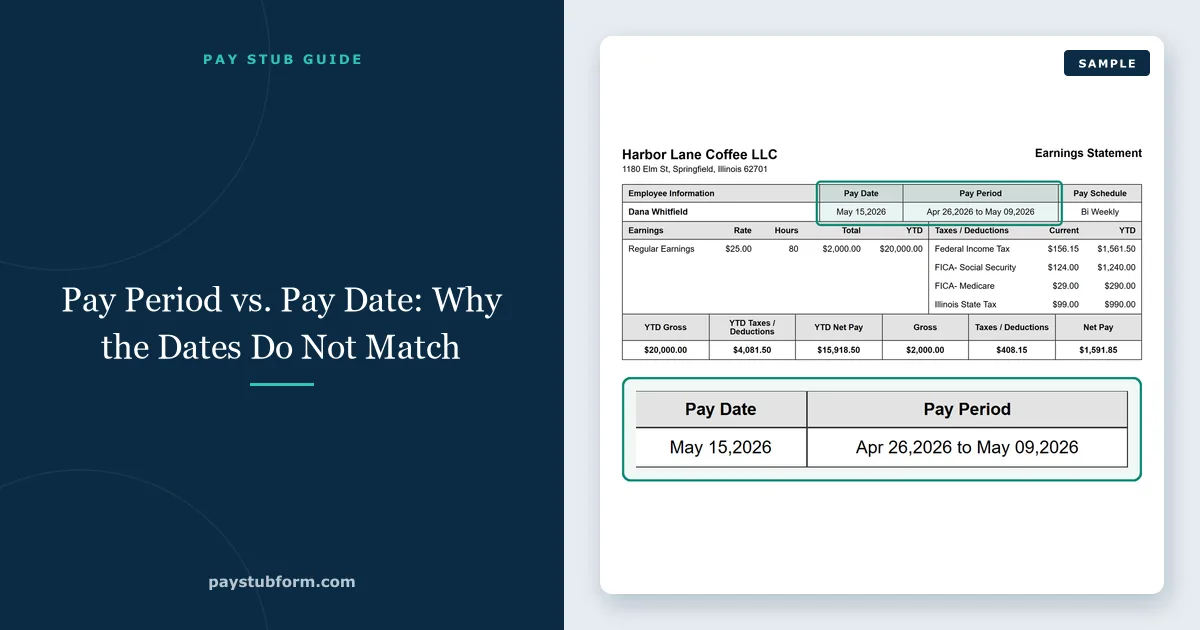
Someone looks at a pay stub, sees a date at the top and a date at the bottom, and assumes one of them is a typo. They are two different facts: the pay period is when you worked, and the pay date is when the money arrived. They are never the same, and the gap between them is where most "my stub looks wrong" questions come from.
Confusing the two produces real errors — hours that look missing, overtime that seems not to have been paid, a W-2 that covers the wrong year. Here is what each date means and what it governs.
Quick take: The pay period is the stretch of work the stub covers. The pay date is when you were paid for it. Tax year, W-2 reporting and most legal deadlines run on the pay date; hours and overtime are calculated on the workweek inside the pay period.
The three dates on a stub
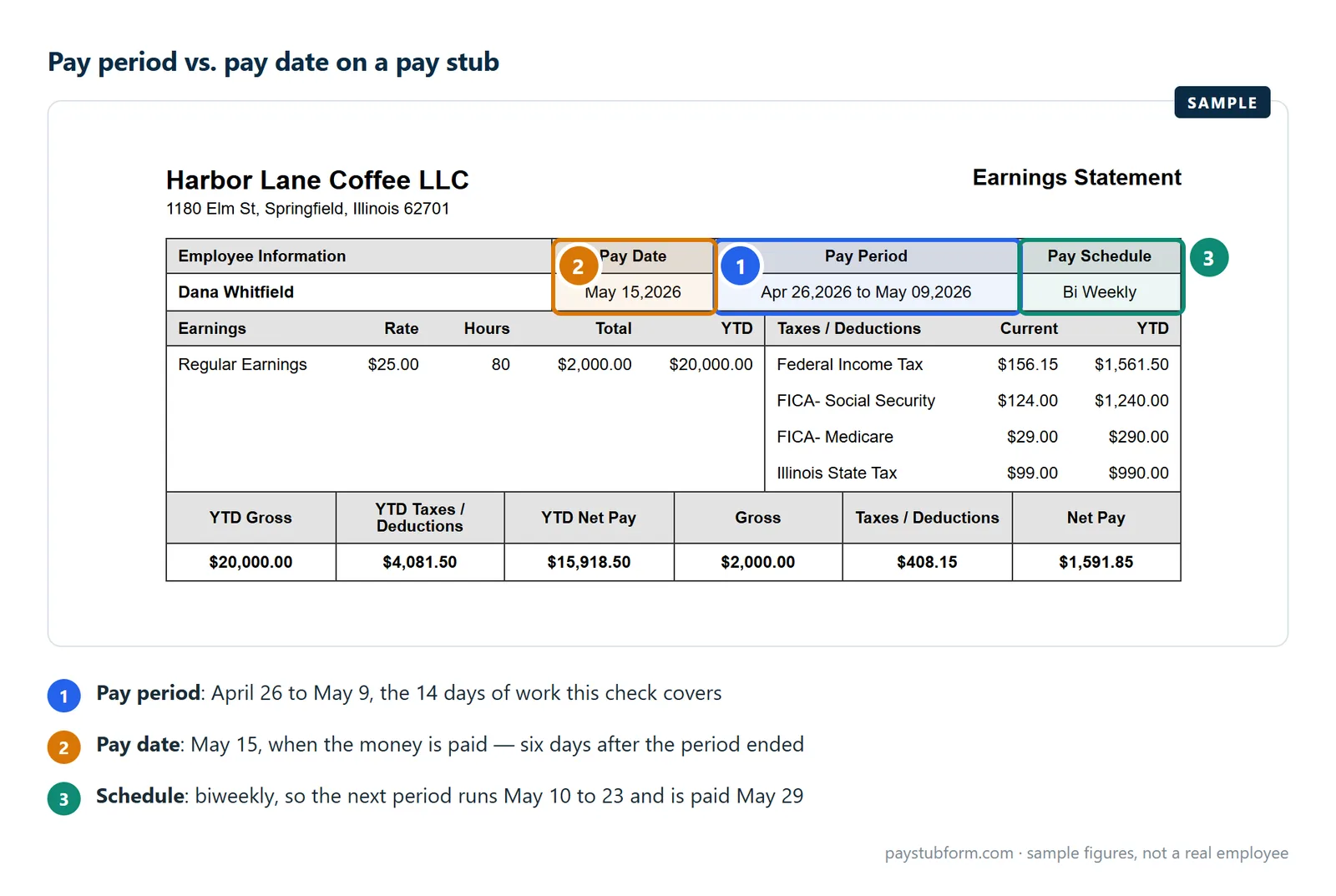
- Pay period start and end — the work being paid for. Usually shown as a range.
- Pay date — the day the money is issued. Often several days after the period ends, to give payroll time to process.
- The workweek — often invisible on the stub, but the unit overtime is calculated on. More on this below.
The lag between period end and pay date is normal and usually between three days and two weeks. It is processing time, not a delay.
What the pay date governs
More than people expect. The pay date, not the work date, decides:
Which tax year the money belongs to. A W-2 reports wages paid during the calendar year. Work done in late December and paid in January appears on next year's W-2. This is the single most common source of January confusion — see why a W-2 and a final pay stub differ.
Which year's rates apply. Tax tables, the Social Security wage base and benefit deductions change on January 1 and apply from the first pay date in the new year, even for work done in December. It is why a January paycheck for December work can be smaller than December's was.
When year-to-date figures move. YTD totals advance on pay dates, not work dates.
Legal deadlines. State pay frequency laws are written about pay dates. So is final pay: Texas gives an employer six calendar days after a discharge, while New York, Ohio and North Carolina use the next regular payday for the period in which the employment ended.
What the pay period governs
Chiefly the hours — and here there is a trap worth understanding properly.
Overtime is not calculated on the pay period. It is calculated on the workweek, which the Department of Labor defines as a fixed and regularly recurring period of 168 hours — seven consecutive 24-hour periods. A workweek does not have to start on a Monday or match the calendar week, and it does not have to line up with your pay period.
Crucially, averaging hours over two or more weeks is not permitted. On a biweekly pay period, 50 hours in the first week and 30 in the second is not "80 hours, no overtime" — it is 10 hours of overtime in week one and a short week two. An employer who nets them off across the pay period is underpaying, and this is one of the most common errors on biweekly stubs. Our overtime guide covers how the rate itself is calculated.
Tip: Ask payroll which day your workweek starts. Without it you cannot check an overtime figure at all, because you cannot tell which hours fall in which week — and it is rarely printed on the stub.
Why your last day doesn't appear on your last stub
Because of the lag. If your pay period ends on the 15th and you work until the 20th, the final five days fall into the next period and are paid on the next pay date. That is not a withheld paycheck — it is the schedule working normally.
It does mean that your final pay stub is often not the stub showing your final days. Check both before you lose portal access; the final paycheck checklist covers the rest.
State rules are written about the pay date
How often you must be paid, and by when, varies more than most people realise — and every one of these rules is expressed in pay dates.
- Ohio sets an explicit calendar rather than a frequency: wages earned in the first half of a month, through the 15th, are due on or before the 1st of the following month; wages earned in the second half are due on or before the 15th of the following month. That allows a longer lag than most states.
- New York ties frequency to the kind of work. Manual workers must be paid weekly and not later than seven calendar days after the week in which the wages were earned; clerical and other workers at least semi-monthly.
- Texas requires employees exempt from FLSA overtime to be paid at least monthly and everyone else at least twice a month, with each pay period as nearly as possible an equal number of days.
- North Carolina prescribes no minimum frequency at all — it binds the employer to the payday it announced in writing when you were hired.
Our state-by-state guide sets out the rest.
Check your own dates in three minutes
- Find the pay period range and confirm it is the work you expect to be paid for — not the days immediately before the pay date.
- Note the lag between period end and pay date. It should be consistent from stub to stub; a sudden change is worth a question.
- Establish the workweek start day and split the period's hours into weeks on that boundary.
- Check overtime week by week, never across the period.
- In January, check which year a pay date falls in before comparing a stub to a W-2.
If you need a pay stub with the period and pay date shown correctly, you can create one here.
Quick answers
What is the difference between a pay period and a pay date?
The pay period is the span of work the stub covers. The pay date is the day you were paid for it. The pay date is always after the period ends.
Why is there a gap between them?
Processing time — approving hours, running payroll, submitting the file to the bank. Three days to two weeks is normal, and the gap should be consistent.
Which date decides my tax year?
The pay date. A W-2 reports wages paid during the calendar year, so December work paid in January belongs to the following year's W-2.
My pay period is two weeks. Is overtime calculated on 80 hours?
No. Overtime is calculated per workweek — over 40 hours in each seven-day week separately. Averaging hours across two or more weeks is not permitted, even within one pay period.
My last day isn't on my final stub. Is that wrong?
Usually not. Days worked after the period ended fall into the next period and are paid on the next pay date, which is when your state's final pay deadline is measured against.
Can my employer change the pay schedule?
Generally yes, with notice, provided the new schedule still satisfies your state's frequency rule. What an employer cannot do is use a change to delay wages already earned beyond the deadline that applied to them.
Sources
- U.S. Department of Labor — Fact Sheet #23, Overtime Pay Requirements of the FLSA: the 168-hour workweek definition and the prohibition on averaging hours across weeks.
- IRS — General Instructions for Forms W-2 and W-3 (2026): that a W-2 reports wages paid in the calendar year.
- Ohio Revised Code § 4113.15: the semi-monthly payment calendar.
- New York Labor Law § 191: weekly payment for manual workers and semi-monthly for clerical and other workers.
- Texas Labor Code ch. 61: § 61.011 pay frequency and § 61.014 final pay deadlines.
General U.S. information, current for 2026. Pay frequency and final pay deadlines are set by state law; check yours alongside the federal position on hours and overtime.


Comments (0)
Loading comments...
Leave a Comment