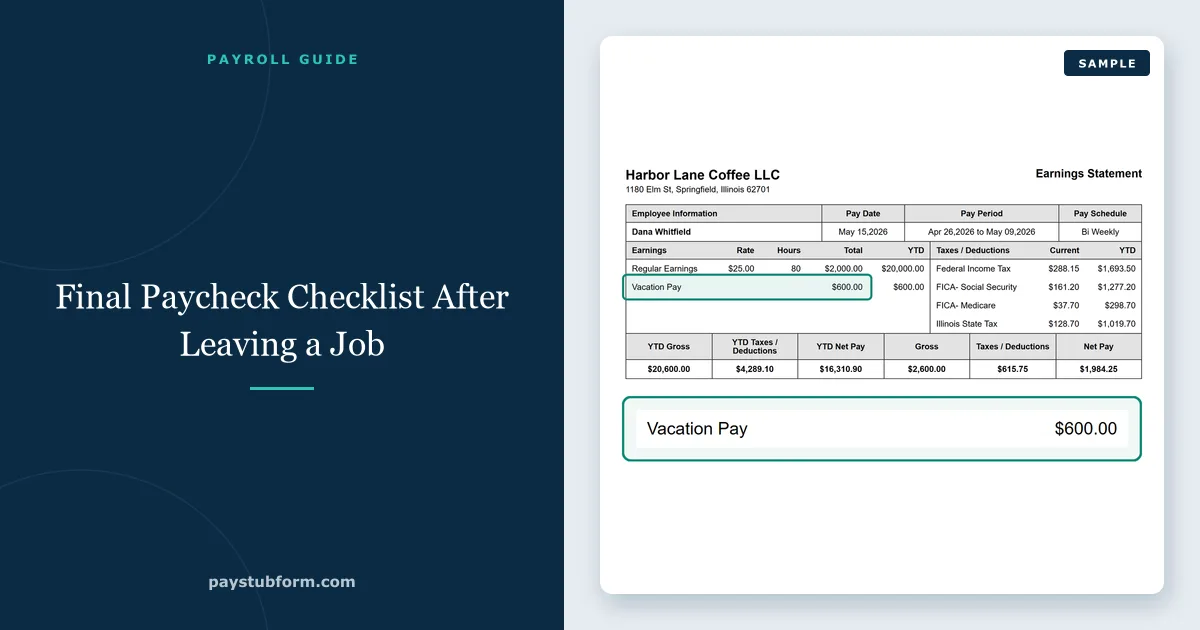
The last pay stub from a job is the one people check least and need most. It settles hours you will not be around to dispute, it carries the year-to-date totals your W-2 will be built from, and it is the last moment anything can be corrected while you are still a name in the payroll system rather than a former employee calling a general number.
It is also the stub most likely to be wrong, because it is the only one assembled by hand — final hours, accrued time off, a last benefit deduction, sometimes a loan balance. Here is what should be on it, when it has to arrive, and what to keep.
Quick take: Federal law does not require an employer to hand over a final paycheck immediately. The timing is set state by state, and so is whether unused vacation has to be paid out at all.
When your final paycheck has to arrive
The Department of Labor is explicit on this: employers are not required by federal law to give former employees their final paycheck immediately. Some states, however, may require immediate payment.
So the answer depends entirely on where you worked, and the rules differ in two dimensions that are easy to confuse:
- Whether you quit or were discharged. Many states set a tighter deadline for an involuntary termination — sometimes the same day — and allow until the next regular payday for a resignation.
- Whether you gave notice. Some states shorten the deadline for a resignation where the employee gave advance notice.
The spread between states is wider than most people expect. California requires all final wages, including accrued unused vacation, immediately at the time of termination when an employer fires or lays someone off. Texas allows six calendar days after a discharge. New York, Ohio and North Carolina all use the next regular payday for the period in which the employment ended, and none of them draws a distinction based on whether you resigned or were let go.
If the regular payday has passed and nothing has arrived, the DOL's own guidance is to contact the Wage and Hour Division or your state labor department. Our state-by-state guide covers what each state requires an employer to provide alongside wages.
What has to be on it
Work through these before you stop having access to your own records.
- Every hour through your last day, including any partial final week. Check it against your own record rather than the timekeeping system you can no longer open.
- Overtime at the correct rate for the final workweek. A short final week does not change how overtime in it is calculated.
- Shift differentials, on-call pay and bonuses already earned. Earned is the operative word — a commission that had met its conditions before you left is wages, not a gift.
- Commission on closed deals, in line with the commission plan rather than in line with what is convenient.
- Expense reimbursements still outstanding. These are not wages and are not taxed, so they should appear separately and should not be reduced by withholding.
- Year-to-date totals, which are the figures your W-2 will be built from and your only cross-check if the W-2 looks wrong in January.
Unused vacation: the line that varies most
There is no federal rule requiring accrued vacation to be paid out when you leave. What governs it is a combination of state law and your employer's own written policy.
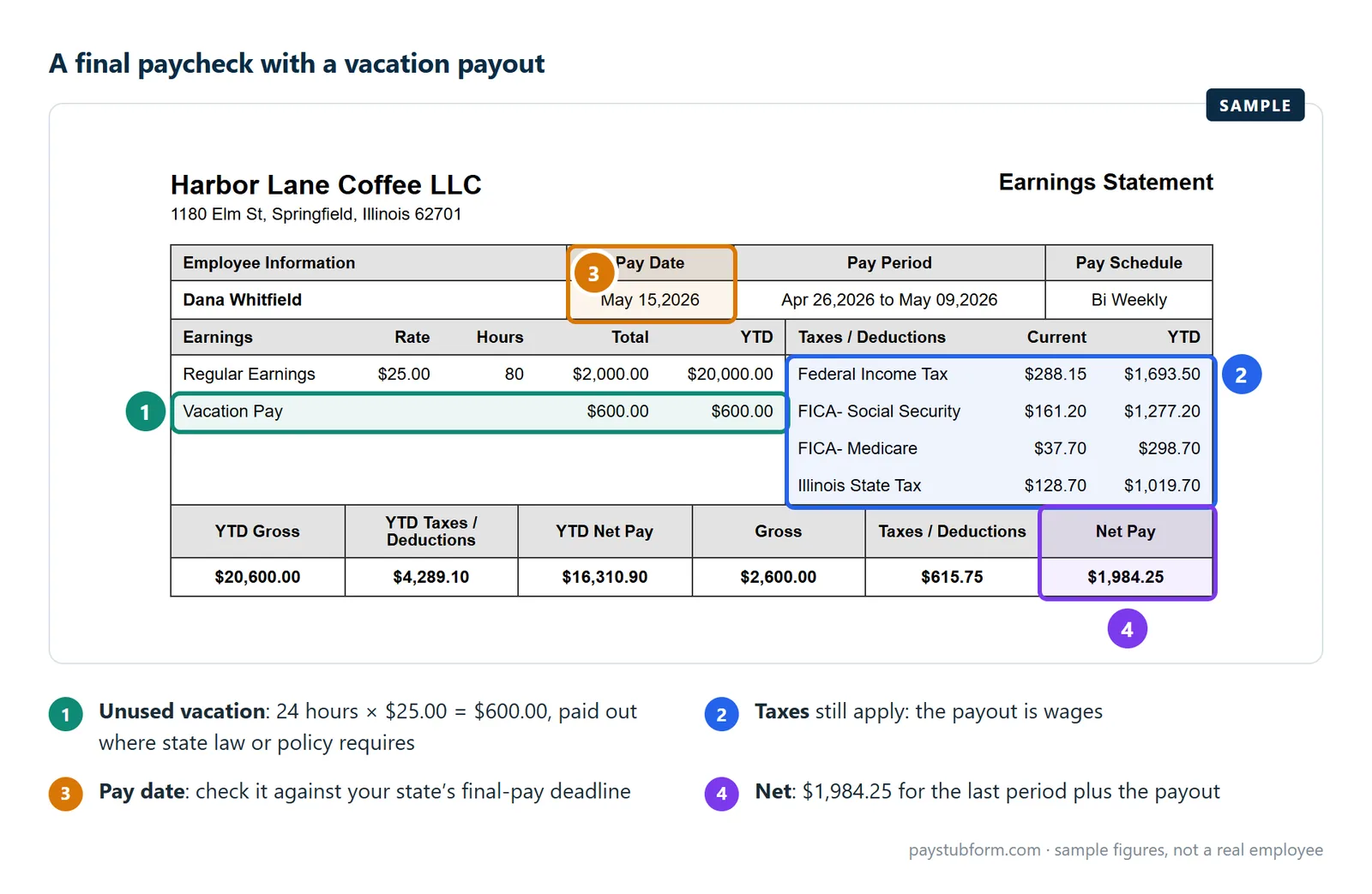
Three patterns exist. Some states treat accrued vacation as earned wages that must be paid out on separation, and in some of those states a policy saying otherwise is unenforceable. Some states let the employer's written policy decide, including a policy that forfeits unused time. And some states are silent, which in practice means the policy governs.
Whichever applies, check the balance itself against your own count before you accept the figure. A payout at the wrong accrual balance is the most common error on a final stub, and it is much easier to argue in week one than in month three.
Tip: Download your last twelve pay stubs before your access is cut off, not after. Former employees frequently lose the self-service portal on the termination date, and reconstructing a year of stubs afterwards means asking a company you no longer work for to do you a favour.
What is still deducted — and what cannot be
A final paycheck is still wages, so Social Security at 6.2%, Medicare at 1.45%, federal income tax and any state tax all still apply. A large payout of accrued time can push withholding higher than usual for that one check, in the same way a bonus does.
Two things worth checking:
- Benefit deductions. A premium is often taken for coverage running to the end of the month. One taken for a period after your coverage actually ended is worth questioning.
- Deductions that take you below minimum wage. Recovering equipment costs, training costs or a cash shortage from a final paycheck is constrained — federal rules limit deductions that cut into minimum wage, and several states restrict them further.
Your final 401(k) deferral comes out of this check too, which is worth knowing if you were close to the annual limit. See how 401(k) contributions appear on a pay stub for the 2026 figures.
Severance is not automatic
There is no requirement in the Fair Labor Standards Act for severance pay. It is a matter of agreement between an employer and an employee, usually based on length of service.
If you are offered it, note two things. It is supplemental wages for withholding purposes, so it may be withheld at the flat 22% rather than through your usual tables — which is why a severance payment often looks smaller than expected; the same mechanism as a bonus. And severance agreements typically ask you to give something up, so the number is not the only term worth reading.
What stops, and what you have to act on
- Health coverage. Find the actual end date — often the last day of the month, not your last day of work.
- COBRA. For employers with 20 or more employees, you generally have 60 days from when coverage ends or the election notice is provided, whichever is later, to elect continuation coverage. For a job ending, it can run up to 18 months. You pay the full premium — your old share plus the employer's share, plus up to 2%.
- Your 401(k). The balance is yours, but an outstanding plan loan usually becomes due on a short timetable, and an unpaid balance can be treated as a distribution.
- Your W-2. It arrives in January at the address payroll has on file. Update it before you lose contact.
Documents to keep
- Every pay stub for the year, especially the final one with its year-to-date totals.
- Your offer letter, any commission plan and the employee handbook section on time-off payout.
- The separation or severance agreement, signed and dated.
- Your own record of hours for the final pay period.
- Benefit termination and COBRA election notices, with the dates they arrived.
If you need a clean copy of a pay record for an application and no longer have access to the originals, you can produce an accurate stub here. For what a stub has to show in the first place, see our guide to reading one.
Quick answers
How long does an employer have to send a final paycheck?
Federal law sets no immediate deadline — the DOL says employers are not required by federal law to pay it immediately. State law decides, and some states do require immediate payment, often with different rules for being fired than for resigning.
Does unused vacation have to be paid out?
Not under federal law. Some states treat accrued vacation as earned wages that must be paid; others let the employer's written policy govern, including forfeiture. Check your state and your handbook together.
Can my employer deduct for unreturned equipment?
Sometimes, but not without limits. Federal rules restrict deductions that cut into minimum wage, and many states restrict them further or require written authorisation. A deduction that takes your final hours below minimum wage is worth challenging.
Why was my final check withheld at such a high rate?
A payout of accrued time or a severance payment is treated as supplemental wages and may be withheld at a flat rate rather than through your usual tables. It is withholding, not extra tax — the difference settles when you file.
What if my final paycheck never arrives?
Contact the Department of Labor's Wage and Hour Division or your state labor department. Bring your own record of hours, your last stub and the dates you worked.
When will I get my W-2?
In January, from your former employer, for the whole of the year you worked there. Check it against the year-to-date totals on your final pay stub — that is exactly what those totals are for. See when W-2s come out in 2027.
Sources
- U.S. Department of Labor — Last Paycheck: that federal law requires no immediate payment, that some states do, and where to complain if payday passes.
- U.S. Department of Labor — Severance Pay: that the FLSA contains no severance requirement and that it arises by agreement.
- U.S. Department of Labor — FAQs on COBRA Continuation Health Coverage for Workers: the 20-employee threshold, the 60-day election window, the 18-month maximum and the full-premium-plus-2% rule.
- IRS Topic no. 751 — Social Security and Medicare withholding rates: the taxes that still apply to a final paycheck.
General U.S. information, current for 2026. Final pay timing and vacation payout are set by state law and by your employer's written policy; for your own situation, check both.


Comments (0)
Loading comments...
Leave a Comment