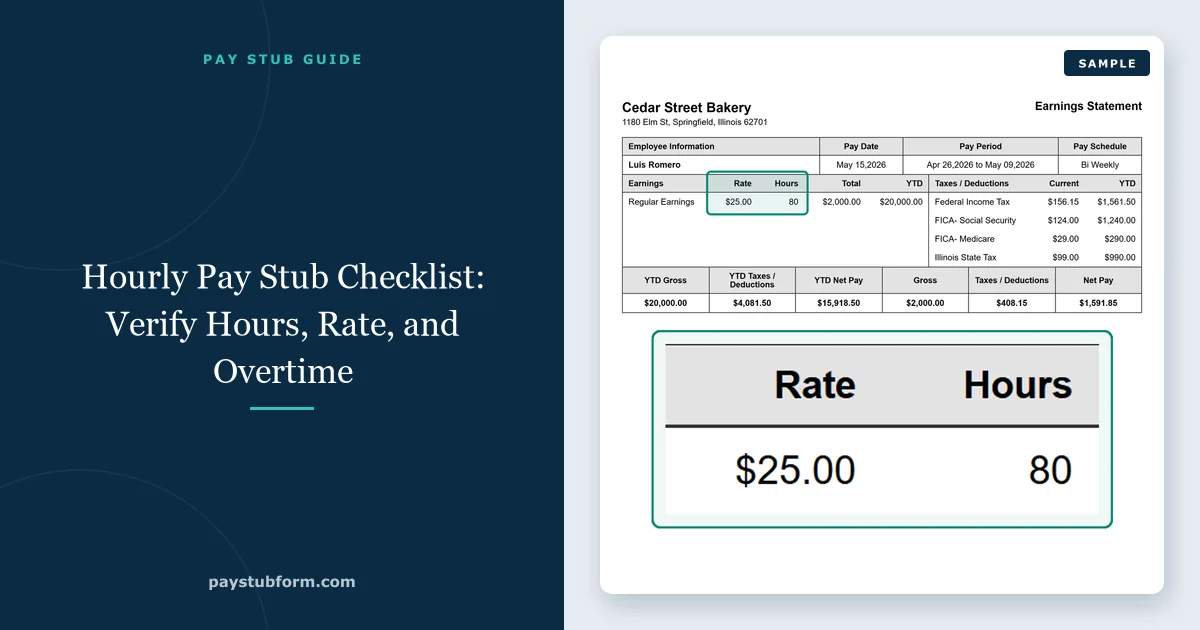
An hourly pay stub is the easiest kind to check and the one most worth checking, because every error on it is arithmetic you can redo yourself. Hours times rate, plus overtime, minus deductions. If the numbers do not reconcile, something is wrong — and unlike a salaried stub, there is no "that's just how the salary divides" to hide behind. Paid a salary instead? Use the salaried pay stub checklist.
The checks below take about five minutes and catch the three things that actually go wrong: hours that do not match what you worked, an overtime rate calculated on the wrong base, and a deduction that should not be there.
Quick take: Check hours against your own record, not the timekeeping system. Check overtime per workweek, never across the pay period. And check the overtime rate, because it is usually not simply 1.5× your base wage.
1. Hours, against your own record
Keep a note of your start and finish times, however rough. Comparing the stub to your own record is the only check that is independent of the system that produced the error.
What to look for: a shift that is missing entirely; a shift rounded down; time spent on required tasks before clocking in or after clocking out; and a meal break deducted automatically on a day you worked through it. Automatic meal deduction is the single most common source of quiet underpayment on hourly stubs, because it happens by default rather than by decision.
2. The base rate, and every rate
Confirm the hourly rate on the stub is the rate you agreed. If you work at more than one rate — a different role, a different site, a weekend rate — each should appear separately with the hours worked at each.
Whether your employer must show that breakdown depends on your state. California requires all applicable hourly rates in effect during the pay period with the corresponding hours at each. New York requires a non-exempt employee's statement to show the regular hourly rate, the overtime rate, the number of regular hours and the number of overtime hours. Ohio, since April 2025, requires hours worked, the hourly rate, and hours in excess of forty in a workweek. North Carolina requires none of it — only an itemised statement of deductions.
Also confirm the rate is at least the applicable minimum wage. The federal floor is $7.25 an hour, but many states are well above it and a few tie the rate to the employer's size or revenue.
3. Overtime — per week, and at the right rate
Two separate checks, and most people only do the first.
Per week. Overtime is calculated on the workweek — a fixed and regularly recurring period of 168 hours — not on the pay period. Averaging hours over two or more weeks is not permitted. On a biweekly stub, 48 hours one week and 32 the next is 8 hours of overtime, not "80 hours, none owed".
At the right rate. Overtime is 1.5× your regular rate, which is total compensation for the week divided by hours worked. Nondiscretionary bonuses, commissions and shift differentials all go into it. If you earned a night differential or a production bonus in a week where you also worked overtime, overtime paid at exactly 1.5× your base wage is too low. Our overtime guide works a full example.
Tip: Ask payroll which day your workweek starts and write it down. Without it you cannot check overtime at all, and it is almost never printed on the stub.
4. Gross pay reconciles
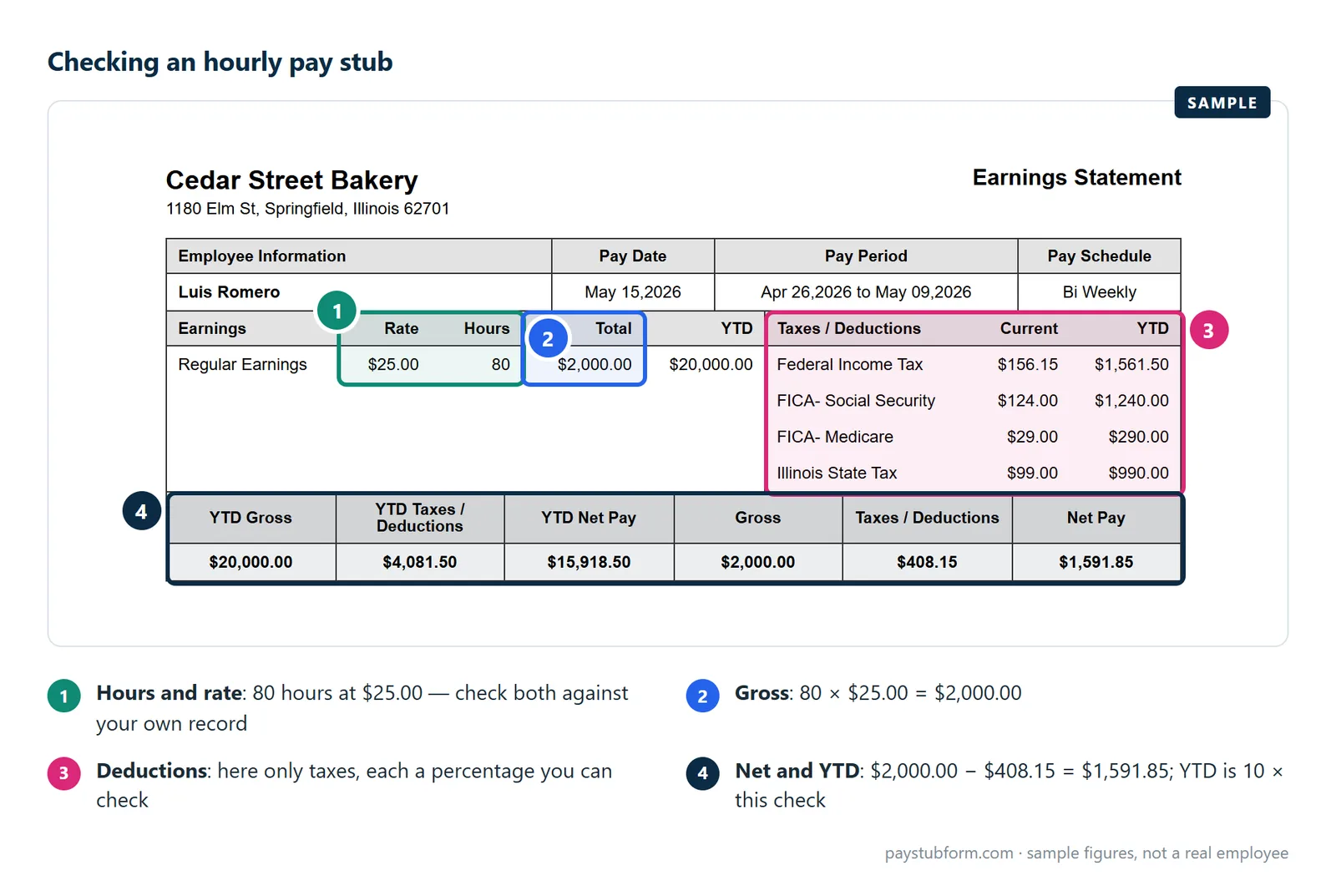
Add every earnings line — regular hours, overtime, differentials, any bonus or paid time off. The total must equal the gross pay figure printed on the stub. If it does not, a line is missing or one is being double-counted.
5. The deductions are yours and lawful
Work down the deduction column and sort it. Taxes, pre-tax benefits, after-tax items, and anything court-ordered. Our guide to what each deduction layer does covers the whole stack.
What to question on an hourly stub specifically: a deduction you did not authorise in writing; a charge for a uniform, tools or a till shortage; and any deduction that takes your effective rate below minimum wage for the hours worked. Federal rules restrict deductions that cut into the minimum wage, and several states restrict them further or require written authorisation.
If there is a garnishment, note that its ceiling is calculated on disposable earnings — gross minus only legally required deductions — not on your net pay, so it will look larger than a share of your take-home. For an ordinary debt the limit is the lesser of 25% of disposable earnings or the amount above 30 times the federal minimum wage, which is $217.50 a week at $7.25.
6. Net pay and the year-to-date column
Gross minus all taxes and deductions must equal net pay to the cent. Then check the deposit matches net pay — if it does not, a split deposit is the most likely reason.
Finally, glance at the year-to-date totals. An error of a few dollars a period is invisible in one stub and obvious across twenty, which is the only place a repeating rounding problem or a wrong differential will show itself.
The five-minute version
- Hours on the stub against your own record, including any day you worked through a break.
- Each rate, and the hours at each rate, with the rate at or above the applicable minimum wage.
- Overtime split by workweek, and the overtime rate recalculated if you earned a differential, commission or nondiscretionary bonus.
- Earnings lines add to gross; gross minus deductions equals net; net equals the deposit.
- Every deduction is one you authorised, and none pushes you below minimum wage.
Our state-by-state guide sets out what your state obliges an employer to show, and you can create an accurate hourly pay stub here with overtime and rates calculated properly.
Quick answers
My employer deducts 30 minutes for lunch automatically. Is that allowed?
Only when you actually took the break and were fully relieved of duty. An automatic deduction on a day you worked through is unpaid working time, and it is worth raising with the specific dates.
I worked 48 hours one week and 32 the next. Do I get overtime?
Yes — 8 hours of it, in the first week. Averaging hours across two or more weeks is not permitted, even inside a single biweekly pay period.
Why is my overtime rate not exactly 1.5 times my hourly wage?
Because it should be 1.5× your regular rate, which includes shift differentials, commissions and nondiscretionary bonuses. If it equals 1.5× base pay in a week where you earned one of those, it is too low rather than too high.
Can my employer charge me for a uniform or a till shortage?
Within limits. Federal rules restrict deductions that cut into the minimum wage, and many states require written authorisation or prohibit the deduction outright. A deduction you never agreed to in writing is worth challenging.
My stub doesn't show my hours. Is that legal?
It depends entirely on your state. California, New York and Ohio all require hours for non-exempt employees; North Carolina requires only an itemised statement of deductions.
How long should I keep my pay stubs?
At least through the following tax year, so you can check your W-2 against the final stub's year-to-date totals. Keep them longer if you are ever likely to need proof of income.
Sources
- U.S. Department of Labor — Fact Sheet #56A, Overview of the Regular Rate of Pay: how the regular rate is calculated and what must be included in it.
- U.S. Department of Labor — Fact Sheet #23, Overtime Pay Requirements of the FLSA: the 168-hour workweek and the prohibition on averaging hours across weeks.
- U.S. Department of Labor — Fact Sheet #30, Wage Garnishment Protections of the CCPA: disposable earnings and the 25% / $217.50 ceilings.
- IRS Topic no. 751 — Social Security and Medicare withholding rates: the 6.2% and 1.45% deductions on an hourly stub.
General U.S. information, current for 2026. State wage and hour rules are frequently stricter than the federal standard — check yours alongside this.


Comments (0)
Loading comments...
Leave a Comment