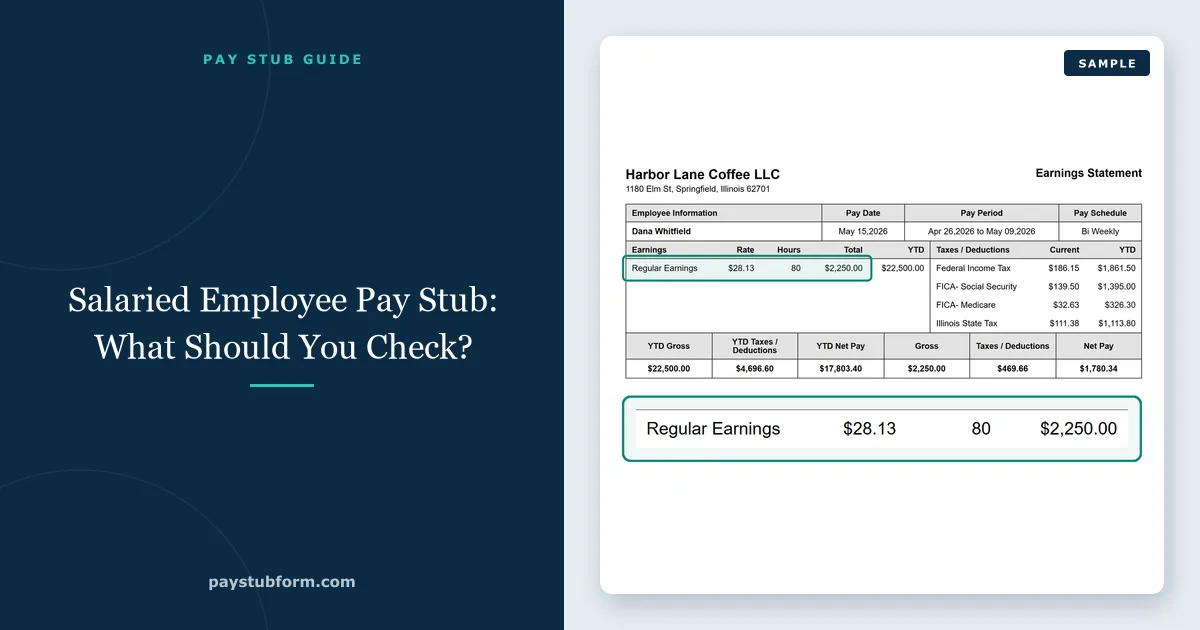
A salaried pay stub is easy to stop reading. The gross figure is the same every period, so the eye slides past it and lands on the net — which moves, for reasons that are never explained on the stub itself.
That is exactly why it is worth a periodic check. On an hourly stub an error announces itself as hours that do not match. On a salaried one it hides inside a figure you have stopped looking at. Here is what to verify, and the one assumption that costs salaried employees the most money.
Quick take: Being paid a salary does not make you exempt from overtime. Exemption requires qualifying duties and a salary of at least $684 a week — $35,568 a year. Job titles count for nothing.
1. Gross pay divides correctly
Your annual salary divided by the number of pay dates should equal the gross on the stub. On 24 semimonthly dates a $78,000 salary is $3,250 a period; on 26 biweekly dates it is $3,000. Those are different numbers for the same salary, and confusing the two schedules is how people conclude they are being underpaid when they are not — the schedules produce different monthly patterns.
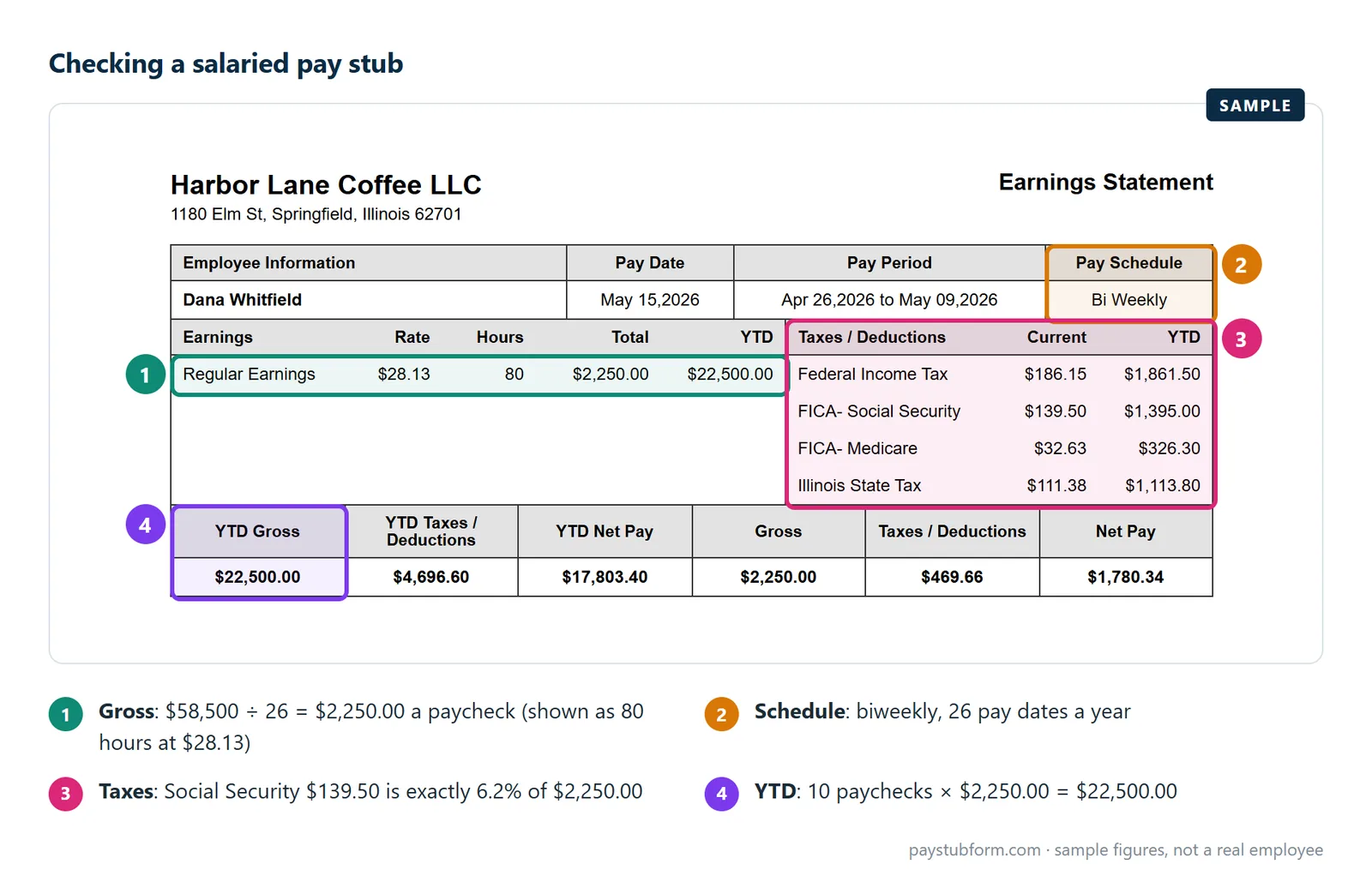
A partial period at hire or departure should be prorated, and a raise mid-period should show as two rates or a clear adjustment rather than quietly averaging.
2. Whether you should be getting overtime at all
This is the check worth more than all the others combined, because it is the one most often assumed away.
A salary does not remove the right to overtime. Exemption from the executive, administrative and professional rules requires two things together: the job duties have to qualify, and the salary has to clear a threshold.
That threshold is currently $684 per week, equivalent to $35,568 a year, with a separate highly compensated employee route at $107,432 a year including at least $684 a week on a salary basis. These are worth stating plainly because the figures moved and moved back: a 2024 rule raised them, was judicially vacated, and on May 14, 2026 the Department of Labor published a technical amendment removing the vacated language and republishing the operative 2019 regulations. A great deal of guidance written in 2024 and 2025 still quotes the higher numbers.
Clearing the salary threshold is necessary but not sufficient — the duties test still applies. A salaried employee whose work does not meet it is non-exempt and is owed overtime at 1.5× the regular rate for hours over 40 in a workweek, whatever the contract calls the role.
Tip: If you are salaried, paid under about $36,000, and regularly working more than 40 hours, that is the combination worth looking into properly. The salary test alone is decisive below the threshold — no duties can make a $34,000 salaried employee exempt.
3. Pay frequency meets your state's rule
Salaried does not mean monthly. Several states set a floor, and exempt status sometimes changes it. Texas allows employees exempt from FLSA overtime to be paid once a month but requires everyone else at least twice a month. California requires most employees to be paid at least twice a month on paydays announced in advance. New York requires clerical and other workers to be paid at least semi-monthly. Our state-by-state guide covers the rest. Paid twice a month? Semi-monthly pay explains the per-check math.
4. The deduction stack, and what moves it
Gross is constant; net is not. The usual causes of a change, none of which is an error:
- Social Security stopping. The 6.2% applies only to the first $184,500 of wages for 2026. Higher earners see net pay jump late in the year and fall again in January.
- Crossing $200,000 with one employer, which adds the 0.9% Additional Medicare Tax — employee-only, with no employer match.
- Reaching the 401(k) limit of $24,500 for 2026, which stops the deduction entirely for the rest of the year.
- A three-paycheck month on a biweekly schedule, where monthly benefit premiums are usually taken from the first two cheques only.
- Open enrolment changing a benefit election.
What to question instead: a deduction you did not elect, a pre-tax election that is not reducing any taxable wage figure, and taxable wages that exceed gross pay without an explanation — usually imputed income from employer-paid group-term life insurance above $50,000 of coverage.
5. The taxable wage figures, not just gross
A salaried stub typically shows three or four wage figures, and they are meant to differ. Gross pay minus Section 125 benefits equals Social Security and Medicare wages. Gross minus Section 125 and your traditional 401(k) deferral equals federal taxable wages — because a pre-tax deferral is excluded from income tax but not from Social Security and Medicare.
If a deduction you elected as pre-tax is not reducing any of those figures, the election was not applied, and it costs you every period until someone fixes it. Which group each deduction falls into is the thing to check it against.
6. Year-to-date, once a quarter
On a salaried stub the year-to-date column is doing most of the work, because a constant gross hides a drift that only accumulates. Divide YTD federal income tax by YTD taxable wages for your effective withholding rate so far, and compare it to the rate you expect to owe. Adjusting a W-4 in June is painless; discovering the gap in April is not.
The five-minute version
- Annual salary ÷ pay dates = gross on the stub.
- If you work over 40 hours and earn under $35,568, check your exempt status properly.
- Pay frequency meets your state's minimum for your classification.
- Compare this stub to the last and account for anything that changed.
- Confirm each pre-tax election is actually reducing the wage figures it should.
- Check YTD withholding against the rate you expect to owe.
You can create an accurate salaried pay stub here with the wage bases calculated correctly.
Quick answers
Does being on a salary mean I can't get overtime?
No. Exemption needs qualifying duties and a salary of at least $684 a week ($35,568 a year). Below that threshold no duties can make you exempt, and job titles carry no weight at all.
What is the current overtime salary threshold?
$684 per week, or $35,568 a year, with a highly compensated employee route at $107,432. The 2024 rule that raised these was vacated, and the Department of Labor republished the operative regulations on May 14, 2026.
Why does my net pay change when my salary doesn't?
Most often reaching the Social Security wage base, hitting the annual 401(k) limit, a three-paycheck month, or a benefit election change. Comparing two stubs line by line identifies it quickly.
Can my employer pay me monthly?
Only if your state allows it for your classification. Texas permits monthly payment for FLSA-exempt employees but requires twice-monthly for everyone else; California requires at least twice a month for most employees.
Why are my taxable wages higher than my gross pay?
Imputed income, most commonly the cost of employer-provided group-term life insurance above $50,000 of coverage. It adds taxable value without adding cash.
My 401(k) stopped coming out in November. Why?
You reached the annual deferral limit — $24,500 for 2026. Worth knowing in advance, because a plan that matches per pay period without a true-up stops matching too.
Sources
- U.S. Department of Labor — Earnings thresholds for the EAP exemption: the $684 weekly and $107,432 annual figures currently in force.
- U.S. Department of Labor — Technical amendment restoring the EAP exemption regulations (May 14, 2026): removal of the judicially vacated 2024 rule.
- Social Security Administration — Contribution and Benefit Base: the $184,500 wage base for 2026.
- IRS — 401(k) limit increases to $24,500 for 2026: the deferral limit that stops the deduction.
- IRS Publication 15-B — Employer's Tax Guide to Fringe Benefits (2026): Section 125 treatment and the $50,000 group-term life exclusion.
General U.S. information, current for 2026. Exempt status turns on the facts of your role; for a dispute about classification, speak to your state labor department or an employment lawyer.


Comments (0)
Loading comments...
Leave a Comment