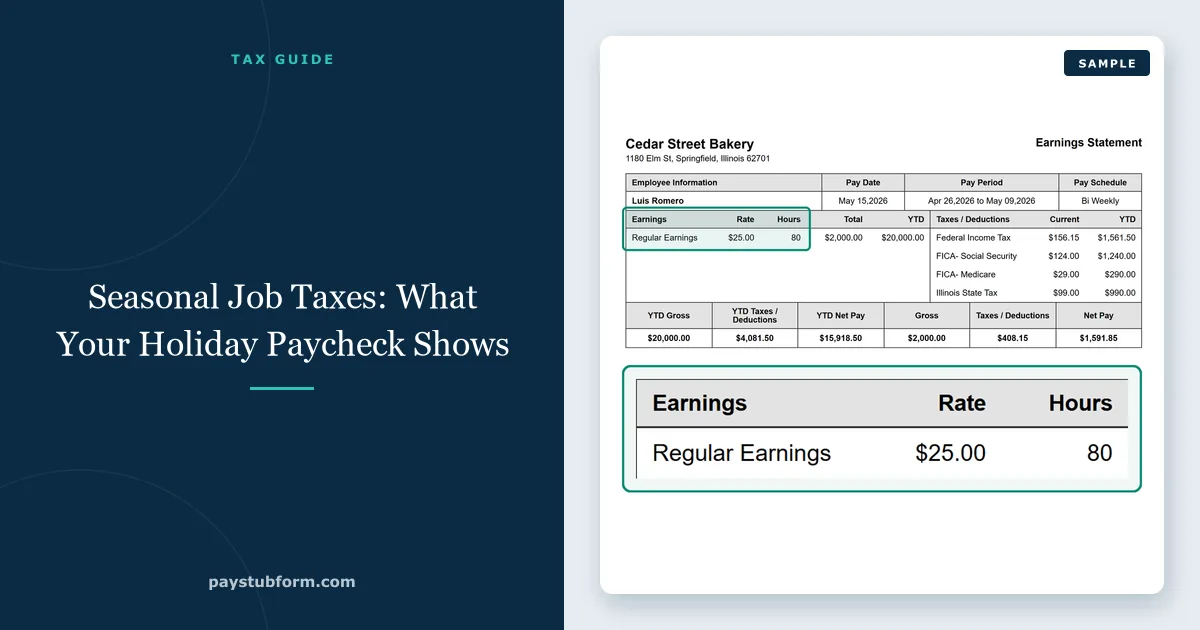
A holiday or seasonal job is taxed like any other W-2 job, but the paycheck often looks worse than it should. Payroll withholds federal income tax as if you were going to earn that week's pay all year, so a ten-week job can lose more to withholding than you will finally owe. Social Security and Medicare are a different story: they come out of every check at fixed rates and do not come back. Knowing which is which tells you what to check on your stub, what you can change, and roughly what refund to expect.
Quick take: Seasonal pay has the same lines as any W-2 paycheck: federal and state income tax, Social Security (6.2%) and Medicare (1.45%). Federal income tax is withheld as if the job lasted a full year, so short jobs are often over-withheld — you get the excess back only if you file a return. You can ask in writing for the IRS part-year withholding method if you expect to work no more than 245 days this year.
1. What comes out of a seasonal paycheck
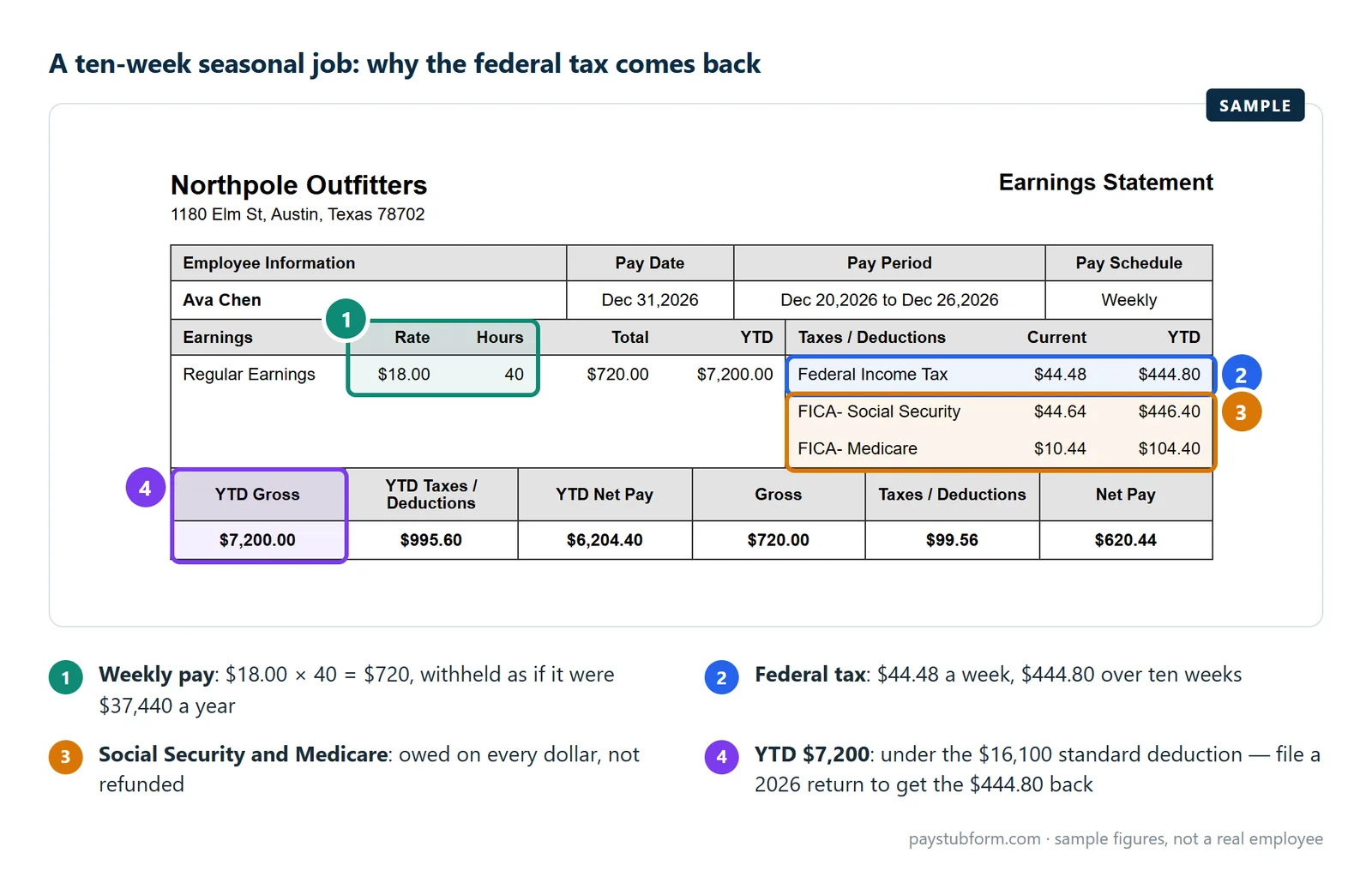
Take a typical warehouse or retail holiday job: $18 an hour, 40 hours a week, so $720 gross per week, single filer with a standard 2026 Form W-4.
| Line | Weekly amount | Comes back at tax time? |
|---|---|---|
| Gross pay | $720.00 | — |
| Federal income tax (2026 weekly table) | about $44.44 | Often, partly or fully |
| Social Security (6.2%) | $44.64 | No |
| Medicare (1.45%) | $10.44 | No |
| State income tax | Depends on the state | Often, like federal |
The federal figure comes from the IRS 2026 percentage method for a weekly payroll: $23.80 plus 12% of wages above $548. Overtime weeks push it up, and state tax varies — Florida and Texas have no state income tax line at all, while California adds both income tax and SDI. Our free paycheck calculator runs the same federal, FICA and state income tax math for your own rate and hours.
2. Why short jobs are over-withheld
Withholding tables annualize each paycheck. $720 a week is treated as $37,440 a year, and tax is withheld on that basis. But if the job runs ten weeks and you have no other income, you earn $7,200 for the year — well under the 2026 standard deduction of $16,100 for a single filer. Your federal income tax for the year would be zero, yet about $444 was withheld over those ten weeks.
That money is a prepayment, not a loss. It comes back as a refund — but only if you file a 2026 return. Many students and first-time workers skip filing because their income is below the filing requirement and leave the refund unclaimed.
Social Security and Medicare are not part of this. They are flat percentages owed on every dollar of wages, regardless of your income for the year, so they do not come back. (The one exception: if several employers together withheld Social Security on more than the wage base — $184,500 for 2026 — you can claim the excess when you file. That rarely applies to seasonal work.)
3. The part-year withholding method
The IRS has a method designed for exactly this situation. Under Publication 15-T, a part-year employee who files on a calendar-year basis may ask the employer to withhold using the part-year employment method. Instead of annualizing one week's pay, it spreads your wages over the whole period since your last job (or since January 1), which for a short, late-year job usually brings withholding close to zero.
The request must be in writing, signed under penalties of perjury, and include:
- the last day of any employment with a prior employer during the calendar year;
- a statement that you use the calendar year as your tax year;
- a statement that you reasonably expect to be employed by all employers for a total of no more than 245 days in the year.
Ask payroll before you rely on it — not every payroll system is set up for the method. If it is not available, the alternative is to accept the over-withholding and file for the refund. Do not simply claim exempt on your W-4 unless you truly expect zero federal tax for the year; exemption is for people who owed nothing last year and expect to owe nothing this year, and it must be renewed by February 15 of the following year. Our guide to how a W-4 change affects your paycheck covers what each step of the form does.
Tip: if a seasonal job is your second job of the year, or you will earn a full-year salary elsewhere, the over-withholding above may not exist. Run the IRS Tax Withholding Estimator with your stubs from both jobs instead.
4. Holiday pay, overtime and tips on a seasonal stub
- Overtime. Non-exempt workers earn at least time and a half for hours over 40 in a workweek. Peak weeks often produce it; check it per workweek, not per pay period. See overtime on a pay stub.
- The overtime deduction. For 2025 through 2028, the federal law known as the One Big Beautiful Bill lets eligible workers deduct qualified overtime pay — the "half" in time and a half — up to $12,500 ($25,000 for joint filers), phasing out at higher incomes. It is claimed on your return. Payroll still withholds on it unless you estimate it on the 2026 W-4's Step 4(b) worksheet.
- Holiday pay. Federal law does not require employers to pay extra for working on a holiday, or to pay for holidays off; the Department of Labor treats it as a matter between employer and employee. If your employer offers a holiday premium, it appears as its own earnings line. See PTO and holiday pay on a pay stub.
- Tips. Restaurant, delivery and hospitality jobs: cash tips of $20 or more in a month must be reported to your employer, and reported tips are taxed through payroll. A new deduction for qualified tips, up to $25,000, is also claimed on the return.
- Seasonal bonuses. Referral, attendance or completion bonuses are supplemental wages, often withheld at a flat 22%. See why bonus checks are taxed so heavily.
5. Gig and 1099 holiday work is different
Delivery apps, holiday markets and freelance gift-wrapping or decorating jobs usually pay you as an independent contractor. Nothing is withheld — no income tax, no Social Security, no Medicare — and there is no pay stub. You owe self-employment tax of 15.3% on net earnings, plus income tax, and if you net $400 or more from self-employment you must file. Clients file a 1099-NEC only once they have paid you $2,000 or more in 2026, but income below that is still taxable. Our guides to 1099-NEC versus a pay stub and pay stubs for the self-employed cover the record-keeping.
6. After the season ends
- Download your pay stubs before your last day. Employee portal access usually ends with the job. Our walkthroughs for Amazon pay stubs, Target pay stubs and Walmart pay stubs include what former workers can still access.
- Check your mailing address. W-2s must be furnished by January 31 and are often mailed to the address on file at year-end.
- Compare your final stub with the W-2. Box 1 can be lower than your year-to-date gross because of pre-tax deductions; see W-2 versus your final pay stub.
- File, even if you are not required to. It is the only way to get over-withheld federal and state income tax back.
Do you have to file a return?
For 2026, a single filer under 65 who is not anyone's dependent generally must file if gross income is at least the standard deduction, $16,100. Dependents — including students claimed by their parents — follow separate thresholds, and self-employment of $400 or more triggers filing on its own. The IRS's Do I need to file a tax return? tool answers it in a few minutes. Below the threshold, filing is optional but is still how you claim any refund.
The five-minute version
- Check gross pay against your hours, with overtime counted per workweek.
- Expect Social Security (6.2%) and Medicare (1.45%) on every check — they do not come back.
- Expect federal withholding to look high for a short job; it often comes back as a refund.
- If you will work no more than 245 days this year, ask payroll in writing about the part-year method.
- Download every stub before the job ends and keep your address current for the W-2.
- File a return next spring, even below the filing threshold, to get over-withholding back.
Quick answers
Do seasonal workers pay taxes?
Yes. Seasonal wages are taxed like any other wages: federal income tax, Social Security, Medicare, and state and local taxes where they apply. What differs is that withholding on a short job often exceeds the tax you finally owe.
Will I get my taxes back from a seasonal job?
Often part or all of the federal and state income tax, if your total income for the year is low — but only by filing a return. Social Security and Medicare are not refunded.
Why is so much federal tax taken from my holiday job paycheck?
Because withholding tables assume each paycheck repeats for the whole year. A $720 week is withheld as if you earned $37,440 a year, even if the job lasts ten weeks.
What is the part-year withholding method?
An IRS method in Publication 15-T that spreads your wages over the whole period since your last job, lowering withholding for short-term work. You must request it in writing, under penalties of perjury, and expect to work no more than 245 days in the year.
Can I claim exempt on my W-4 for a seasonal job?
Only if you owed no federal income tax last year and expect to owe none this year. Exemption must be renewed by February 15 of the next year, and claiming it wrongly can leave you with a bill.
Is holiday pay required by law?
Not under federal law. Premium pay for working a holiday is up to the employer's policy or contract; some states and local laws add rules for specific situations.
Sources
- IRS Publication 15-T (2026), Federal Income Tax Withholding Methods: the weekly percentage method table and the part-year employment method requirements.
- IRS — Tax year 2026 inflation adjustments: the $16,100 standard deduction for single filers.
- IRS — New and enhanced deductions for individuals: the qualified overtime and tips deductions for 2025–2028.
- IRS — Tax Withholding Estimator: checks withholding across one or more jobs.
- U.S. Department of Labor — Holiday pay: no federal requirement to pay for holidays or holiday work at a premium.
- IRS — Check if you need to file a tax return: filing thresholds, including for dependents.
General U.S. information, current for 2026. The withholding example assumes a single filer with a standard 2026 Form W-4 and no other income; your figures depend on your pay, W-4 entries and state.


Comments (0)
Loading comments...
Leave a Comment