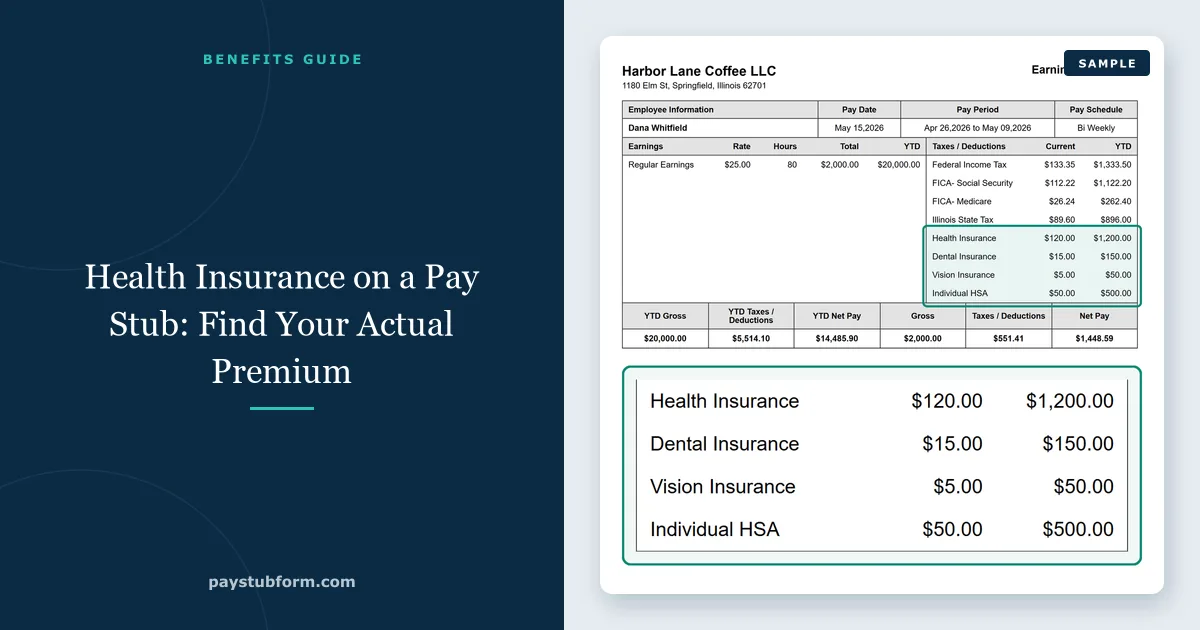
Open enrolment tells you the plan costs a certain amount a month. Your pay stub shows a different number, taken at a different interval, and nobody reconciles the two for you. Then a colleague on the same plan mentions a figure that is nothing like yours.
Both can be right. The premium on a stub is only your share, the employer pays the rest without it ever passing through your pay, and the way it is deducted changes what it actually costs you. Here is how to find your real number.
Quick take: The deduction on your stub is your share only. Because health premiums usually run through a Section 125 plan, they are excluded from federal income tax, Social Security and Medicare alike — so a $200 premium costs you well under $200 of take-home.
Finding the line
Labels vary: MEDICAL, MED PRE-TAX, HEALTH EE, DEN, VIS, or a single combined BENEFITS line. The suffix matters more than the name. EE is the employee's share, deducted from your pay. ER is the employer's share, which appears on some stubs for information and is never deducted from anything.
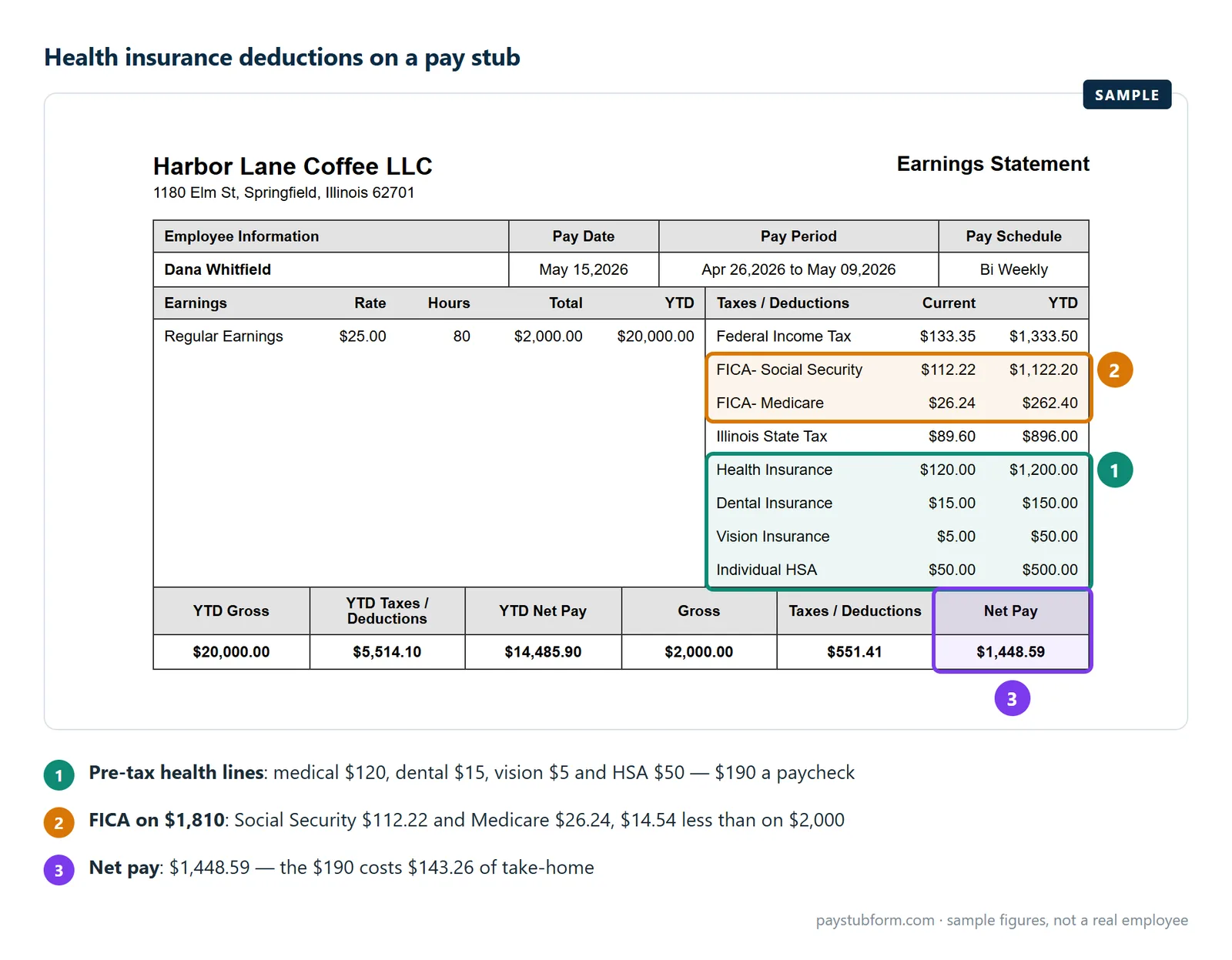
If your stub shows both, only the EE line belongs in the arithmetic that produces your net pay. Seeing a large ER figure and assuming it came out of your money is one of the more common misreadings of a stub.
Why the stub figure doesn't match the monthly premium
Three reasons, and usually all three at once.
It is split across pay periods. A $240 monthly premium is $120 a period semimonthly, or about $110.77 biweekly across 26 cheques. Employers handle the biweekly mismatch in one of two ways: take the full monthly amount from the first two cheques of each month and skip the third in a three-paycheck month, or spread the annual total evenly across all 26. The first is more common, and it is why the third cheque in those months is noticeably larger.
It is only your share. The employer's contribution is usually the larger part and never touches your pay.
It is pre-tax. Which means the amount leaving your pocket is smaller than the amount leaving your gross — covered next.
What a pre-tax premium actually costs
Benefits provided under a Section 125 cafeteria plan are generally excluded from federal income tax withholding, Social Security tax and Medicare tax alike. That is the strongest form of pre-tax treatment available on a pay stub — stronger, in fact, than a traditional 401(k) deferral, which escapes income tax but not Social Security and Medicare.
So a $200 premium in the 22% bracket reduces your take-home by roughly $200 less 22% income tax less 7.65% FICA — about $141. The plan costs $200; you feel about $141.
Two consequences worth knowing. Your federal taxable wages, Social Security wages and Medicare wages all drop by the premium, which is part of why those figures on your stub are lower than gross pay. And because Social Security wages drop, a pre-tax premium very slightly reduces the earnings on which your future Social Security benefit is calculated — a real trade-off, though a small one for most people. Our guide to pre-tax versus after-tax deductions sets out which group each benefit falls into.
Tip: If your employer has no Section 125 plan, the premium is an after-tax deduction and reduces nothing but your net pay. You can tell which you have by checking whether your taxable wage figures fall below gross by at least the premium amount.
The accounts alongside it
Health benefits often come with a savings or spending account, each with its own 2026 ceiling and its own line on the stub.
- Health FSA: for plan years beginning in 2026, a cafeteria plan may not allow salary reduction contributions above $3,400. Use-it-or-lose-it rules apply subject to whatever carryover or grace period your plan offers.
- HSA: $4,400 for self-only coverage and $8,750 for family coverage, plus $1,000 from age 55. Requires a qualifying high-deductible plan, and the balance is yours to keep.
- Dependent care FSA: a separate account with its own limit, for childcare rather than medical costs.
Contributions made by salary reduction get the same Section 125 treatment as the premium itself.
What is not on the stub
A few things people look for and do not find. Your deductible and out-of-pocket maximum are plan terms, not payroll figures. Claims and reimbursements run through the insurer or the FSA administrator. And the total cost of your coverage — your share plus the employer's — is reported on your W-2 for information, which is usually the first time employees see what the coverage actually costs.
What to check at open enrolment
- Multiply the per-period deduction by your number of pay dates and compare it to the annual premium you were quoted. They should agree.
- Confirm the deduction is pre-tax by checking that your taxable wage figures fall below gross by at least that amount.
- Check the deduction changed on the date the new plan year began, not a period early or late.
- Check dependants added or removed are reflected — a premium that did not change when your coverage did is worth a question.
- If you contribute to an FSA or HSA, divide the annual election by the remaining pay dates and confirm the per-period figure matches.
If coverage is ending because you are leaving, the premium timing matters: a deduction taken for a period after your coverage actually ended is worth challenging, and the final paycheck checklist covers what else to verify. For the wider deduction picture see what each layer of deductions does, and you can create an accurate pay stub here with benefits in the right place. Our open enrollment guide shows how each election changes take-home pay in January.
Quick answers
Why is my premium different from what open enrolment said?
The quoted figure is usually monthly and your stub shows a per-period share. Multiply the stub figure by your pay dates per year and compare annual to annual.
Is my health premium pre-tax?
Usually, if it runs through a Section 125 cafeteria plan — which is the common arrangement but not universal. Check whether your taxable wages fall below gross by the premium amount.
Does a pre-tax premium save me the full amount?
No. It saves tax at your marginal rate plus 7.65% FICA. A $200 premium in the 22% bracket reduces take-home by roughly $141.
What is the ER line on my stub?
The employer's share of the premium, shown for information. It is paid on top of your wages and never deducted from your pay.
Why was no premium taken from one paycheck?
Most likely a three-paycheck month on a biweekly schedule, where the monthly premium is taken from the first two cheques only. That is also why that cheque is larger.
Does a pre-tax premium affect my Social Security benefit?
Slightly. Section 125 contributions reduce Social Security wages as well as taxable wages, so the earnings your future benefit is calculated on are marginally lower. For most people the current tax saving outweighs it, but it is a genuine trade-off rather than a free one.
Sources
- IRS Publication 15-B — Employer's Tax Guide to Fringe Benefits (2026): Section 125 treatment, the $3,400 health FSA salary reduction limit, and the $4,400 and $8,750 HSA limits.
- IRS Topic no. 751 — Social Security and Medicare withholding rates: the 6.2% and 1.45% a pre-tax premium also avoids.
- IRS — Are retirement plan contributions subject to withholding for FICA, Medicare or federal income tax?: the contrast with a 401(k) deferral, which does not escape FICA.
- IRS — General Instructions for Forms W-2 and W-3 (2026): how pre-tax benefits appear in the W-2 wage boxes at year end.
General U.S. information, current for the 2026 plan year. Plan rules vary — your benefit guide and summary plan description govern what is offered and how it is deducted.


Comments (0)
Loading comments...
Leave a Comment