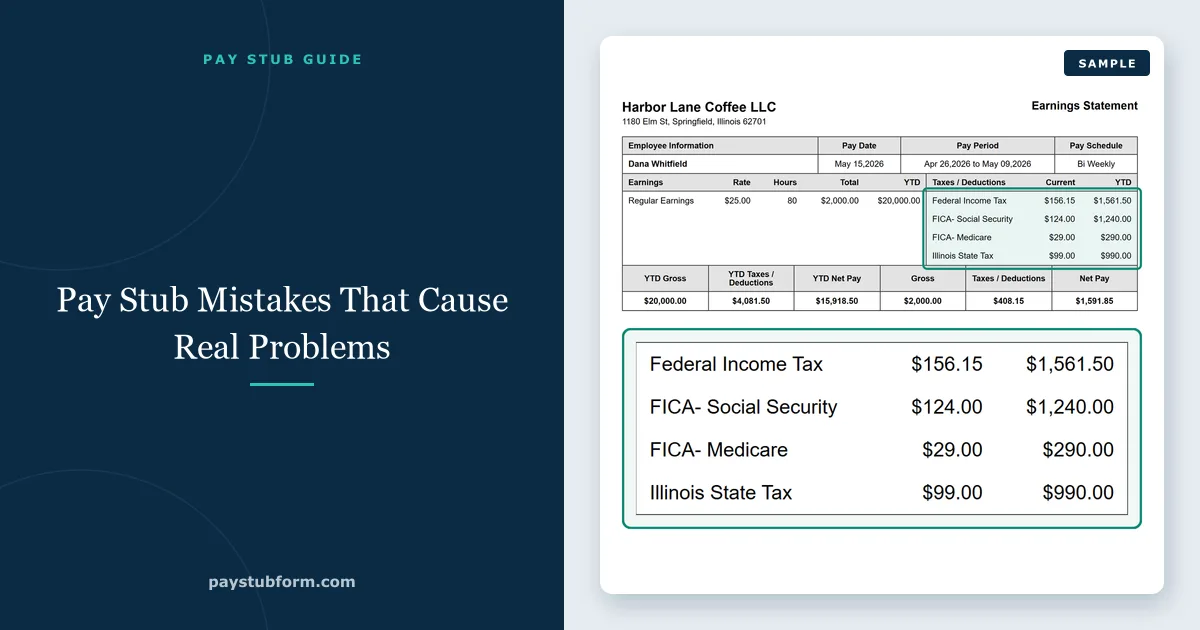
Most pay stub errors are not dramatic. They are a rate that is ten cents off, a pay period that runs to the wrong Saturday, a state tax line for a state you no longer live in. Small enough to skim past — and expensive enough that people find them months later, usually while filing taxes or explaining to an underwriter why the numbers do not add up.
This is what actually goes wrong on pay stubs, how to spot it in about two minutes, and what to do once you have.
Start with the arithmetic that must always work
Before reading anything closely, check one equation:
Gross pay − total deductions = net pay.
If those three figures do not reconcile, stop there. Nothing else on the stub is worth checking until they do, and a stub that fails this test is either a software error or, if someone handed it to you as proof of income, a fabricated document. It is the first thing an experienced underwriter checks, and it is the single most common giveaway on a fake.
The second check is almost as quick: hours × rate should produce the regular earnings line, and overtime hours should be paid at the higher rate rather than folded in at the base rate.
Mistakes in the earnings section
Overtime paid at the wrong rate
Under the Fair Labor Standards Act, non-exempt employees are owed at least one and a half times their regular rate for hours over 40 in a workweek — and the "regular rate" includes non-discretionary bonuses and shift differentials, not just the base hourly wage. Paying overtime on the base rate alone, when a shift premium applies, is an underpayment that looks perfectly normal on the stub.
A pay period that does not match the work
The pay period is the range of dates you worked. The pay date is when the money moved. People compare their hours against the wrong one of those two constantly, conclude a shift is missing, and raise a complaint about a stub that is correct. Check the period dates before anything else.
Hours that never made it in
Missed punches, shifts covered for someone else and time worked across a period boundary are where hours genuinely disappear. Compare against your own record for those exact dates, not against the deposit amount.
Mistakes in the deductions section
Withholding for the wrong state
This is the error that costs the most to unwind. If you moved, or work in one state and live in another, income tax may be going to a state with no claim to it. It does not correct itself, and fixing it after year end means filing in two states to get the money back. Whenever you move, check the next stub rather than waiting for a W-2 to tell you.
Pre-tax and post-tax deductions in the wrong place
A traditional 401(k) contribution and most medical premiums come out before income tax is calculated; a Roth contribution and things like garnishments come out after. Put one in the wrong column and taxable wages are wrong — which means the tax withheld is wrong too, and the error compounds every pay period until someone notices.
Payroll taxes that should have stopped, or started
Social Security tax applies only up to an annual wage cap, so high earners should see it stop later in the year; Medicare has no cap and gains an additional surtax above a threshold. A stub still deducting Social Security after the cap, or missing the Medicare surtax, is a real error rather than a rounding quirk.
Mistakes in the header — the boring ones that fail applications
The identifying details at the top of a stub carry no money, which is why nobody proofreads them, and they are exactly what a verifier looks at first.
A misspelled name that does not match photo ID, an old address, a wrong employer name or missing employer identification number, a pay date that falls before the pay period ends — any of these will get a document questioned even when every figure on it is correct. If the header is wrong, ask payroll to reissue. Correcting it yourself with a PDF editor converts a clerical error into a falsified record, and that is how people who were entirely in the right end up in serious trouble.
Year-to-date figures that do not accumulate
Year-to-date totals should rise from one stub to the next, and the last stub of the year should reconcile with your W-2 — remembering that Box 1 reflects taxable wages, so pre-tax deductions make it legitimately lower than YTD gross. A YTD column that moves backwards, or stays flat across two periods with earnings, is a data problem worth flagging immediately. It is also what lenders use to annualise your income, so an understated YTD quietly shrinks how much you qualify for.
What to do when you find one
If you are the employee: put it in writing to payroll, naming the pay period and the specific line, and keep a copy of what you sent. Corrections usually arrive as an adjustment on a later stub rather than a reissued one — which is normal, but means you should check that the adjustment actually appears. Under federal rules employers must retain payroll records for at least three years, and many states give you an explicit right to request copies of your own, so the underlying data exists even when a portal will not show it to you.
If you are the employer: correct it in the period you find it, document what changed and why, and tell the employee before they notice. An underpayment discovered by the employee is a payroll question; the same underpayment discovered by a state labour agency is a different kind of conversation, and several states carry penalties for wage statements that omit required information — which varies by state, so check the rules where your employees actually work. Our state-by-state pay stub requirements page covers what each one asks for.
A two-minute review that catches most of it
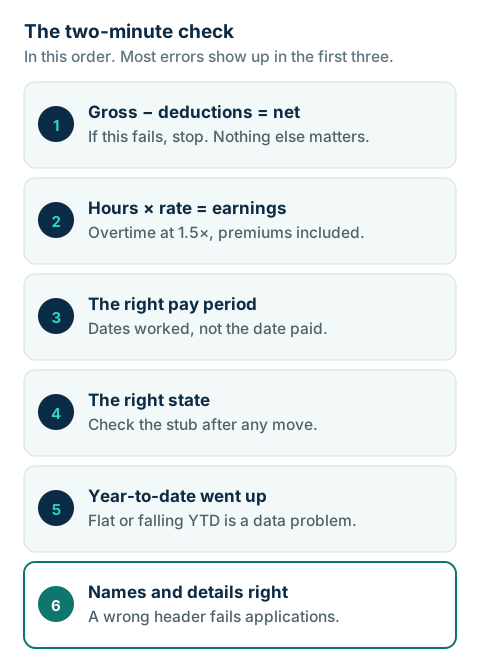
Every payday, in order: do gross minus deductions equal net; do hours times rate equal the earnings line; is the pay period the range you actually worked; is the state withholding the right state; did year-to-date go up; are your name, address and employer details right. If all six pass, file it. If one fails, raise it that week — every pay period you wait makes the correction bigger and the conversation harder.
If any of these terms are unfamiliar, our guide to what a pay stub is and what belongs on one explains each line in plain English. And if you produce stubs yourself — for your own payroll or for a handful of staff — our pay stub generator handles the tax math for all fifty states, which removes most of the arithmetic errors above before they reach anyone.
Frequently asked questions
My employer says the stub is right and I think it is wrong. What now?
Ask for the time records behind it in writing. If the hours on those records do not match what you worked, that is the disagreement to resolve — and if it stays unresolved, your state labour department handles wage claims.
Can I fix a small typo myself before sending it to a landlord?
No. Any alteration to an issued pay stub makes it a falsified document, regardless of how minor the change or how correct your intention. Ask for a reissue.
My W-2 does not match my last pay stub. Is one of them wrong?
Usually neither. Box 1 shows taxable wages, so pre-tax deductions such as a traditional 401(k) or medical premiums make it lower than year-to-date gross. If the gap is larger than your pre-tax deductions, ask payroll to explain it.
How long should I keep pay stubs?
Keep the whole year until you have checked the W-2 against it, then keep the final stub of each year. Most applications only ever ask for the last two to four periods plus the most recent W-2.


Comments (0)
Loading comments...
Leave a Comment